AI for accountants in the UK, as of October 2026, mostly means the AI already built into Xero (JAX), QuickBooks, Sage (Copilot), FreeAgent and IRIS, plus specialist tools for receipt coding, working papers and tax research. It can run the month-end grind of reconciliation, coding, chasing and first-draft working papers, but it cannot replace an accountant: ICAEW, ACCA and the FRC all say judgement and sign-off stay human. This guide compares the tools by job with UK prices, shows which month-end jobs to hand an AI agent first, and covers ICAEW and ACCA guidance, UK GDPR and Making Tax Digital for Income Tax.
Key facts
- Built in already: Xero JAX, QuickBooks' accounting AI, Sage Copilot (every plan), FreeAgent and IRIS AI anomaly detection come with software many practices already pay for. Check them before buying anything (October 2026).
- Where practices are: 87% use ChatGPT; top uses are client communication (77%), meeting summaries (59%), research (58%). Data-security concern is at a three-year high (Karbon, 2026).
- First agents: bank reconciliation, receipt coding, invoice chasing, client query triage. Repetitive, rule-bound, checkable.
- Keep human: judgements, sign-off, anything affecting a client's rights or money without review.
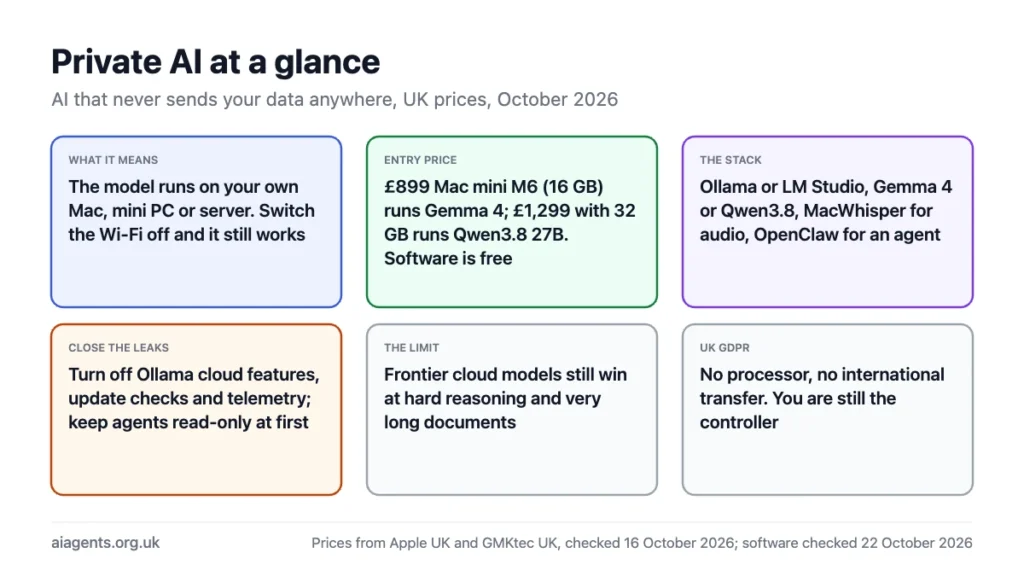
- Privacy: client ledgers are personal data; lawful basis, narrow access, DPIA, log. On-device models remove the third-party processor question.
- Clients: 64% of UK SMEs ask their accountant for advice on digital and AI. You are the trusted adviser here.
On this page
- What is an AI accountant, and can AI replace one?
- AI tools for UK accountants compared by job
- Best AI tools for UK accountants and bookkeepers in 2026: price, VAT and where data is held
- Which AI works with Xero, QuickBooks, Sage, FreeAgent, IRIS and CCH?
- AI working papers and audit software in the UK
- How far have UK practices got with AI?
- Which month-end jobs can an AI agent run?
- A month-end example
- How to start: a 4-week plan for a small practice
- What are the best AI tools for accountants?
- How do accountancy firms use AI for their own marketing?
- What do ICAEW, ACCA and the FRC say about using AI?
- Does HMRC accept tax returns prepared with AI?
- How do you handle client data under UK GDPR?
- Advising clients
- Frequently asked questions
- Sources
What is an AI accountant, and can AI replace one?
An AI accountant is software that does parts of an accountant's routine work, such as coding transactions, matching bank lines, reading documents and drafting emails, for a qualified person to review. As of October 2026, AI cannot replace an accountant: it cannot take professional responsibility, sign accounts or exercise the judgement that ICAEW, ACCA and the FRC say stays human.
If you searched for "IA accountant", IA is simply AI in French and Spanish (intelligence artificielle, inteligencia artificial). The answer is the same in any language.
Vendors now use the phrase themselves. Xero says its JAX assistant "works like an AI accountant for your day-to-day admin", and Papercare calls its product "The AI Accountant for UK Accountancy Practices". Both describe tools that prepare work for a person to check. Launching Dext AI Assist in March 2026, Dext's Chief Product and Technology Officer, Stephen Edginton, put it plainly: "We designed Dext AI Assist to work alongside users, not replace them."
| What AI does well (October 2026) | What still needs an accountant |
|---|---|
| Coding and categorising routine transactions | Unusual items, director's loan accounts, tricky VAT treatment |
| Matching bank lines to invoices and bills | Deciding what an unexplained difference means |
| Reading figures from P60s, invoices and bank statements | Checking the figures make sense for this client |
| Flagging changes against last year's return | Judging whether a change is a risk |
| Drafting client emails, letters and report commentary | Advice, and every word sent under your name |
| Preparing MTD quarterly updates | Signing accounts, approving filings and carrying professional responsibility |
The worry is real. Wolters Kluwer's survey of UK accountants, published in May 2025, found 41% concerned about AI taking their job, just behind worries about accuracy (43%) and data security (42%). In practice the hours that go are keying, matching and chasing, which is where the tools below aim.
AI tools for UK accountants compared by job
The best AI tools for UK accountants in October 2026 sit inside software you already use: Xero JAX, QuickBooks, Sage Copilot, FreeAgent and IRIS for bookkeeping and tax. Add Dext for coding across clients, Papercare or Silverfin for working papers, Karbon for client email and a business-grade assistant for drafting. Every price below was checked on 23 October 2026.
| Tool | Job | What the AI does | UK price, 23 October 2026 | Best for |
|---|---|---|---|---|
| Xero JAX | Bookkeeping | Matches and reconciles bank lines (Xero claims 97% accuracy), reads bills and receipts, keeps MTD records current. XeroForce agent builder was in early access in August 2026. | Included in Xero plans, £18 to £70 a month excl. VAT; auto-reconcile included from Grow (£39), or £3.50 a month extra on Ignite | Practices whose clients are on Xero |
| QuickBooks Online accounting AI | Bookkeeping | Categorises bank transactions and learns from corrections; anomaly flags on Plus and above. Chat and custom automations are beta; Finance Agent is Advanced only. | £10 to £123 a month + VAT | Clients already on QuickBooks |
| Sage Copilot | Bookkeeping and MTD | In every Sage Accounting plan: categorises expenses, drafts reminders, chases VAT tasks. MTD Agent free for Sage for Accountants practices. | £20 to £59 a month excl. VAT; Sage for Accountants is free | MTD for Income Tax clients on Sage |
| FreeAgent | Bookkeeping and MTD | AI explains bank transactions (since 2020), Smart Capture for receipts and bills, error detection (June 2026), automatic quarterly MTD updates (April 2026). | £19 (sole trader) or £33 (limited company) a month excl. VAT; free with NatWest, RBS, Ulster Bank or Mettle | Sole traders and landlords |
| Dext AI Assist | Receipt and bill coding | Learns your team's corrections and suggests rules across clients. Works in Costs and Sales now; Bank planned. | Core guidance is free to all Dext users. Custom guidance £5 per client a month (launch offer ending 31 October 2026); Dext Solo from £2.50 per client excl. VAT | Practices coding for many clients |
| Briefcase | Bookkeeping to working papers | AI agents capture and code invoices, post to Xero or QuickBooks, and build prepayment, accrual and fixed-asset schedules. | From £19 a month + VAT; 14-day free trial | Small practices wanting one tool from capture to schedules |
| Papercare | Working papers | Builds the trial balance and lead schedules from ledger exports, raises AI review points, answers UK tax questions, drafts client emails. | From £99 a month for 1 to 3 staff (50% launch discount; normally £199); VAT not stated | Small UK practices leaving Excel working papers |
| Silverfin | Working papers | AI mapping of client charts of accounts, connected working papers and file review. | Per-file pricing, quote only | Larger firms (used by 30 of the UK top 100) |
| Caseware Verity | Audit | Agentic AI that reads engagement files, reconciles schedules and runs a Disclosure Checklist Agent. Replaced the AiDA assistant. | Quote only | Audit firms on Caseware Cloud |
| CCH iFirm Accounts Production | Accounts production | Generative AI search of disclosure guidance; CCH Personal Tax automation extracts data from client documents. | Quote only | Firms already on CCH |
| IRIS AI | Tax returns | Compares each SA100 with last year and flags changes; AI document import. Bulk import was due October 2026 and was still listed as coming soon on 25 October. | Anomaly detection free for IRIS tax subscribers; extraction costs extra | IRIS Elements and Accountancy Suite users |
| Tolley+ with Protégé | Tax research | AI answers grounded in Tolley content; drafts file notes, client letters and reports. | Quote only | Complex tax research |
| Karbon AI | Client email | Summarises threads, drafts replies in your firm's style, writes client summaries. Available to all customers since 31 March 2026. | From $59 (about £44) a user a month, billed annually; VAT not stated | The practice inbox |
| Microsoft 365 Copilot Business | Drafting and analysis | Copilot in Outlook, Word, Excel and Teams under your Microsoft 365 controls. | £13.80 a user a month, billed yearly, excl. VAT (offer price; usually £16.10) | Firms already on Microsoft 365 |
| ChatGPT Business or Claude Team | Research and drafting | General assistants; neither trains on business content by default. Keep client identifiers out. | $25 (about £19) a user a month, billed monthly; VAT not stated | Drafting and research |
| Mintli | Practice marketing | Writes LinkedIn posts, tax-deadline reminders and client emails from your website, in your tone. | £9, £29 or £79 a month; VAT not stated | Sole practitioners who want posts without an agency |
My picks by job. If you only change one thing this quarter, switch on the AI in the ledger your clients already use. These are the tools I would shortlist for each job, based on the vendors' own documentation and pricing; I have not tested them myself.
Bookkeeping
Your ledger's own AI
Xero JAX, Sage Copilot and QuickBooks' accounting AI already have the bank feed and the permissions. Switch them on and test them before you buy anything else.
Coding across clients
Dext AI Assist
Learns the corrections your team keeps making and turns them into rules you approve, client by client or practice-wide.
Working papers
Papercare
Builds the trial balance and lead schedules and raises review points for a small practice. Larger firms should look at Silverfin.
Tax returns
IRIS AI
Compares each SA100 with last year and flags what changed, inside IRIS Elements and IRIS Accountancy Suite.
Client email
Karbon AI
Summarises long threads and drafts replies in your firm's style, inside the practice inbox.
Drafting and research
Microsoft 365 Copilot Business
Works in Outlook, Word and Excel under your existing Microsoft 365 controls. ChatGPT Business and Claude Team are the alternatives.
What can wait
XeroForce and Sage's Finance Intelligence Agent
XeroForce, Xero's agent builder with a new month-end agent, was still in early access in August 2026. Sage's Finance Intelligence Agent is for Sage Intacct and is in a phased release. Neither is something a small practice needs yet.
Best AI tools for UK accountants and bookkeepers in 2026: price, VAT and where data is held
The table above shows what each tool does. This one answers the next two questions: what it costs with VAT, and where client data ends up. I checked each vendor's own pricing, privacy or security page on 25 October 2026. "Excl. VAT" means add 20%.
| Tool | What the AI does | UK price, as of 25 October 2026 | Where the vendor says data is held | Link |
|---|---|---|---|---|
| Xero (JAX) | Reconciles bank lines, reads bills and receipts | £18, £39, £55 or £70 a month excl. VAT; auto-reconcile included from Grow, £3.50 extra on Ignite | Not UK-only: may be processed in countries "such as Australia, New Zealand and the United States" | Pricing |
| QuickBooks (Intuit Assist) | Categorises transactions; chat and automations in beta | £10 to £123 a month; VAT: not stated, check with vendor | Intuit may store and process data in the US | Pricing |
| Sage Accounting (Copilot) | Categorises expenses, drafts reminders, chases VAT tasks | £20, £43 or £59 a month; "All pricing excludes VAT" | Sage Accounting: AWS in Ireland. Copilot AI processing: not stated, check with vendor | Sub-processors |
| FreeAgent | Explains bank transactions; reads receipts and bills | £10 (landlord) to £33 (limited company) a month excl. VAT; free with NatWest, RBS or Ulster Bank | "Data centres located in Ireland" | Pricing |
| Dext (AI Assist) | Turns your team's coding corrections into suggested rules | Solo from £2.50 per client excl. VAT; core guidance free, custom guidance £5 per client a month until 31 October 2026 | AI Assist data "remains within EU/UK data regions" | AI Assist |
| AutoEntry | Extracts data from invoices, receipts and statements | From £15.45 a month for 50 credits excl. VAT | AWS in Ireland (Sage owns AutoEntry) | Pricing |
| Karbon | Practice management with AI email summaries and replies | $59 (about £44) a user a month billed annually; no VAT wording | UK hosting: not stated, check with vendor (EU users are on an EU data centre) | Pricing |
| Silverfin | Working papers with AI account mapping | Per client file, by quote | Google Cloud; region: not stated, check with vendor | Security |
| Caseware (Verity) | Agentic AI for audit files | By quote | AWS; you are told the server's jurisdiction and can refuse it | Security |
| Microsoft 365 Copilot Business | Copilot in Outlook, Word, Excel, Teams | £13.80 a user a month paid yearly, £19.32 monthly; excludes VAT | Stays in the Microsoft 365 service boundary; UK local processing "expected" by end of 2026 | Pricing |
| ChatGPT Business | Drafting and research | $25 (about £19) a user a month; no VAT wording | No UK storage option; that is for new Enterprise and Edu customers only | Residency |
| Claude Team | Drafting and research | $25 (about £19) a seat a month; excludes tax | "Data is stored in the US" | Servers |
FreeAgent, Sage Accounting and AutoEntry hold data in Ireland, which has UK adequacy, so no extra transfer safeguard is needed. QuickBooks, ChatGPT Business and Claude Team hold it in the US. That does not rule them out. It means a line in your DPIA and a check of the vendor's transfer terms (see the UK GDPR points below).
Which AI works with Xero, QuickBooks, Sage, FreeAgent, IRIS and CCH?
All six of the main UK accounting and practice packages had AI features live by October 2026, mostly included in the plan price. Xero has JAX, QuickBooks has its accounting AI and agents, Sage includes Copilot in every plan, FreeAgent automates bank explanations and MTD updates, IRIS checks SA100 returns, and CCH adds generative AI to accounts production.
- Xero (JAX). Xero says JAX matches and reconciles bank transactions at 97% accuracy, reads bills and receipts, and keeps records ready for MTD for Income Tax, with every action logged for review. UK plans cost £18, £39, £55 or £70 a month excluding VAT, with auto-reconcile included from Grow (£39), or £3.50 a month extra on Ignite. Xero also connects to Claude, ChatGPT and Microsoft 365 so you can ask about live Xero data from those assistants. XeroForce, its natural-language agent builder with a new month-end agent, was in early access in August 2026, with general availability promised "later this year".
- QuickBooks Online. The accounting AI categorises bank transactions and learns from corrections; on Plus and above it flags possible anomalies in the balance sheet and profit and loss. Chat for instant insights and custom automations are labelled beta with limited monthly use, the Finance Agent is on Advanced only, and agent output is in English only. Plans cost £10 (Sole Trader Plus) to £123 a month plus VAT.
- Sage. Sage Copilot is included in every Sage Accounting plan (£20, £43 or £59 a month excluding VAT after the introductory offer) and categorises expenses, drafts payment reminders and chases VAT tasks. Sage for Accountants is free for verified practices, and Sage says its MTD Agent for Income Tax is free for Sage Accountants. Sage's newer Finance Intelligence Agent is for Sage Intacct, a mid-market product, and is being rolled out in phases.
- FreeAgent. FreeAgent has used AI to explain bank transactions since June 2020 and reads receipts and bills with Smart Capture. Its 2026 timeline adds automatic quarterly MTD for Income Tax updates with client approval (April) and AI checks for tax, transaction and duplicate errors (June). It costs £19 a month for sole traders and £33 for limited companies excluding VAT, or nothing for NatWest, RBS, Ulster Bank and qualifying Mettle customers.
- IRIS. IRIS AI in IRIS Elements and IRIS Accountancy Suite compares each SA100 return with the prior year and flags new, removed or changed items. Basic anomaly detection is free for IRIS tax subscribers; data extraction and enhanced HMRC validation cost extra. IRIS said in August 2026 that bulk AI document import was due in October 2026, with an AI virtual assistant planned for April 2027. On 25 October 2026 its AI page still listed bulk ingestion as "coming soon". Dext is part of the IRIS Software Group.
- CCH (Wolters Kluwer UK). CCH iFirm Accounts Production includes generative AI for finding disclosure guidance, and CCH Personal Tax has an automation tool that extracts and categorises data from client documents. Pricing is by quote. Wolters Kluwer's agentic CCH Axcess Expert AI, announced from Minneapolis in October 2025, is not listed on its UK site.
The practical rule: switch on and test the AI in the ledger your clients already use before paying for a separate tool. It already has the bank feed, the chart of accounts and the permissions, and its actions sit in the same audit trail as everything else.
AI working papers and audit software in the UK
AI working papers software builds the trial balance, lead schedules and review points from a client's ledger, then flags anomalies for a person to check. The main UK options in October 2026 are Papercare and Briefcase for small practices, Silverfin for larger firms, CCH and IRIS for firms already on those suites, and Caseware for audit.
- Papercare imports from QuickBooks Online over its API, or from Xero general-ledger exports and Excel, prepares the trial balance, builds twelve lead schedules and runs six AI modules on the file, from review to drafting client emails. It is priced by staff count, not by client: from £99 a month for one to three staff at its current 50% launch discount (normally £199), with free AI credits; VAT is not stated.
- Silverfin connects to your accounting software, maps each client's chart of accounts with AI and rolls working papers forward. It says it supports over 340,000 client files a year, including for 30 of the UK's top 100 firms. Pricing is per file, by quote.
- Briefcase starts earlier in the job: AI agents capture and code invoices, post to Xero or QuickBooks, and build prepayment, accrual and fixed-asset schedules, so the working papers come out of the bookkeeping. Plans start at £19 a month plus VAT, with unlimited users and a 14-day free trial.
- Caseware launched its AiDA assistant in the UK in October 2024 and has since developed it into Caseware Verity, agentic AI that reads engagement files, reconciles schedules against the financial statements and runs a Disclosure Checklist Agent. Pricing is by quote.
Before you choose, ask each vendor four questions. Which ledgers does it import from, and is that by API or file export? Does the AI work to your firm's own templates and standards? Where is client data stored, and is it used to train models? Can you export the whole file if you leave? For audit work, remember that under the FRC's March 2026 guidance the human auditor stays accountable for anything these tools produce.
More AI working papers and audit software
- Inflo is a digital audit platform with "AI-powered risk analysis" and a working papers module. There is no list price; you "only pay for what you use". EMEA data sits in Microsoft Azure in Ireland, with a backup in the Netherlands.
- Silverfin says its AI "improves through pattern recognition on aggregated mapped files". Ask whether your client files feed that training before you sign.
How far have UK practices got with AI?
Karbon's 2026 State of AI in Accounting report found 83% of accounting professionals optimistic about AI, with scepticism rising alongside it. Usage is dominated by general tools: ChatGPT 87%, Microsoft Copilot 53%, Gemini 34%, with Karbon's own AI and Dext among the practice tools. The jobs are communication (77%, up 14 points), meeting transcripts and summaries (59%, up 19), and research and problem-solving (58%, up 19). Process documentation, marketing content and reporting are emerging. Two warning lights: data-security concern is at a three-year high, and only 18% think their peers are excited, which suggests firms use AI more than they discuss it. AccountingWEB's 2026 State of the Nation survey of over 600 members covers the UK picture in depth.
For a UK-only figure, Wolters Kluwer's survey of UK accountants, published in May 2025, found 66% already using AI in their firm or finance department and another 25% planning to, so 91% are using it or intend to. Among those using it, 70% use generative AI for drafting reports, summarising financial data and writing client communications.
Which month-end jobs can an AI agent run?
| Job | What the agent does | Human keeps | Risk |
|---|---|---|---|
| Bank reconciliation | Matches feed lines to invoices and bills; lists exceptions with a suggested match | Approving exceptions; the final tick | Low |
| Receipt and expense coding | Reads receipts, codes to nominal, flags VAT oddities and policy breaches | Spot checks; unusual items | Low |
| Invoice chasing (client's debtors) | Sends reminders in the client's tone, checks payment, escalates | The phone call; disputes | Low |
| Client query triage | Reads the practice inbox, answers routine questions from the engagement terms, routes the rest with a summary | Anything with advice in it | Medium |
| Missing-information chaser | Lists what is outstanding for year-end, chases clients, tracks replies | Judging what is material | Low |
| Management report draft | Pulls the numbers, drafts commentary against last month and budget | Every word of the commentary | Medium |
| Deadline and filing tracker | Watches HMRC and Companies House dates, nudges staff and clients | Filing itself | Low |
| Payroll checks | Compares this run to last, flags variances before submission | Submission | Medium |
A month-end example
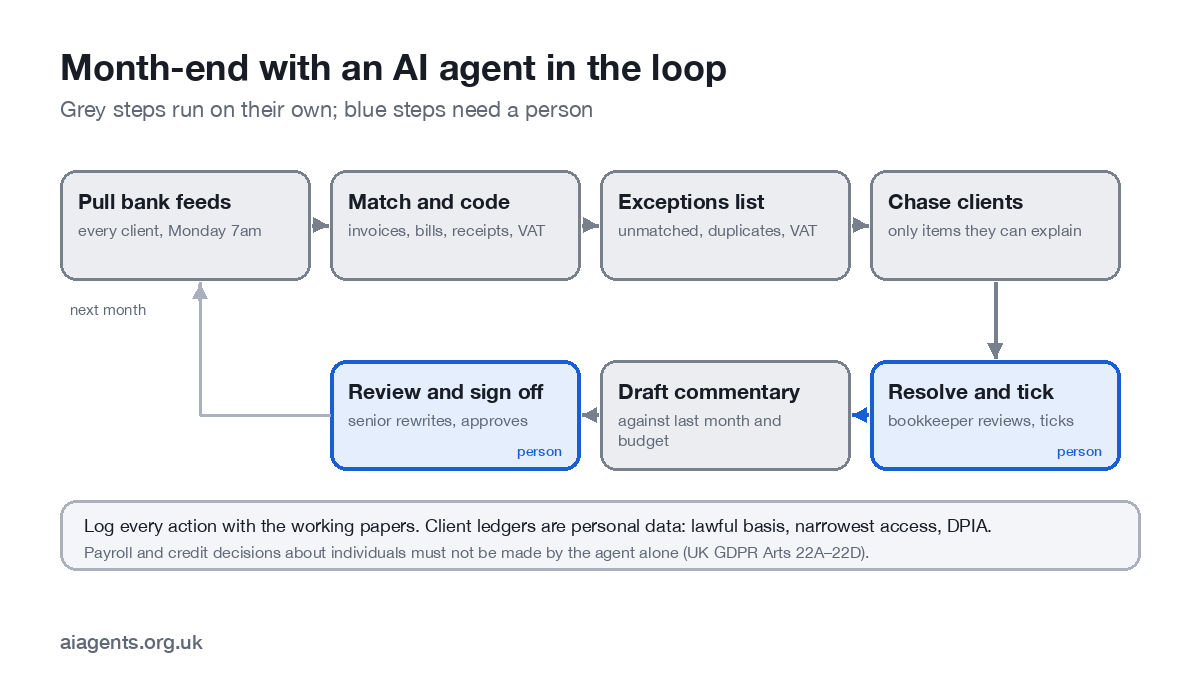
Monday 1st, 7am. The agent pulls the bank feed for each client, matches lines to invoices and bills, codes receipts that arrived through the capture app, and writes an exceptions list per client: unmatched lines, duplicate-looking payments, VAT codes that disagree with history. It emails each client for the items only they can explain, in your firm's tone, and logs every message. By Wednesday it has chased non-responders once. On Thursday a bookkeeper opens the exceptions list, resolves what the client answered, and ticks the reconciliation. On Friday the agent drafts the management-report commentary from the agreed numbers for a senior to rewrite (my AI client reporting workflow has the prompt and checklist). What used to be two days of a bookkeeper's week is now a morning of review, and every action is in the log if a client asks.
How to start: a 4-week plan for a small practice
This plan suits a practice of 1-10 people. It uses software you already pay for, and no client data goes into a public AI tool.
- Week 1: policy and one job. Pick one job from the month-end table, such as bank reconciliation. Write a one-page AI policy: approved tools, what data may go in, who checks the output. ACCA expects a firmwide policy. ICAEW members can take up to eight hours of free generative AI e-learning through its GenAI Accelerator programme.
- Week 2: switch on and paperwork. Turn on your ledger's AI for 3-5 willing clients. Check where the vendor holds data (table above) and add it to your DPIA. Add an engagement-letter line saying AI-enabled software may be used, as the PCRT AI guidance suggests.
- Week 3: run it alongside a person. Let the AI do the job while a person does it too. Log every correction. Check tax points against a trusted source: ICAEW says treat AI "as a starting point for research, not the final authority".
- Week 4: decide. Compare the time spent and the corrections logged. If corrections are few, extend to more clients. If not, stop and try the next job.
What can wait: agent builders such as XeroForce, still in early access, and anything that files with HMRC before a person approves it.
What are the best AI tools for accountants?
The best AI tools for accountants are the ones that sit where the work already is: first the AI inside Xero, QuickBooks, Sage, FreeAgent or IRIS, then a specialist for a job your ledger does not cover, such as Dext for coding or Papercare for working papers (see the comparison table). Those packages already hold the data and the permissions. Add a workflow tool such as Make or n8n or an agent platform when the job crosses systems your software does not connect: the practice inbox, the bank, the client's own systems. For anything that touches full client ledgers, consider running the model on your own hardware so no third party sees the data; see Run AI agents on your own Mac. Independent reviews are in the Tools hub.
How do accountancy firms use AI for their own marketing?
Accountancy firms mostly use AI for marketing to draft LinkedIn posts, newsletters, tax-deadline reminders and website content, which a person then edits. Karbon's 2026 report found 29% of accounting professionals using AI for marketing content, an emerging use well behind communication (77%) and research (58%). The ICAEW Code of Ethics still applies: no exaggerated claims.
What accounting professionals use AI for
Share of respondents using AI for each task. Source: Karbon, 2026 State of AI in Accounting report, reported by CFOtech UK on 23 January 2026.
The marketing jobs that suit AI best are the repetitive ones:
- Deadline content. Self Assessment, VAT and Making Tax Digital reminders, such as the move of MTD for Income Tax to income over £30,000 from April 2027, written once and scheduled.
- Newsletters and explainers drafted from your own notes and checked by a qualified person before they go out.
- Website answers. Plain-English pages answering the questions prospects actually ask, which also help you turn up in AI search answers.
- Enquiry handling. An assistant that answers the phone or website chat and books calls; see AI receptionists in the UK: costs and providers.
- Repurposing. Turning one webinar or client briefing into posts, an email and a web page.
The rules do not change because a machine wrote the first draft. ICAEW's marketing helpsheet says advertising should be "legal, decent, honest, truthful and clear", and paragraph R115.2 of its Code of Ethics bars exaggerated claims and unsubstantiated comparisons with other firms. AI drafts are prone to both, so a person should sign off every post, and client details never go into a marketing prompt.
AI marketing services and consultants. Done-for-you AI marketing services now target the profession: Mintli, for example, writes LinkedIn posts, deadline reminders and client emails from your website for £9, £29 or £79 a month (VAT not stated). If you would rather hire a consultant to set up AI across the practice, write a short brief first: the job, the software, the data the tool may touch, the budget and how you will test it. My AI implementation brief walks through it, and how much AI agents cost in the UK gives realistic price ranges.
What do ICAEW, ACCA and the FRC say about using AI?
The UK accountancy bodies agree that AI is allowed but the accountant stays responsible. ICAEW says never load confidential client information into public generative AI tools; the PCRT bodies' January 2026 guidance says AI does not replace professional judgement; ACCA expects a firmwide AI policy; and the FRC's March 2026 guidance keeps the human auditor accountable.
- ICAEW. Its Generative AI guide applies the five fundamental principles to AI. On confidentiality it says respecting client information means "not loading confidential information into public Generative AI tools", and on competence it reminds members that these tools "are not fully qualified accountants".
- Tax work (PCRT). The seven PCRT bodies, including ICAEW, published AI topical guidance on 19 January 2026, alongside an updated PCRT that applies from 1 January 2026. In ICAEW's summary, AI "does not replace professional judgement", outputs must be checked against current rules, thresholds and reliefs, and identifiable client data should not go into uncontrolled systems.
- ACCA. Its March 2026 technical article asks firms to write an AI policy, to question vendors on encryption, models and data use, and ideally to tell clients at engagement which AI tools will be used on their file. Members "cannot abdicate nor outsource their responsibilities for professional scepticism and judgement to technology."
- Audit (FRC). The FRC published guidance on generative and agentic AI tools in audit engagements on 30 March 2026. It leaves accountability where it was: "the human auditor is always accountable".
Making Tax Digital for Income Tax. According to GOV.UK, MTD for Income Tax started on 6 April 2026 for sole traders and landlords with qualifying income over £50,000 in 2024 to 2025. It extends to those over £30,000 (based on 2025 to 2026) from 6 April 2027 and over £20,000 (based on 2026 to 2027) from 6 April 2028. Quarterly updates are where AI earns its keep: Sage's MTD Agent, FreeAgent's automatic quarterly updates, JAX's categorisation in Xero and QuickBooks' MTD submission checks all target that extra admin. Check every update before it goes to HMRC.
On consumer accounts, ChatGPT can train on what you type unless you opt out (see Is ChatGPT private?), which is why ChatGPT Business, Claude Team or a model on your own machine (see private AI) is the floor for any client work. For the ICO's latest positions, see the ICO AI guidance tracker.
Does HMRC accept tax returns prepared with AI?
Yes, but the person filing stays responsible. On 28 January 2026 HMRC published guidelines for developers of tax software that uses generative AI. The software "should clearly remind users that it is their responsibility to make sure their tax returns are accurate", and "should support, not replace, human judgment".
The tax tribunal has already met unchecked AI. In Harber v HMRC (December 2023), a taxpayer appealing a penalty cited nine tribunal decisions. None were genuine; AI had generated them. The appeal was dismissed.
- Client consent (PCRT). Paragraph 4.2 of the PCRT AI guidance says putting client data into publicly available AI tools "is likely to constitute a breach of client confidentiality, unless the client has consented to this".
- Audit firms (ICAEW). ICAEW's Audit Registration Committee expects all audit firms to set AI policies, train staff and watch for unauthorised AI use. It suggests telling clients about AI in their audit.
- Ethics (ACCA). In ACCA's October 2026 survey of 1,178 professionals, 61% named AI as the top ethical challenge, up from 32% in 2024.
UK GDPR: when client data leaves the UK
- A US-hosted tool means a restricted transfer. The ICO says each one needs adequacy regulations, a safeguard such as the IDTA or UK Addendum, or an exception. Ask which the vendor relies on.
- The UK-US data bridge has conditions. The US company must have an active Data Privacy Framework listing for the type of data you send.
- Safeguards need a risk check. A transfer under the IDTA or Addendum needs a transfer risk assessment, which UK law now calls a "data protection test".
How do you handle client data under UK GDPR?
Client ledgers, payroll and correspondence are personal data, often about your clients' customers and staff as well as the clients themselves, and you are usually a processor for some of it and a controller for the rest. The ICO has said UK GDPR applies in full to agentic systems. In practice for a practice:
- Lawful basis per purpose, written into the engagement letter where you act as processor.
- Narrowest access: the agent reads the ledger and the practice inbox, not the whole drive.
- A DPIA. Agents are new technology processing personal data at scale; the ICO's draft 2026 guidance says you will usually need one.
- No solely automated significant decisions about individuals without the Articles 22A-22D safeguards; payroll and credit decisions are the ones to watch.
- A log of every action, kept with the working papers.
- Vendor terms: if a cloud model sees client data, read the processing terms and switch off training on your content.
The full guide, with the lawful-basis table and a DPIA outline, is AI agents and UK GDPR: what the ICO expects.
Advising clients
Enterprise Nation found 64% of UK SMEs turn to their accountant for advice on digital and AI, more than any other source. You will be asked. The useful answers are the same ones on this page: start with one repetitive job, write the rule down, give the agent read access, keep a human on anything irreversible, and do the short DPIA. Our client-facing guide is AI agents for small business in the UK; feel free to send it.
Frequently asked questions
Can AI replace an accountant?
No, AI cannot replace a qualified accountant. It can code transactions, match bank lines and draft working papers, but it cannot take professional responsibility, sign accounts or give advice. ICAEW, ACCA and the FRC all say judgement and accountability stay with the accountant.
What is the best AI assistant for accountants in the UK?
Start with the AI built into your ledger: Xero JAX, Sage Copilot, QuickBooks or FreeAgent. For drafting, Microsoft 365 Copilot Business costs £13.80 a user a month billed yearly, excluding VAT, and Karbon AI handles the practice inbox. Prices checked October 2026.
What is the best AI agent for bookkeeping?
For most practices it is the agent inside the client's ledger, because it already has the bank feed. Dext AI Assist is the add-on built for coding across many clients, and Briefcase covers capture to schedules from £19 a month plus VAT.
Is there AI working papers software for UK accountants?
Yes, several tools sold to UK practices now build working papers with AI. Papercare, Silverfin and Briefcase all work from client ledgers with AI checks. Papercare starts at £99 a month for up to three staff at its launch price, Silverfin prices per file by quote, and Briefcase starts at £19 a month plus VAT.
How much does AI cost for an accountancy practice?
Often nothing extra, because Xero, Sage, QuickBooks, FreeAgent and IRIS include their core AI in the plan. Add-ons run from £5 per client a month for Dext AI Assist to £99 a month and up for Papercare, plus about £14 to £19 a user for a business assistant.
Can accountants use ChatGPT with client data?
Not on a consumer account. ICAEW says not to load confidential client information into public generative AI tools. Use a business plan that does not train on your data, such as ChatGPT Business or Claude Team, remove identifiers, and cover the use in your DPIA.
How are UK accountants using AI in 2026?
Mostly for communication (77%), meeting summaries (59%) and research (58%), according to Karbon's 2026 report; 87% use ChatGPT. Agents that run month-end jobs on their own are the next step and still uncommon in small practices.
Will AI agents replace bookkeepers?
Not on current evidence. Agents remove the repetitive hours of reconciliation, chasing and coding; the judgement, the client relationship and the sign-off stay human. UK SMEs using AI overwhelmingly report no headcount change.
Is it safe to let an AI agent see client ledgers?
Only with a lawful basis, the narrowest access that does the job, a DPIA and a log. Many practices run the agent on their own machine so client data never reaches a third-party model vendor.
Which accounting software has AI agents built in?
Xero (JAX), QuickBooks, Sage (Copilot), FreeAgent and IRIS all have AI built in as of October 2026, from bank reconciliation and receipt coding to SA100 anomaly checks. Check what your current software includes before buying a separate tool; it already has the data and the permissions.
Do I need to tell clients I use AI agents?
If the agent processes their personal data, your engagement letter and privacy notice should say so. If it makes significant decisions about individuals on its own, UK GDPR Articles 22A-22D add mandatory safeguards.
What is the best AI for accounting?
For most UK practices: the AI already built into your accounting and practice software, because it holds the data and permissions; a general assistant such as ChatGPT, Copilot or Claude for drafting and research; and a workflow or agent tool only for jobs that cross systems. Choose by the job you want gone.
Does HMRC accept tax returns prepared with AI?
Yes, HMRC does not ban AI-assisted returns, but the person filing stays responsible. HMRC's January 2026 guidance says AI tax software should remind users it is their responsibility to make sure returns are accurate, and should support, not replace, human judgment.
Where do AI accounting tools store UK client data?
It varies by vendor. As of 25 October 2026, FreeAgent and Sage Accounting say data is held in Ireland and Dext says AI Assist data stays in EU or UK regions, while QuickBooks and Claude Team store data in the US. Check each vendor before client data goes in.
How should a small accountancy practice start using AI?
Start with one repetitive job, such as bank reconciliation, using the AI already in your ledger. Write a one-page AI policy, update your engagement letters and DPIA, run the AI alongside a person for a week, log corrections, then decide whether to extend it.
Next: build the first job on this list with How to set up an invoice-chasing AI agent.
Read next
- AI agent marketplaces: 23 stores reviewed with UK prices
- How to set up an invoice-chasing AI agent
- AI agents and UK GDPR: what the ICO expects
- 25 AI agent examples that do real work
- AI client reporting workflow: guide, prompt and checklist
- How much do AI agents cost in the UK? Real prices for 2026
- Is ChatGPT private? What OpenAI keeps and how to stop it
Sources
- CFOtech UK, Accountants embrace AI tools as scepticism increases (Karbon 2026 report), 23 January 2026 - usage and sentiment figures
- AccountingWEB, AI in Accounting 2026: State of the Nation report (18 February 2026) - UK practice survey, 600+ members
- Enterprise Nation, Digital and AI adoption among UK SMEs (2026) - 64% ask their accountant
- Inside Privacy, ICO draft ADM guidance (April 2026) - DPIA expectation
- AI in accounting (JAX), Xero UK: JAX features, 97% reconciliation accuracy claim - checked 23 October 2026
- Pricing plans, Xero UK: plan prices excluding VAT - checked 23 October 2026
- Xero announces new AI innovations at Xerocon US, Xero (20 August 2026): XeroForce early access, Claude, ChatGPT and Microsoft 365 integrations - checked 23 October 2026
- AI accounting agent, QuickBooks UK: AI features, beta labels, Finance Agent on Advanced - checked 23 October 2026
- QuickBooks pricing, QuickBooks UK: plan prices plus VAT, beta features - checked 23 October 2026
- Sage Accounting, Sage UK: Copilot in every plan, prices excluding VAT - checked 23 October 2026
- Sage for Accountants, Sage UK: free practice plan, MTD Agent free for Sage Accountants - checked 23 October 2026
- Sage expands AI agents across finance, HR and operations, Sage (28 April 2026): Finance Intelligence Agent phased release - checked 23 October 2026
- How FreeAgent uses AI, FreeAgent (17 August 2023): AI bank explanations since June 2020 - checked 23 October 2026
- Product timeline, FreeAgent: 2026 MTD and error-detection features - checked 23 October 2026
- Pricing, FreeAgent: prices excluding VAT, free bank offers - checked 23 October 2026
- IRIS AI for tax, IRIS Software Group: SA100 anomaly detection, what is free and what costs extra - checked 23 October 2026
- IRIS Elements update, IRIS (3 August 2026): AI document import, roadmap to April 2027 - checked 23 October 2026
- CCH iFirm Accounts Production, Wolters Kluwer UK: generative AI for disclosure guidance - checked 23 October 2026
- AI in tax and accounting, Wolters Kluwer UK: CCH Personal Tax automation - checked 23 October 2026
- Wolters Kluwer launches CCH Axcess Expert AI (15 October 2025): US launch - checked 23 October 2026
- How are accountants in the UK using AI?, Wolters Kluwer (28 May 2025): UK adoption and job-worry figures - checked 23 October 2026
- Dext launches AI Assist, Dext (23 March 2026): launch, Stephen Edginton quote, IRIS ownership - checked 23 October 2026
- Dext AI Assist for accounting practices, Dext: what it covers, £5 per client launch offer - checked 23 October 2026
- Partner pricing, Dext: Dext Solo per-client price - checked 23 October 2026
- Pricing, Briefcase: plans from £19 plus VAT - checked 23 October 2026
- Papercare, the AI Accountant for UK practices: features and product description - checked 23 October 2026
- Pricing, Papercare: staff-based tiers and launch discount - checked 23 October 2026
- Working papers, Silverfin: AI mapping, per-file pricing, UK top 100 use - checked 23 October 2026
- Caseware unveils AiDA at CwX London, Caseware (October 2024): UK launch of AiDA - checked 23 October 2026
- From AiDA to agentic, Caseware: Caseware Verity and Disclosure Checklist Agent - checked 23 October 2026
- Tolley+ with Protégé, Tolley: tax research and drafting features - checked 23 October 2026
- Pricing, Karbon: per-user prices - checked 23 October 2026
- Karbon AI now available to all customers, Karbon (31 March 2026): AI features and regional data processing - checked 23 October 2026
- Microsoft Copilot for business pricing, Microsoft UK: Copilot Business price excluding VAT - checked 23 October 2026
- ChatGPT Business overview, OpenAI: seat prices - checked 23 October 2026
- Business data privacy, OpenAI: no training on business data by default - checked 23 October 2026
- Plans and pricing, Anthropic: Team price, no training by default - checked 23 October 2026
- AI marketing services for accountants, Mintli: plans and prices - checked 23 October 2026
- Find out if and when you need to use MTD for Income Tax, GOV.UK: £50,000, £30,000 and £20,000 thresholds and dates - checked 23 October 2026
- Generative AI and ethics, ICAEW: confidentiality and competence - checked 23 October 2026
- AI and accountants: the rules and guidance you need to follow, ICAEW: PCRT principles applied to AI - checked 23 October 2026
- PCRT bodies publish guidance on using AI in tax, ICAEW (19 January 2026): date and scope - checked 23 October 2026
- Marketing helpsheet, ICAEW: advertising rules and R115.2 - checked 23 October 2026
- Key areas of risk when adopting AI, ACCA (March 2026): AI policy, vendor questions, telling clients - checked 23 October 2026
- Guidance on generative and agentic AI in audit, FRC (30 March 2026): human auditor accountable - checked 23 October 2026
- Privacy notice, Xero UK: processing countries - checked 25 October 2026
- Global privacy statement, Intuit: US storage, UK Addendum - checked 25 October 2026
- Customer due diligence and sub-processors, Sage UK: Sage Accounting and AutoEntry hosting - checked 25 October 2026
- Data security and backup, FreeAgent: Ireland data centres - checked 25 October 2026
- Pricing, AutoEntry: credit plans excluding VAT - checked 25 October 2026
- GDPR compliance statement, Karbon: EU data centre - checked 25 October 2026
- Security, Silverfin: Google Cloud, AI training - checked 25 October 2026
- Security certifications, Caseware: AWS hosting and jurisdiction choice - checked 25 October 2026
- Security, Inflo: Azure hosting in Ireland - checked 25 October 2026
- In-country data processing for Microsoft 365 Copilot, Microsoft (updated 3 April 2026): UK timing - checked 25 October 2026
- Data residency for ChatGPT, OpenAI: eligible plans and regions - checked 25 October 2026
- Where are your servers located?, Anthropic: US storage - checked 25 October 2026
- Guidelines for using generative AI if you're a software developer, HMRC (28 January 2026) - checked 25 October 2026
- Harber v HMRC [2023] UKFTT 1007 (TC): AI-generated case citations - checked 25 October 2026
- PCRT topical guidance on AI tools, ICAEW: confidentiality and engagement letters - checked 25 October 2026
- AI in audit work: managing the risks, ICAEW Audit Registration Committee - checked 25 October 2026
- Using AI with confidence, ICAEW: validating AI output - checked 25 October 2026
- Navigating ethics for trust, ACCA (October 2026): 61% name AI top ethical challenge - checked 25 October 2026
- A brief guide to international transfers, ICO - checked 25 October 2026