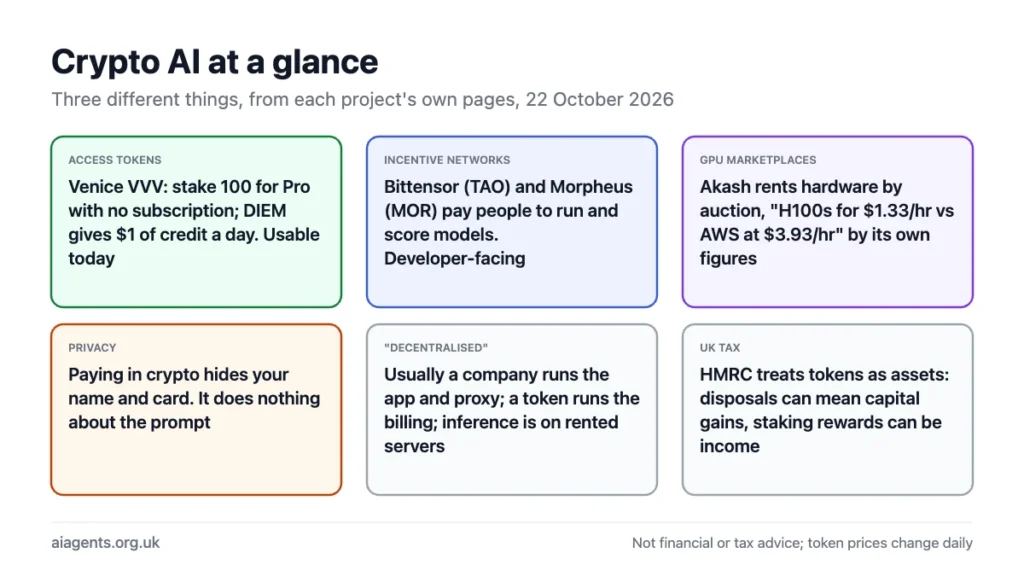
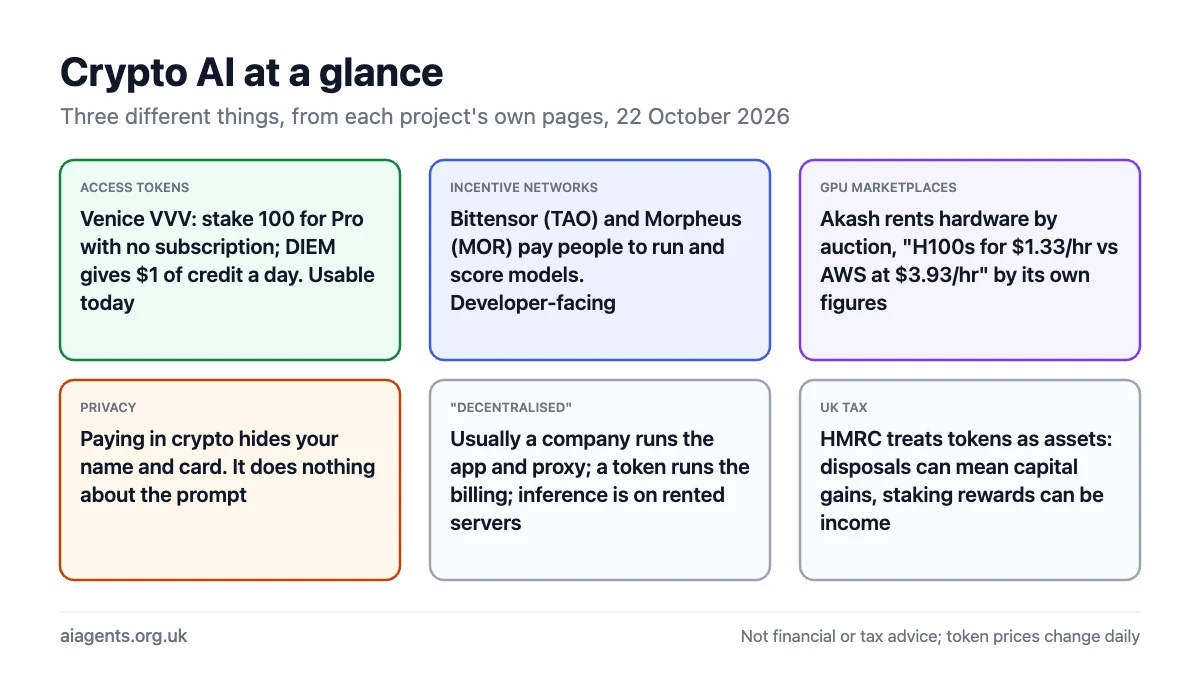
"Crypto AI" covers three different things, and only one of them is useful to an ordinary person today. Tokens that pay for AI access, such as Venice's VVV, let you skip a subscription and a card. Networks that pay people to run models, such as Bittensor and Morpheus, are built for developers and GPU owners. GPU marketplaces such as Akash rent hardware for crypto at prices they say undercut AWS. None of them makes a conversation private, because privacy comes from where the model runs and who can read the prompt, not from how you paid. A blockchain is a public ledger and the last place your chats should go. This page explains each project from its own documentation, read on 22 October 2026, says who can use it, and sets out the UK tax point nobody mentions.
On this page
- The three things people mean by crypto AI
- Venice and VVV: a token instead of a subscription
- Bittensor and TAO: a market for AI work
- Morpheus and MOR: stake to get inference
- Akash: GPUs rented for crypto
- What crypto does and does not do for privacy
- The UK angle: tax, volatility and exchanges
- Frequently asked questions
The three things people mean by crypto AI
| Type | Examples | What the token does | Can you use it to chat today? |
|---|---|---|---|
| Access tokens | Venice (VVV, DIEM) | Holding or staking it replaces a monthly fee for a normal AI service | Yes: stake 100 VVV and Venice Pro is unlocked |
| Incentive networks | Bittensor (TAO), Morpheus (MOR) | Pays people to run models or score them; stakers get a share of capacity | Through developer APIs or third-party apps, not a consumer chat app from the project |
| Compute marketplaces | Akash (AKT) | Pays GPU owners for rented hardware, priced by auction | No: it rents servers to developers who then host a model |
The first is a payment method. The second and third are infrastructure. Each of the project pages below says so itself once you read past the headline.
Venice and VVV: a token instead of a subscription
Venice is a normal AI chat service with a crypto payment layer. Its token page calls VVV "an access key for AI agents and developers to consume private, uncensored inference through the Venice API" without paying per request. Datawallet's explainer, updated 11 October 2026, has the mechanics: VVV launched on 27 January 2025 on Base, Coinbase's network, with 100 million tokens and no presale; staking 100 VVV unlocks the Pro tier with no subscription; locking staked VVV mints a second token, DIEM, and each DIEM held gives $1 of Venice credit a day, reset at midnight UTC with nothing carried over. Software agents holding staked VVV can create API keys without a human account, which is the part developers care about.
So the question is whether holding 100 VVV beats paying $18 a month. That depends on the token price on the day you buy and the day you sell, which is a bet, not a saving. You also need a crypto exchange account, a wallet on Base and the patience for the tax paperwork below. Venice's privacy policy notes that if you pay in crypto it records the paying wallet's public key, so the payment is pseudonymous rather than anonymous. Everything else about the service, including what its four privacy modes do and do not protect, is in the Venice AI review.
Bittensor and TAO: a market for AI work
Bittensor is the largest of the incentive networks and the most searched, and its own documentation describes something quite different from a chatbot: "an open network where independent subnets produce digital commodities", with compute, inference, storage and prediction as the examples. Each subnet is a marketplace for one kind of work. Miners produce it, validators score it, subnet creators set the rules, and stakers back validators with TAO, the network's token, which the chain pays out "in proportion to the value they contribute."
Can you chat with it? Not from Bittensor itself. The documentation is written for developers and operators, around a Python SDK and a command line tool, and describes no consumer product or privacy model. Some subnets expose chat through third-party apps, and those apps have their own terms; the network does not add privacy and, as a public ledger, could not. If you are looking at TAO, you are looking at an investment in a market for AI services, and that is a different decision from choosing an assistant.
Morpheus and MOR: stake to get inference
Morpheus describes itself as a network to "incentivize the first open-source peer-to-peer network of personal general-purpose AI, powered by the MOR token." The mechanics on its homepage: stake stETH, WETH, USDC or USDT to earn MOR; run open models on your own GPUs to earn MOR; and "Stake your MOR to get inference from the Morpheus network", which arrives as an OpenAI-compatible API with what the site calls Phase 1 TEE-backed providers. In other words, a developer can point an app at Morpheus instead of OpenAI by changing one line, and pay by staking rather than by card.
For a non-developer that means waiting for apps built on it. The homepage's network status widget was still loading when I read the page, which is a small thing but a fair picture of where the project is: live, developer-facing, and not yet something to hand to a relative.
Akash: GPUs rented for crypto
Akash is the clearest of the lot about what it is: "an open network that lets users buy and sell computing resources securely and efficiently." Providers list GPUs, customers rent them, and prices come from "a global reverse auction". The homepage claims "H100s for $1.33/hr vs AWS at $3.93/hr", which is Akash's own comparison. Its AkashML service offers open models through OpenAI-compatible APIs for developers. If you self-host a model for a team and want cheaper GPUs than the big clouds, Akash is a real option; the self-hosted LLM guide covers when that arithmetic works. If you want to chat, it is not for you.
What crypto does and does not do for privacy
Paying in crypto does one thing: it stops the service holding your name and card details. That is worth something. It does nothing about the prompt, which still travels to a server, is read by a model and is kept or discarded according to that operator's policy. Venice is the useful example because it does both halves well and keeps them separate: the token handles payment, and a separate set of privacy modes, up to end-to-end encryption into a hardware enclave, handles the text. A project that offers a token but no equivalent of those modes has not addressed privacy at all. One UK wrinkle I found when I opened Venice on 22 October 2026: since July 2025 it has asked UK visitors for a card payment as its Online Safety Act age check and shows no free tier here, and nothing on the notice says whether a staked wallet satisfies that check instead. So "pay without a card" may not survive the age gate for a UK user; the Venice review has the screenshot.
Three more things to keep straight. "Decentralised" on a homepage usually means a company runs the app and the proxy and a token contract runs the billing; the inference happens on rented servers like anyone else's, and Datawallet's explainer says as much about Venice. A blockchain is public by design, so no sane project puts prompts on one; the ledger records payments and stakes, not conversations. And none of this changes the hierarchy on this site: a model on your own Mac is private because nothing leaves the room, a service like Lumo or Venice's E2EE mode is private because of encryption and contracts, and a cloud chatbot paid for in crypto is a cloud chatbot. The private AI guide has that hierarchy in full and private AI chatbots compared rates the services.
The UK angle: tax, volatility and exchanges
HMRC treats cryptoassets held by individuals as assets, so selling, swapping or spending a token can be a disposal for capital gains tax, and rewards from staking can count as income depending on how they arise; HMRC's Cryptoassets Manual is the reference and an accountant is the person to ask. Spending VVV to pay for AI, or earning MOR for running a GPU, both fall inside that. Add the price swings, the need for an exchange account with identity checks, and the fact that a lost wallet is lost for good, and the honest summary is that paying for AI in crypto is for people who already hold crypto. For everyone else a card is simpler, and the privacy question is answered elsewhere.
Frequently asked questions
What is crypto AI?
A loose label for three different things: tokens that pay for access to an AI service, such as Venice's VVV; networks that pay people in tokens to run or score AI models, such as Bittensor and Morpheus; and marketplaces that rent GPUs for crypto, such as Akash. Only the first is something an ordinary person uses directly today.
Can I buy ChatGPT with crypto?
Not from OpenAI, which takes cards. Services such as Venice accept crypto or a staked token and route your prompts to OpenAI's models with your identity stripped. That hides who you are from OpenAI; it does not stop OpenAI processing the text. Duck.ai does the same identity-stripping for free with no crypto involved.
What is the Venice token used for?
VVV replaces Venice's subscription and API bills. Staking 100 VVV unlocks the Pro tier with no monthly fee, and locking staked VVV mints DIEM, each of which gives $1 of Venice credit a day. It launched on Base on 27 January 2025 with 100 million tokens. Whether it saves money depends on the token price when you buy and when you sell.
Is Bittensor a chatbot?
No. Bittensor's documentation describes an open network of subnets that produce digital commodities such as compute, inference, storage and prediction, paid in TAO. It is built for developers, miners and validators, with a Python SDK and a command line tool. Some subnets are reached through third-party chat apps, which have their own terms; the network itself offers no consumer product and no privacy model.
Does paying with crypto make AI private?
No. It stops the service holding your name and card, and a wallet address is still recorded. Your prompt travels to a server and is handled under that operator's policy exactly as it would be after a card payment. Privacy comes from running the model yourself or from a service designed so the operator cannot read the text, such as Proton Lumo or Venice's end-to-end encrypted mode.
What is decentralised AI?
AI where the models, the compute or the payments are spread across many independent parties rather than one company, usually coordinated by a token. In practice most projects decentralise the billing and the GPU supply while a company still runs the app and the proxy. It can lower costs and remove a single gatekeeper; it does not by itself make your conversations private.
Read next
- Venice AI review
- Private AI: the UK guide
- Private AI chatbots compared
- Self-hosted LLMs: when renting GPUs makes sense
Sources
- Venice token page and privacy policy - read 22 October 2026
- Datawallet: Venice AI explained, updated 11 October 2026: VVV launch, staking thresholds, DIEM mechanics, infrastructure - read 22 October 2026
- Bittensor documentation - read 22 October 2026
- Morpheus homepage - read 22 October 2026
- Akash Network homepage - read 22 October 2026
- HMRC Cryptoassets Manual - for the tax treatment of tokens held by individuals