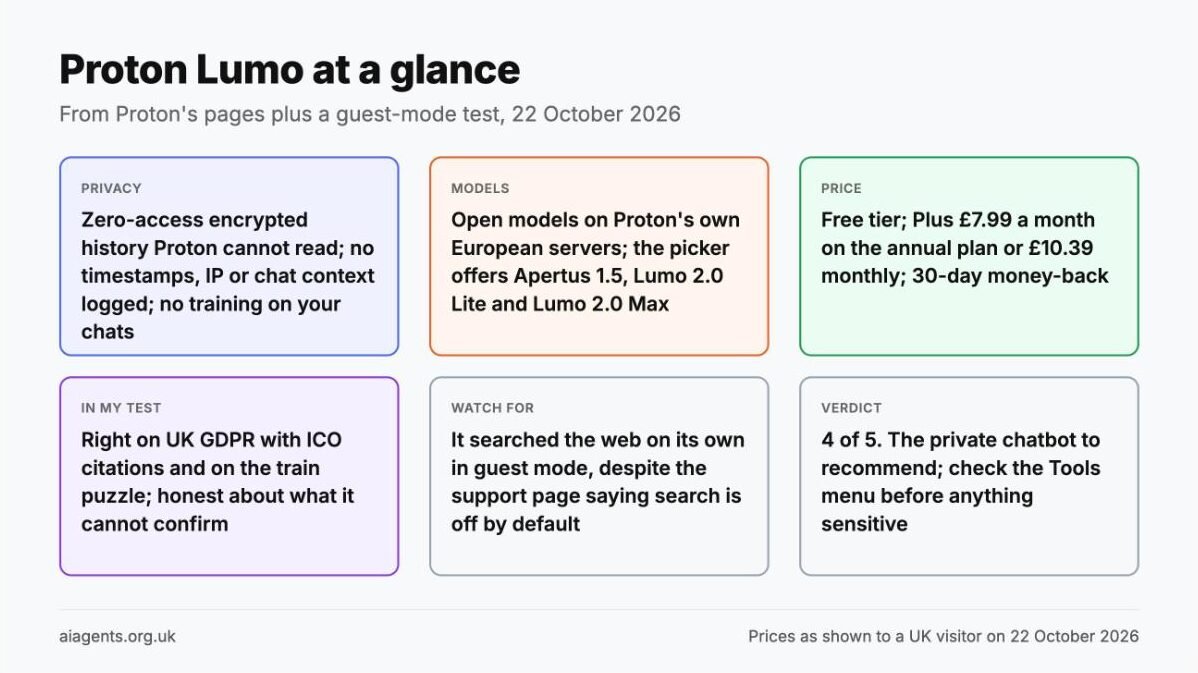
Lumo is the most private AI assistant you can use without running the model yourself. Proton, the Swiss company behind Proton Mail, stores your chat history with zero-access encryption so it cannot read it, keeps no logs of prompts, timestamps or IP addresses, and runs open models on servers it owns in Europe. The price of that is capability: you get Qwen 3.5, GLM 5.3 and the Swiss-built Apertus, not GPT or Claude, and the free tier is limited. Lumo Plus is £7.99 a month on the annual plan in the UK, £10.39 monthly. This review covers what Proton's own privacy page promises, what Plus adds, how it compares with ChatGPT and with a model on your own Mac, and who it is for. Everything is from Proton's pages, read on 22 October 2026.
Key facts
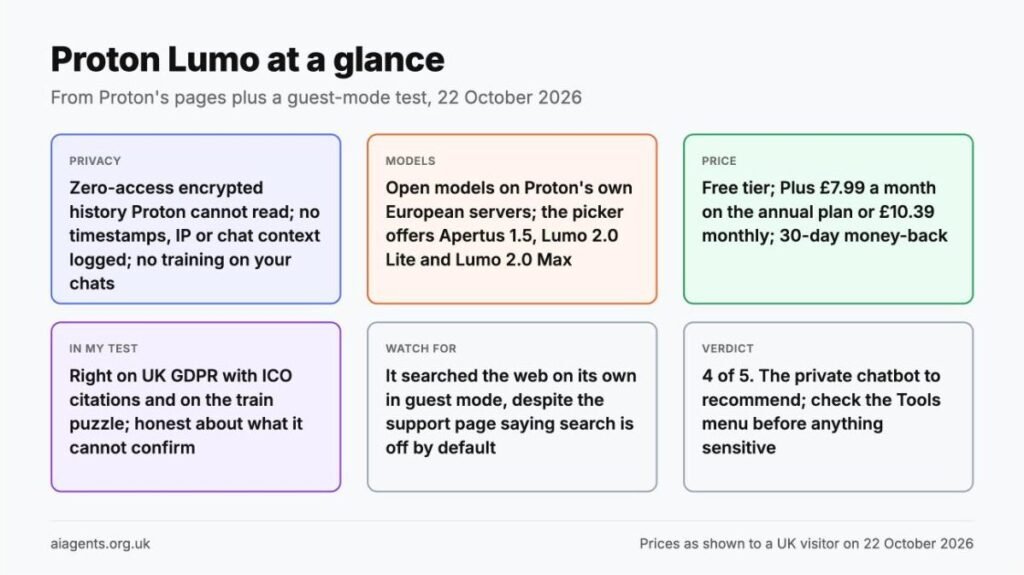
- What it is: an AI chat assistant on the web, iPhone and Android from Proton AG, launched 23 July 2025
- Privacy: "Proton does not have access to your chat history"; no metadata such as timestamps, IP addresses or chat context is stored; chats are not used to train models
- Models: open models only, Qwen 3.5, GLM 5.3 and Apertus 1.5, plus image models, running "exclusively on servers Proton controls" in Europe; the picker labels them Apertus 1.5, Lumo 2.0 Lite and Lumo 2.0 Max
- Price in the UK: Free with limits; Plus £7.99 a month billed £95.88 a year, or £10.39 month to month; 30-day money-back guarantee
- Guest mode: works without an account; the conversation is erased when the session ends
- Web search: Proton's support page says off by default; in my guest-mode test Lumo searched the web on the first prompt without being asked, so check the Tools menu before you type anything sensitive
- In my test: correct on UK GDPR with ICO citations, correct on a timetable puzzle, and candid that it cannot confirm who at Proton can see what
- Official site: lumo.proton.me
On this page
- How I tested it, and what happened
- How private Lumo is, in Proton's own words
- The models, and what that means for quality
- Lumo Plus price in the UK
- Lumo vs ChatGPT
- Lumo vs a model on your Mac
- Verdict
- Frequently asked questions
How I tested it, and what happened
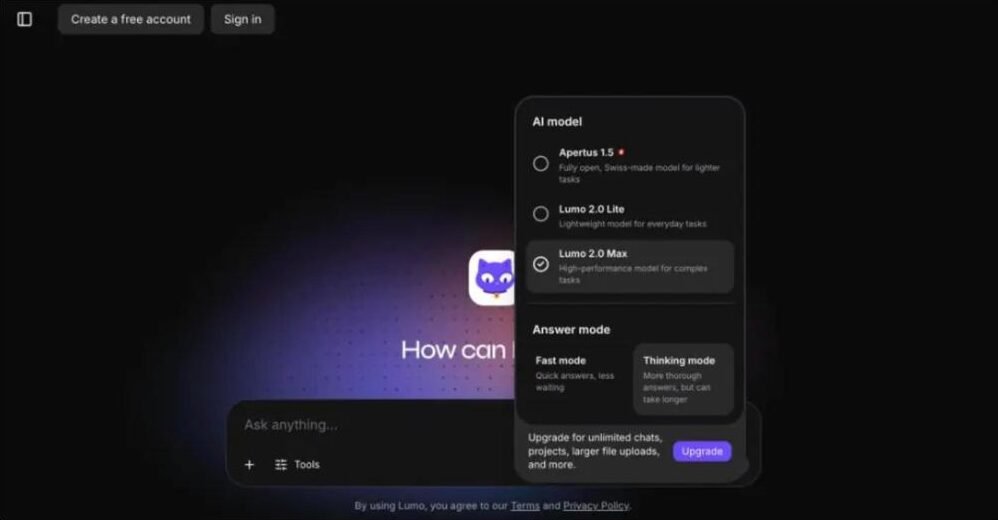
On 22 October 2026 I opened lumo.proton.me in guest mode, without an account, and ran the same three prompts I use on every chatbot in the comparison: a UK GDPR question that needs current knowledge, a timetable puzzle that needs arithmetic, and a question about what the service stores. The model picker offered Apertus 1.5 ("fully open, Swiss-made model for lighter tasks"), Lumo 2.0 Lite and Lumo 2.0 Max, with a Fast or Thinking answer mode; I left it on Lumo 2.0 Max in Thinking mode, which was the default.
Prompt 1, UK GDPR. "In 100 words, what must a UK small business do before using an AI chatbot with customer data under UK GDPR?" The answer was about 100 words and right: do a DPIA, record a lawful basis, update the privacy notice, sign a processing agreement covering international transfers, minimise and secure the data, add human review where outputs affect people. It added that Article 22 was amended by the Data (Use and Access) Act 2025 and that ICO guidance has been under revision, which is correct and more current than I expected from an open model. The surprise was how it got there: the thinking panel showed it had "Searched the web" twice, for ICO guidance and for the DUAA, before I had touched the Tools menu. Proton's support page says web search is off by default. In guest mode, on this day, it was not.

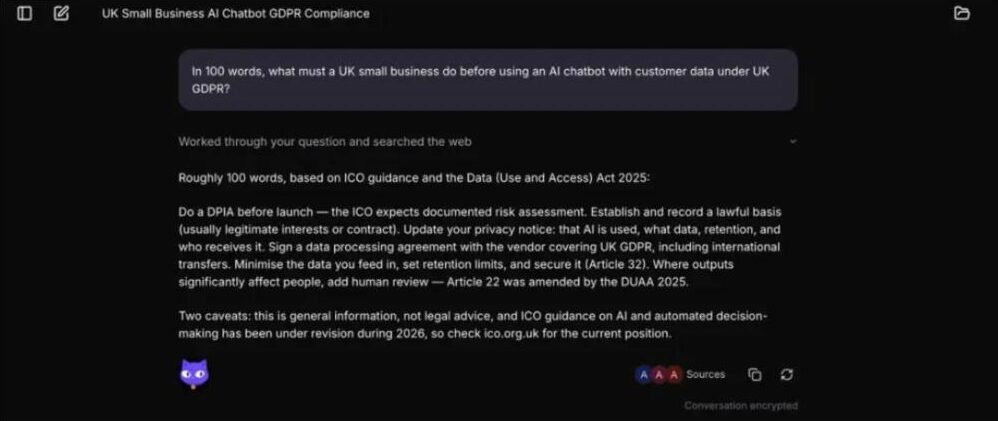
That matters for a privacy product. A web search sends your question, or a version of it, to a search provider, and Proton's page does not say which one Lumo uses in guest mode or what that provider keeps. Nothing in my prompt was sensitive, but if you are about to paste something that is, open Tools first and make sure search is off. The "Conversation encrypted" label under each answer refers to the chat itself, not to anything that leaves to a search engine.
Prompt 2, the timetable. A train leaves Leeds at 09:12 and arrives in London at 11:30; another leaves London at 09:45 and arrives in Leeds at 12:10. Which arrives first, and by how many minutes? Lumo laid the two out in a table and answered train 1, by 40 minutes, which is right, with no web search this time.
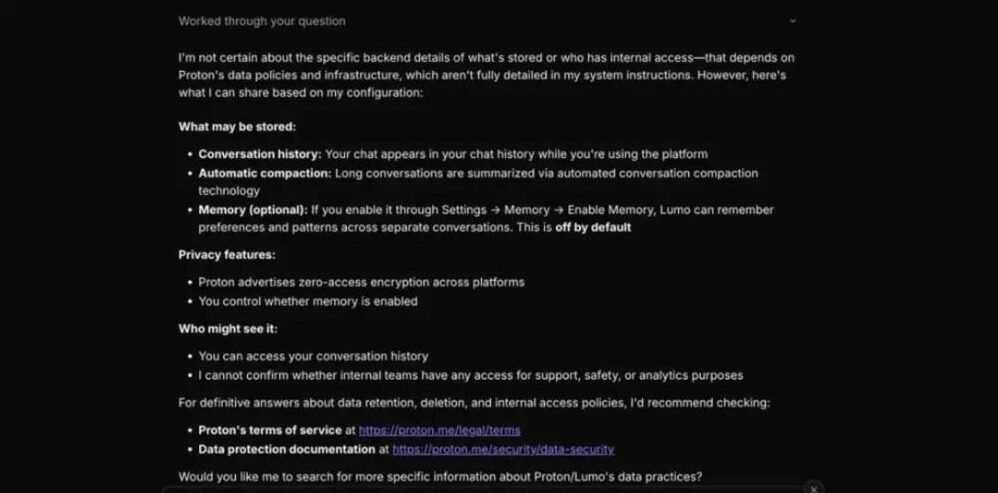
Prompt 3, what it stores. "What do you store about this conversation, and who can see it?" This is the answer I rate the chatbots on most, because the tempting thing is to overclaim. Lumo did not. It opened with "I'm not certain about the specific backend details", listed what it could say from its own configuration (history visible while you use the platform, automatic compaction of long chats, memory off by default and only on if you enable it in Settings), and then said plainly "I cannot confirm whether internal teams have any access for support, safety, or analytics purposes", pointing me to Proton's terms and data-security pages instead. Compare that with Duck.ai's "no risk of de-anonymization" on the same question. An assistant that knows the limits of what it knows is the one I would trust with a question that matters.
Two smaller observations. Guest chats get their own URL under lumo.proton.me/guest/ and a persistent prompt to "create a free account to keep your chats", so guest mode is a real mode rather than a demo. And the thinking panel is visible by default, which makes it easy to see when the model has gone to the web.
How private Lumo is, in Proton's own words
Proton's support page is unusually specific, so it is worth quoting. Stored history: "Lumo uses zero-access encryption for stored chat history", which is the same design as Proton Mail, where the key lives on your device and Proton holds only ciphertext. Prompts in flight: "we asymmetrically encrypt your prompts so only the Lumo GPU servers are able to decrypt them", and once the answer is generated "the data is erased". Logging: "Lumo doesn't store metadata such as timestamps, IP addresses, or chat context." Training: "Lumo doesn't use your chats to train the AI models." On Free and Plus plans, "The only record of the conversation is on your device."
Two honest limits. The GPU servers do decrypt your prompt to answer it, so for the seconds of inference the text exists in plain form on Proton's hardware; the promise is that it is erased and never logged, which you take on trust and on Proton's record. And "built and based in Europe" does not name a country: the launch post says Lumo runs from Proton's European data centres and that Proton is moving most of its infrastructure out of Switzerland into the EU, with Lumo the first product to move. For a UK user that is still an international transfer in GDPR terms, to a jurisdiction with an adequacy decision, which is the easiest kind.
The models, and what that means for quality
Lumo runs open-weights models that Proton hosts itself: Qwen 3.5 and GLM 5.3 for text, Apertus 1.5 from the Swiss AI Initiative, and Image-Turbo and FireRed-Image-Edit for pictures. The launch post commits Proton's research to open models. In practice that puts Lumo roughly where a good local setup sits: Qwen 3.5 and GLM 5.3 are capable for writing, summarising, questions about uploaded documents and everyday coding help, and short of the frontier models at hard multi-step reasoning. If you have run Qwen3.8 on a Mac, you know the level. Proton's support page says web search is off unless you turn it on, which would be the right default for a privacy product. In my guest-mode test Lumo searched anyway, so treat that as a setting to check rather than a promise to rely on.
Lumo Plus price in the UK
| Free | Lumo Plus | |
|---|---|---|
| Price | £0, no card required | £7.99 a month billed £95.88 a year; £10.39 month to month |
| Max model usage | Limited | More |
| Messages and chat history | Limited | More, with "unlimited chats and the fastest responses" |
| Image generation | Limited | More |
| Projects | 1 | Unlimited |
| Custom Lumos | Not included | Unlimited |
| Guarantee | 30-day money-back |
Prices as shown to a UK visitor on 22 October 2026, with the £10.39 figure the struck-through list price against the annual rate. Proton does not publish the exact free-tier message cap on the plans page, only "limited". Plus is also bundled into Proton's wider subscriptions, so if you already pay for Proton Unlimited it is worth checking what you have before buying it separately.
Lumo vs ChatGPT
| Lumo | ChatGPT (Free, Plus) | |
|---|---|---|
| Can the company read your chats? | No, zero-access encryption | Yes |
| Used for training? | No | Yes unless you switch it off |
| Metadata logged? | No timestamps, IP or chat context | Yes |
| Where it runs | Proton's servers in Europe | OpenAI's servers, mainly in the US |
| Models | Qwen 3.5, GLM 5.3, Apertus 1.5 | GPT-5 family |
| Tools and memory | Projects, custom assistants, optional web search | Memory across chats, connected apps, voice, agents |
| Price | Free; Plus from £7.99 a month | Free; Plus about £20 a month |
Is Lumo as good as ChatGPT? At privacy, it is in a different league. At answering questions, it is a good open model against a frontier one: fine for most daily work, noticeably behind on the hardest tasks and on everything ChatGPT does around the model. What ChatGPT keeps and how to limit it is in is ChatGPT private?.
Lumo vs a model on your Mac
The same models, more or less, in two places. Lumo runs Qwen 3.5 and GLM 5.3 on Proton's hardware; a Mac with 32 GB runs Qwen3.8 27B through Ollama on your desk. Lumo wins on convenience, on the phone, and on needing no hardware. The Mac wins on the one thing Lumo cannot promise, which is that the text never exists on anyone else's machine even for a second, and on working with the internet off. The costs over three years are close: Plus is £287.64 at the annual rate; a 32 GB Mac mini M6 is £1,299 once and does a great deal more than chat. The private AI guide weighs the two routes, and run a local LLM on your Mac is the setup.
Verdict
4 out of 5 as a private assistant. Lumo is the hosted chatbot to recommend to anyone who wants privacy without a Terminal window, and the only one on this site's comparison where the operator's inability to read your history is a matter of design rather than policy. In my test it was accurate, current and honest about its own limits. One point goes for two things: the models are a step behind the frontier and Proton does not publish the free tier's limits; and web search fired on its own in guest mode when the support page says it is off by default, which on a privacy product is the kind of gap that should not exist. If you already trust Proton with your email, trusting it with your questions is an easy decision.
Frequently asked questions
Is Lumo AI actually private?
Yes, by design rather than by promise. Your chat history is stored with zero-access encryption, so Proton holds only ciphertext it cannot read; prompts are encrypted so only Lumo's GPU servers can decrypt them and are erased after the answer; no timestamps, IP addresses or chat context are logged; and chats are not used for training. The one trust point is the moment of inference on Proton's hardware.
Is Lumo as good as ChatGPT?
For privacy, far better. For answers, it runs open models, Qwen 3.5 and GLM 5.3, that handle writing, summaries, document questions and everyday coding well but sit behind GPT-5 on hard reasoning, and it lacks ChatGPT's memory, connected apps and agents. On my three test prompts the two gave answers of the same quality, and Lumo's was the more honest about what it stores. If the task has nothing sensitive in it, ChatGPT is stronger on the hard end; if it does, Lumo is the one to use.
What is Lumo AI used for?
The same things as any chat assistant, writing, rewriting, summarising, answering questions about documents you upload, generating images, light coding, with the difference that nothing you type can be read by the company afterwards. That makes it suited to questions about health, money, legal matters and work you would not want in a ChatGPT history.
How much is Lumo Plus in the UK?
£7.99 a month on the annual plan, billed as £95.88 every 12 months, or £10.39 month to month, as shown on Proton's UK plans page on 22 October 2026, with a 30-day money-back guarantee. Plus adds more model usage, more messages and history, more image generation, unlimited Projects and unlimited custom assistants. The free tier has no card requirement and no time limit.
Which models does Lumo use?
Open-source models hosted by Proton: Qwen 3.5 and GLM 5.3 for text, Apertus 1.5 from the Swiss AI Initiative, and Image-Turbo and FireRed-Image-Edit-1.1 for images. Proton says they run exclusively on servers it controls, so your data is never on a third-party platform, and its research will stay focused on open models.
Can I use Lumo without an account?
Yes. Guest mode needs no sign-up, and Proton says the conversation is erased at the end of each session. An account, free or Plus, adds encrypted history that syncs between the web, iPhone and Android apps, with the key on your devices rather than with Proton.
Read next
- Private AI chatbots compared
- Venice AI review
- Private AI: the UK guide
- Ollama models list: the models Lumo uses, on your own Mac
Sources
- Proton Support: Lumo privacy: encryption, logging, models, hosting, training - read 22 October 2026
- Proton: Lumo plans: UK prices and plan features - read 22 October 2026
- Proton blog: Introducing Lumo, 23 July 2025: launch, European data centres, open-model commitment - read 22 October 2026
- Lumo guest mode: three test prompts run on Lumo 2.0 Max in Thinking mode, screenshots above - 22 October 2026