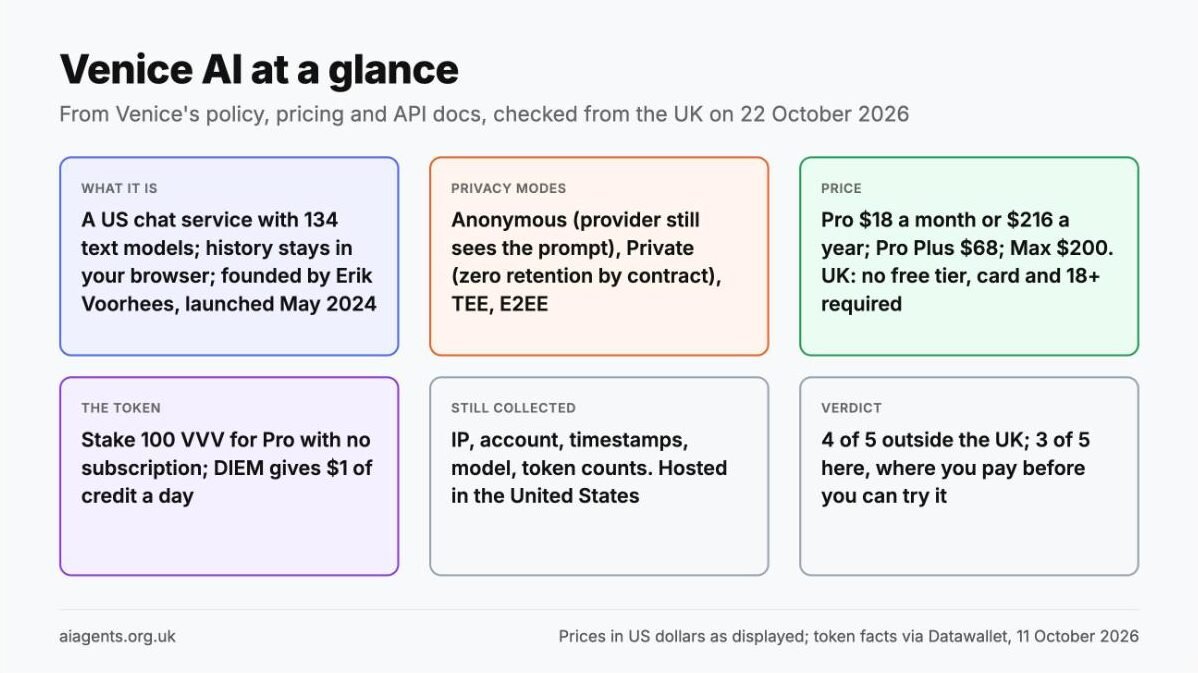
Venice AI is a Wyoming-based chat service that keeps your conversation history in your browser rather than on its servers, says it does not log prompts, and offers models with fewer refusals than ChatGPT. It is more private than the big chatbots and less private than running a model on your own Mac. Outside the UK the free tier gives 10 text prompts a day; in the UK there has been no free tier since July 2025, because Venice uses a card payment as its Online Safety Act age check, so you pay $18 a month before you can type anything. What matters most is which of its four privacy modes you pick: in "Anonymous" mode your prompt still reaches OpenAI, Anthropic or Google, with only your identity stripped. This review covers what Venice keeps, what it costs, how the token works and who it suits, from its own policy pages and documentation, plus what happened when I opened it from the UK on 22 October 2026.
Key facts
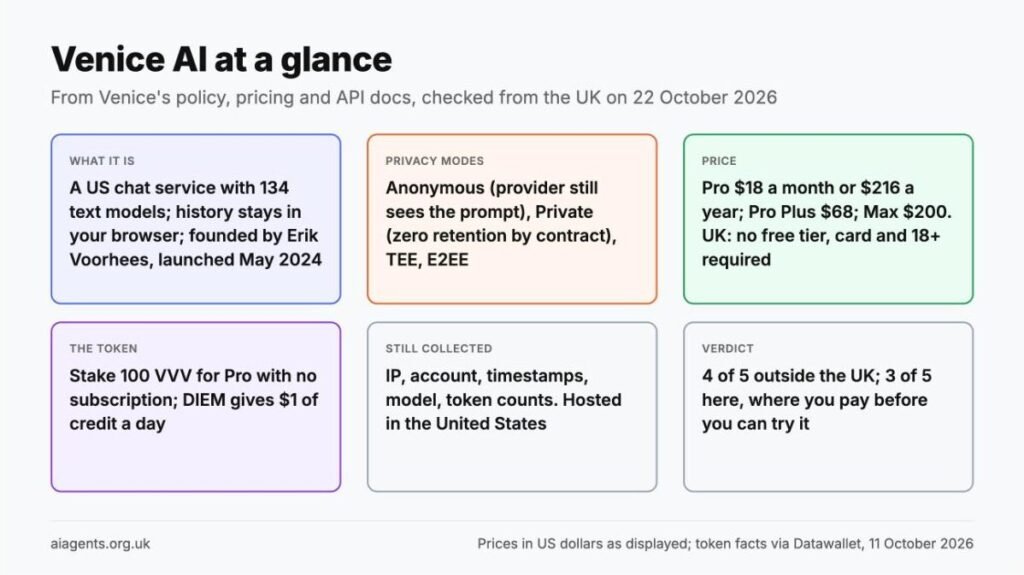
- What it is: a web and mobile AI chat, image and video service with 134 text models, from open-weights Qwen and DeepSeek to Claude, GPT and Gemini
- Made by: Venice.ai, founded by ShapeShift's Erik Voorhees, launched May 2024, based in Sheridan, Wyoming; $65 million Series A in July 2026 led by Dragonfly
- Price: Pro $18 a month or $216 a year; Pro Plus $68; Max $200; all in US dollars. The free tier (10 text and 15 image prompts a day) is not offered to UK users, who must pay and be 18 or over
- Privacy claim: "we will not have access to or store the content of your Prompts or Outputs"; chat history is encrypted and kept in your browser
- The catch: four privacy modes, and the one that gives you Claude or GPT sends your prompt to that provider; the service is hosted in the United States
- Token: VVV on Coinbase's Base network since 27 January 2025; staking 100 VVV unlocks Pro with no subscription
- Official site: venice.ai
On this page
- What happened when I opened it from the UK
- What Venice AI is
- Is Venice AI actually private? The four modes
- What still leaves your device
- What "uncensored" means here
- Venice AI pricing in the UK
- The VVV token: Pro without a subscription
- Venice vs running a model yourself
- Who should use it
- Frequently asked questions
What happened when I opened it from the UK
I went to venice.ai/chat from a UK connection on 22 October 2026, without signing in, to run the same three test prompts I used on Duck.ai and Lumo. I did not reach the prompt box. Venice shows UK visitors a full-screen notice instead: because of the Online Safety Act it no longer offers a free tier "without requiring a credit card", so UK users "must now purchase a Pro account and be at least 18 years old". The "Learn more" link goes to a Venice blog post dated 27 July 2025 whose body did not render in my browser, only its title and date. The notice also describes the UK as an "Orwellian police state", which tells you something about the company's tone.
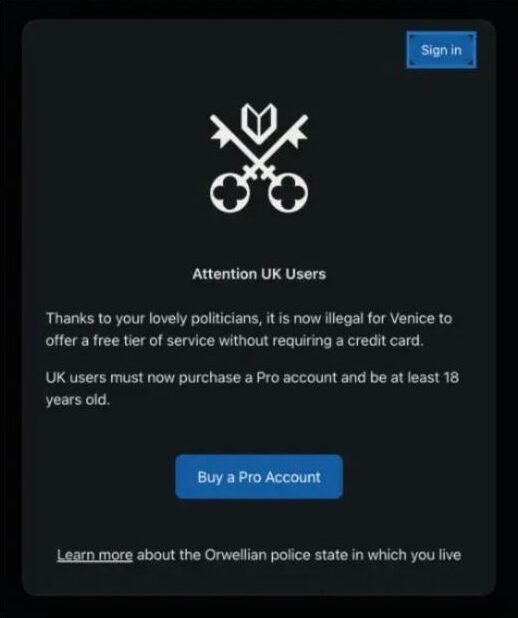
Venice has chosen a card payment as its age check. That is one of the methods Ofcom's January 2025 guidance lists as capable of being "highly effective", alongside photo ID matching, facial age estimation and open banking, so the approach is legitimate even if the wording is not. Two consequences follow. The free tier on the pricing page does not exist for you if you are in the UK, so there is no way to try the privacy modes or the model list before paying $18. And "no card required" is not true here: the card is the age check, and the privacy policy already says the payment processor holds your card details. The rest of this review is from Venice's own documentation, because I have not paid for Pro. If that changes I will run the prompt set and add the results.
What Venice AI is
Venice is a front end to other people's models. You chat in a browser or the mobile app, pick a model from a long list, and Venice's proxy passes the request to whichever provider runs that model and passes the answer back. Its promise is that the proxy keeps nothing: in the words of the privacy policy, "we will not have access to or store the content of your Prompts or Outputs." Your history lives in your browser, encrypted, which is why the documentation warns that clearing browser data wipes it unless you are a paying user with encrypted backup turned on.
The model list on 22 October 2026 ran to 134 text models plus image, video and audio generators. It includes the open-weights models this site covers for local use, such as Qwen3.8 27B, Gemma 4, GLM 5.3, DeepSeek V4 and OpenAI's gpt-oss 120B, and the closed ones you would otherwise need a ChatGPT, Claude or Gemini account for. Venice also sells its own "Venice Uncensored" variants. The founder is Erik Voorhees, who built the crypto exchange ShapeShift; Datawallet's explainer records a May 2024 launch, a Wyoming base and a $65 million Series A in July 2026 led by Dragonfly with Coinbase Ventures, which The Block put at a $1 billion valuation.
Is Venice AI actually private? The four modes
Partly, and it depends entirely on the model you choose. Venice's API documentation describes four privacy modes, and every model on the list is tagged with one. This is the single most important thing to understand before you type anything sensitive.
| Mode | Which models | What Venice says happens | Who can read your prompt |
|---|---|---|---|
| Anonymous | Claude, GPT, Gemini, Qwen's hosted versions and other third-party models | Your Venice identity is hidden from the provider, but "Prompt content is still visible to that provider" | OpenAI, Anthropic, Google or whoever runs the model, under their own policies |
| Private | Open-weights models Venice hosts itself: Qwen3.8, Gemma 4, GLM, DeepSeek, gpt-oss, Llama, Grok | Zero data retention by contract: content "is processed for inference only and is not retained after the request completes" | The server during the request; nobody afterwards, if the contract is honoured |
| TEE | A subset of the private models, text only | Runs inside a hardware trusted execution environment with remote attestation | In principle, not even the host operator |
| E2EE | A smaller subset, text only | Your browser encrypts the prompt; "Venice relays ciphertext, and only the verified TEE decrypts it"; web search and memory are switched off | Nobody between you and the enclave |
So the honest reading is this. If you use Venice to reach Claude or GPT, you get a privacy improvement over logging in directly, because the provider does not know who you are, and a weaker one than the marketing suggests, because the provider still reads the words. If you use a Private, TEE or E2EE model, you get something close to what Venice advertises, with the E2EE tier the only one where the claim does not rest on trusting a contract. The models that fit the strongest tiers are the open-weights ones, which is also the list of models you could run at home.
What still leaves your device
"No logs" refers to prompt and answer content. The documentation is clear that Venice still processes "account identifiers, timestamps, selected model, token counts, IP address, and device information" for billing and abuse prevention, and the privacy policy lists IP-based location, cookies and tracking data, and a log of actions such as creating or deleting a chat. Pay by card and the processor has your card details; pay in crypto and Venice records the paying wallet's public key. Generated videos are stored temporarily until you download them, and images or videos uploaded for likeness features are processed by BytePlus in Singapore and deleted within an hour.
Two things for UK readers. The policy states "The Service is hosted in the United States," so anything you send is an international transfer under UK GDPR if it contains personal data, and the policy names the company only as "Venice.ai" with no registered legal entity. For personal use neither matters much. For client or customer data it means Venice is a processor you cannot easily contract with, which is the same problem as ChatGPT, not a solution to it. AI agents and UK GDPR sets out what you would need.
What "uncensored" means here
Venice's homepage leads with "Uncensored AI chat, images, video, and more", and its own models, Venice Uncensored 1.2 and Gemma 4 Uncensored among them, have had the refusal training reduced or removed. In practice that means the model answers questions the mainstream chatbots decline, and generates images they would block. For writers, researchers and people tired of being lectured, that is the attraction. For a business it cuts the other way: there is no safety layer standing between a customer-facing agent and an awkward output, and the Claude, GPT and Gemini models on the list keep their normal behaviour anyway because the refusals live in the model, not in Venice. It is also why Venice fell under the Online Safety Act's age-check duties in the first place. If you want fewer refusals and full privacy, an "abliterated" open model running locally through Ollama does the same job with nothing leaving the machine and no age gate.
Venice AI pricing in the UK
Everything is priced in US dollars with no UK price list, so what you pay depends on your card's exchange rate on the day. Figures from the pricing page on 22 October 2026. If you are in the UK, ignore the Free row: it is on the pricing page, but the chat will not let you use it.
| Plan | Monthly | Yearly | What you get |
|---|---|---|---|
| Free | $0 | $0 | Base models, 10 text prompts and 15 image prompts a day, API access paid with credits. Not available to UK users since 27 July 2025 |
| Pro | $18 | $216 | All Pro models, unlimited text prompts, 1,000 images a day, 100 credits a month, API access. The entry point for UK users, who must also be 18 or over |
| Pro Plus | $68 | $816 | Pro, plus 7,500 credits a month ($75 of API spend), video generation, two months of credit banking |
| Max | $200 | $2,400 | Pro Plus, plus 22,500 credits a month ($225), highest limits, priority support |
Credits are Venice's internal currency at 100 to the dollar, used for the frontier models, video and anything beyond the plan's allowance; paid plans get 500 welcome credits. Outside the UK the free tier is enough to test whether the privacy modes and the model list suit you, although ten prompts a day is tight for real use. In the UK, Pro at $18 (about £13.50 to £14 depending on the day's rate and your card's fee) is where you start. That sits below Claude Pro at £18 including VAT and ChatGPT Plus at about £20, and buys access to many more models than either, with the difference that you cannot test it first.
The VVV token: Pro without a subscription
VVV is Venice's cryptocurrency, launched on 27 January 2025 on Base, the network run by Coinbase, with 100 million tokens and no presale. Its job is to replace the monthly bill. According to Datawallet's explainer, staking 100 VVV unlocks the Pro tier with no subscription fee, and software agents holding staked VVV can create API keys without a human account. A second token, DIEM, is minted by locking staked VVV and gives $1 of Venice credit per day for each DIEM held, resetting at midnight UTC with nothing carried over. Venice's own token page describes VVV as "an access key for AI agents and developers to consume private, uncensored inference through the Venice API" without paying per request.
Whether that is a good deal depends on the token price, which moves daily, and on whether you want to hold a volatile asset to save $18 a month. Buying 100 VVV means a crypto exchange account, a wallet on Base and the tax questions that come with any token in the UK. Whether staking also satisfies Venice's UK age check is not stated anywhere I could find; the notice only mentions buying Pro. For most readers the card subscription is simpler. The wider picture of tokens, decentralised compute and paying for AI without a card is in crypto AI explained.
Venice vs running a model yourself
| Venice (Private or E2EE model) | Local model on a Mac | |
|---|---|---|
| Where the model runs | Venice's rented servers in the United States | Your own machine |
| What you trust | Venice's contracts and, for E2EE, the hardware enclave | Nothing outside the room |
| Metadata collected | IP, account, timestamps, model, token counts | None |
| Models | 134, including Claude, GPT, Gemini and the largest open models | Whatever fits your memory: 27B on 32 GB, 70B on 64 GB |
| Cost | $18 a month in the UK (free tier elsewhere), in dollars | £899 to £1,299 once for the Mac; software free |
| Try before you commit | Not from the UK | Yes, on the Mac you already own |
| Works offline | No | Yes |
Venice wins on breadth and on the frontier models. A Mac wins on certainty. The useful split is the one described in the private AI guide: run Qwen3.8 or Gemma 4 locally for anything that matters, and use a service like Venice when you want a bigger model and can live with a contract rather than a wall. The private AI chatbots comparison puts Venice beside Proton's Lumo, Duck.ai, Le Chat and Brave Leo, with the results of the prompts I was able to run on the ones that let me in.
Who should use it
Use Venice if you want one subscription that reaches most of the useful models, you understand the four modes and stick to Private or E2EE for anything personal, and you prefer fewer refusals. It is the most capable of the privacy-first chat services on model choice. Skip it if you handle other people's data for a living, because the US hosting and the absence of a named legal entity make it hard to justify under UK GDPR; if you would rather not learn a token system to get the best price; or if you want to try before you pay, which from the UK you cannot. Rating: 4 out of 5 as a private chat service, with the point lost for the gap between the homepage and the small print. For UK readers, 3 out of 5: the same service, but you pay $18 before you can check any of it for yourself.
Frequently asked questions
Is venice.ai actually private?
More private than ChatGPT, less than a local model, and it depends on the model you pick. Venice stores your history in your browser and says it does not keep prompt or answer content. Its Private, TEE and E2EE models keep that promise by contract or by hardware; its Anonymous models, which include Claude, GPT and Gemini, hide your identity but still send the prompt text to that provider. Metadata such as IP address, timestamps and model choice is kept for billing.
Is Venice AI free?
Not in the UK. Since 27 July 2025 Venice has required UK users to buy a Pro account, at $18 a month or $216 a year, and to be 18 or over; I confirmed the block on 22 October 2026. Elsewhere there is a free tier with no card: base models, 10 text prompts and 15 image prompts a day. Pro removes the text limit and adds all Pro models, 1,000 images a day and API access. Staking 100 VVV tokens also unlocks Pro without a subscription.
Why does Venice ask UK users for a credit card?
As an age check. The Online Safety Act requires services that carry adult content, which Venice's uncensored models can produce, to use "highly effective" age assurance for UK users. Ofcom's January 2025 guidance lists credit card checks as one acceptable method, along with photo ID, facial age estimation and open banking. Venice chose the card route and dropped its free tier for the UK at the same time, so the age check and the payment are the same step.
Is Venice AI safe to use?
For personal use, yes, with the same care you would apply to any US web service: the company is funded and established, its documentation is specific about what it keeps, and the E2EE mode is verifiable in principle. For business data it is harder to justify, because the service is hosted in the United States, the policy names no legal entity, and uncensored models have no safety layer. Keep client data on a local model.
Which AI is the most unrestricted?
Among hosted services, Venice's own Uncensored models and the "abliterated" open models on its list refuse the least. The closed models it offers, Claude, GPT and Gemini, behave exactly as they do elsewhere, because the refusals are built into the model. The least restricted option of all is an uncensored open model run on your own computer, where no service terms apply at all.
What is the Venice token?
VVV is Venice's cryptocurrency on Coinbase's Base network, launched on 27 January 2025 with 100 million tokens. Staking 100 VVV unlocks Pro without a subscription, and locking staked VVV mints DIEM, each of which gives $1 of Venice credit a day. It is a way to pay for AI access by holding a token rather than paying a monthly bill, with the price risk that implies.
Is Venice AI any good compared with ChatGPT?
As a chat interface it is plainer than ChatGPT, with fewer built-in tools. As a model menu it is far wider: you can switch between GPT, Claude, Gemini, Grok and the big open models in one place. Quality is the quality of whichever model you pick. What it lacks is the deep integration ChatGPT has built, such as memory across months and connected apps, some of which Venice switches off in its most private mode.
Read next
- Private AI chatbots compared: Venice, Lumo, Duck.ai, Le Chat, Brave Leo
- Crypto AI explained: VVV, Bittensor, Morpheus and paying without a card
- Private AI: the UK guide
- Is ChatGPT private? What OpenAI keeps and how to limit it
Sources
- Venice chat, UK notice: "Attention UK Users" screen requiring a Pro account and a credit card - seen from a UK connection, 22 October 2026
- Venice blog: Credit Card Now Required for All UK Users Thanks to Online Safety Act, 27 July 2025 - title and date read 22 October 2026; body did not render
- Ofcom: Age checks to protect children online, 16 January 2025: methods capable of being highly effective, including credit card checks - read 22 October 2026
- Venice homepage: privacy tier wording, uncensored claims, plan summary - read 22 October 2026
- Venice pricing: plan prices, limits, credits - read 22 October 2026
- Venice privacy policy: data collected, US hosting, model provider terms, BytePlus - read 22 October 2026
- Venice API privacy documentation: the four privacy modes, metadata processed - read 22 October 2026
- Venice model list: 134 text models and their privacy labels - read 22 October 2026
- Venice token page: VVV description - read 22 October 2026
- Datawallet: Venice AI explained, updated 11 October 2026: founder, launch date, token launch, staking thresholds, Series A - read 22 October 2026