Agentic AI is AI that can be given a goal and left to work out the steps, use tools and check its own results, rather than answering one message at a time. The word comes from "agency": the system has some freedom to act. A chatbot waits for your next message; an agentic system plans, does something in the world (sends an email, looks something up, runs a calculation), looks at what happened, and decides what to do next. That loop is the whole difference, and it is why the term has gone from research papers to the most-searched AI phrase in the UK in under two years.
Key facts
- Definition: AI that plans and acts towards a goal with some autonomy, using tools and feedback, instead of producing a single answer on request.
- Not the same as: generative AI (which produces content) or a chatbot (which answers). Agentic AI uses both, then acts.
- Spectrum, not switch: most "agentic" products today are workflows with AI inside a few steps. Fully autonomous agents are rarer.
- Scale: Gartner expects agentic AI in 33% of enterprise software applications by 2028, up from under 1%, and also expects more than 40% of agentic AI projects to be cancelled by the end of 2027.
- UK law: the ICO has said UK GDPR applies in full to agentic systems and is writing dedicated guidance.
On this page
- What agentic AI means
- Agentic AI vs generative AI vs AI agents
- How agentic AI works
- Workflow or agent: which do you actually need?
- Examples of agentic AI
- Agent washing: how to tell real from relabelled
- Risks and what the ICO says
- Agentic AI in the UK: adoption and what comes next
- Glossary
- Frequently asked questions
What does agentic AI mean?
"Agentic" is the adjective from "agent", and an agent in the old computer-science sense is anything that perceives its environment and acts on it to reach a goal. A thermostat is a very simple agent. What is new is that large language models can now do the perceiving, planning and acting in plain language, across almost any software you give them access to.
So agentic AI, in practical terms, means a system with four properties: it is given a goal rather than a single instruction; it can plan a sequence of steps to reach it; it can use tools such as email, a browser, a spreadsheet or your accounting software; and it checks its own results and adjusts. A system with three of the four is usually an assistant. With all four it is an agent, and the field as a whole is agentic AI.
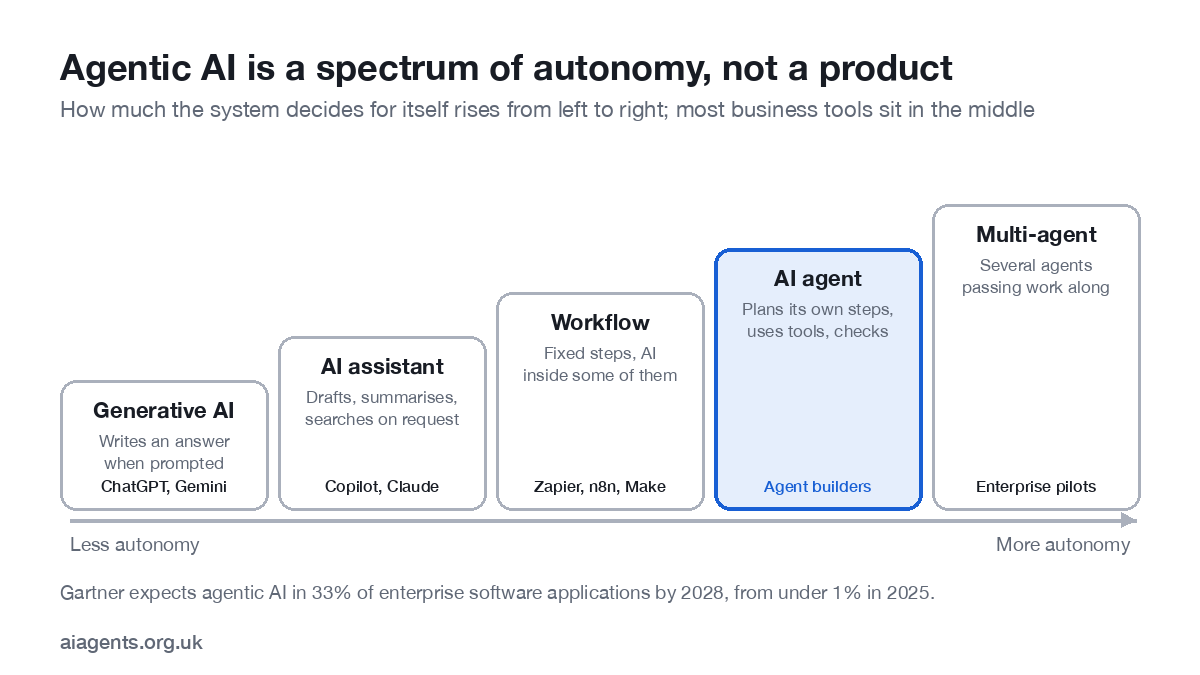
The honest answer to "what is agentic AI?" is therefore a spectrum, not a switch. A tool that drafts replies you must approve is only slightly agentic. A tool that reads your inbox overnight, answers the routine questions, flags the hard ones and files everything is substantially agentic. Both get sold under the same label, which is why the next section matters.
Agentic AI vs generative AI vs AI agents
| Term | What it is | What it does when you ask for help with invoices | Waits for you? |
|---|---|---|---|
| Generative AI | A model that produces text, images or code on request | Writes a reminder email you can copy | Yes |
| AI assistant | Generative AI plus your context and some tools | Drafts the reminder in your tone, addressed to the right client | Yes |
| Agentic AI / AI agent | A model with a goal, tools, memory and a feedback loop | Finds overdue invoices, sends reminders, waits, checks payment, chases again, reports back | No |
People searching for agentic AI usually mean the trend; people searching for AI agents usually mean the product. We treat them as one subject on this site. If you want the ground-up explanation of a single agent and how to pick one, read What is an AI agent? This page stays on the bigger picture: what the term covers, what is real, and what it means for a UK business.
How does agentic AI work?
Every agentic system runs the same loop, whatever it is called by its vendor. A goal comes in. The model breaks it into a plan. It calls a tool: looks something up, sends a message, runs a query. It reads what came back. It decides whether the goal is met; if not, it plans again. Memory sits underneath the loop so that the agent carries forward what you told it last week, which tools it may use, and what happened last time.
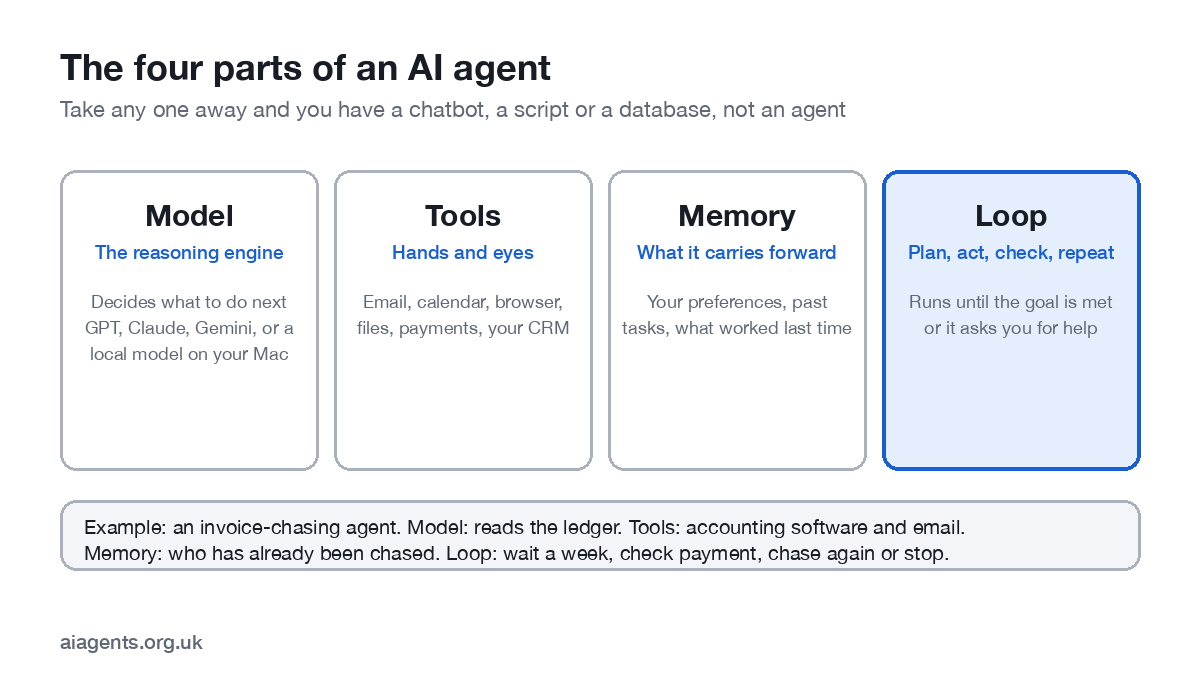
Three things in that loop decide whether an agent is useful or dangerous. Which tools it can reach: an agent that can read your calendar is low risk; one that can move money is not. Where it stops to ask: good agents are built with a short list of actions that always need a human. Whether it keeps a log: you will want to know, in detail, what it did and why, both for your own sake and for the regulator.
Workflow or agent: which do you actually need?
Anthropic, one of the main model developers, draws a line that is more useful than most marketing. A workflow is a system where the model and tools run along code paths written in advance. An agent is a system where the model directs its own process and decides which tools to use. Their advice: find the simplest solution possible and add complexity only when needed, because agents trade cost and speed for flexibility.
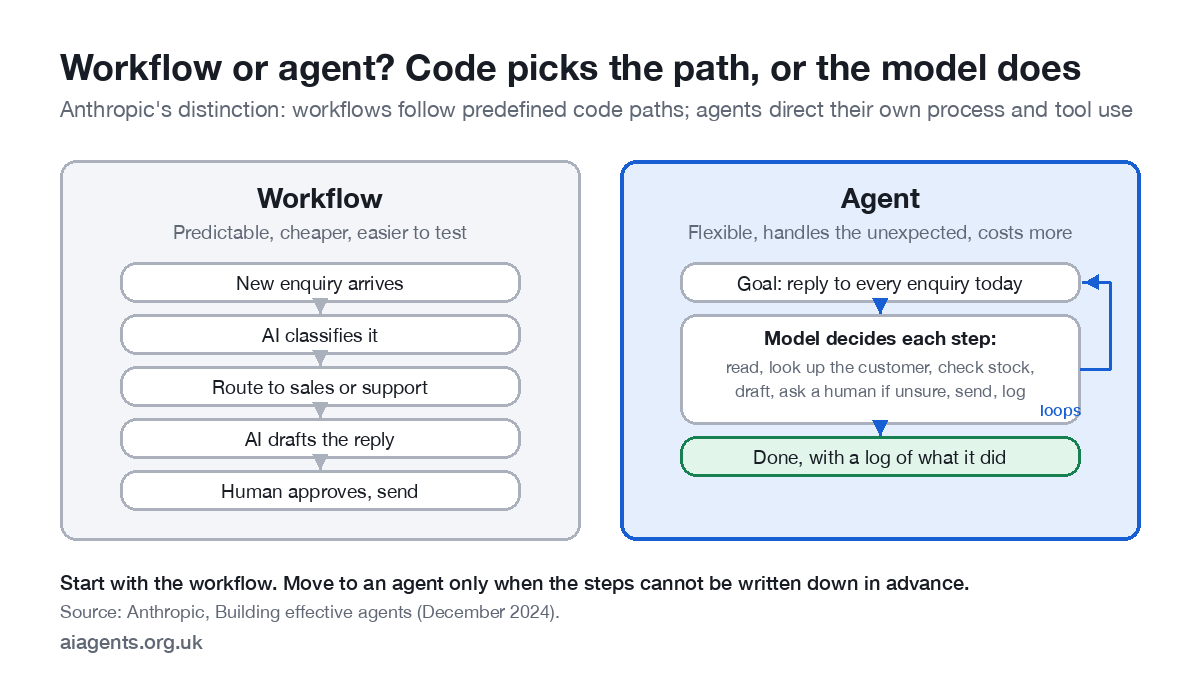
For most UK small businesses the right first project is a workflow with AI inside it: classify incoming enquiries, draft a reply, have a person approve. You get most of the benefit and all of the predictability. Move to a true agent when the steps cannot be written down in advance, for example research tasks, or when the volume of exceptions makes the fixed path break constantly.
Examples of agentic AI
The examples that work today share three traits: the task repeats, the rules are mostly clear, and a mistake is cheap to catch. Here are the eight that UK firms tend to hand over first.
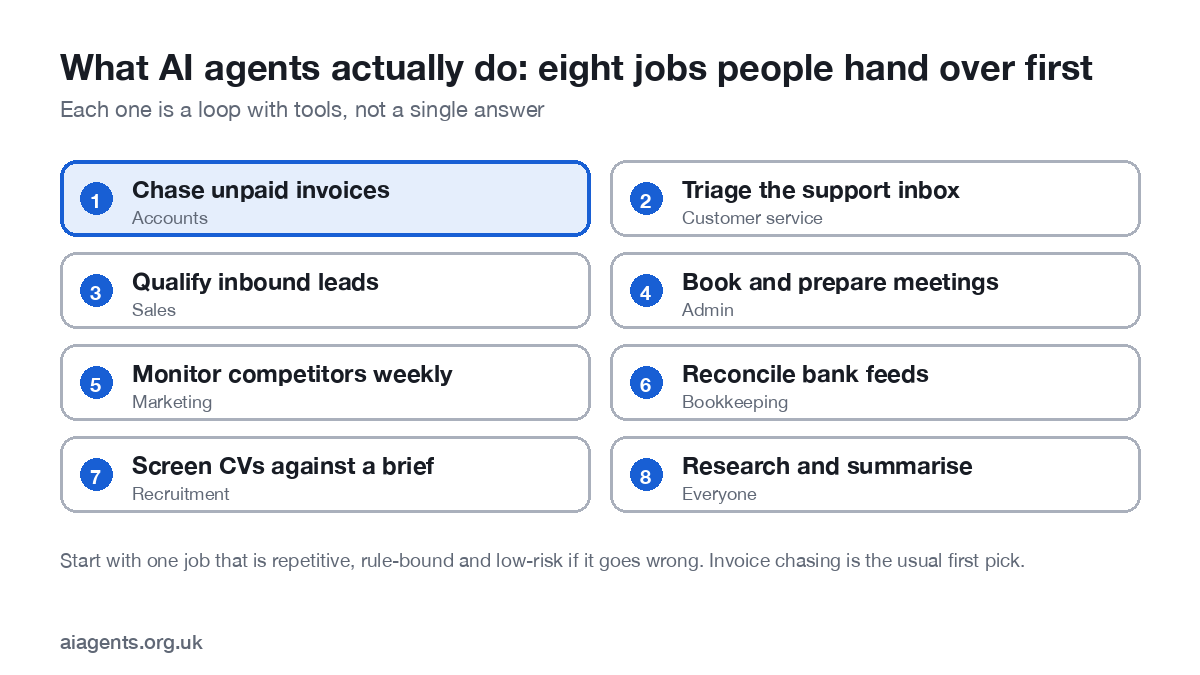
- Chasing unpaid invoices. The agent reads the ledger, sends a reminder, waits, checks payment, escalates. The loop is the point.
- Triaging a support inbox. Reads each message, answers the routine ones, routes the rest with a summary, logs everything.
- Qualifying leads. Looks up the company, checks fit against your rules, drafts a tailored reply, books the call.
- Research. Takes a question, searches dozens of sources, cross-checks, writes a cited report. "AI-powered research assistant" is one of the most searched phrasings for this.
- Coding. The most mature agentic use: tools that write, run, test and fix code. Most of the techniques used elsewhere were proven here first.
- Personal admin. Diary, inbox and reminders, run on your own machine if you prefer. See Personal AI assistant: the 2026 guide.
Agent washing: how to tell real agentic AI from relabelled software
Gartner coined "agent washing" for vendors that rename a chatbot, an assistant or a robotic-process-automation script as agentic AI. It estimated that of the thousands of vendors claiming agentic products in 2025, only around 130 were building the real thing. The label on the box tells you nothing. Four questions do.
- Can I give it a goal, or only a prompt? If every action needs a new message from you, it is an assistant.
- Which tools can it use, and can I see the list? No tools, no agent.
- Does it check its own results and retry, or does it hand back whatever came out first?
- Can I read a log of every action it took? If not, do not let it near anything that matters.
A product that passes all four is agentic. A product that passes one or two can still be useful; just price it as an assistant.
Risks, and what the ICO says
Agentic AI raises every data-protection question a chatbot does, plus some new ones, because the system acts rather than answers. In January 2026 the UK Information Commissioner's Office published its early thinking on agentic AI as part of its Tech Futures series. It stressed that the report is not formal guidance, but the direction is clear: UK GDPR applies in full, and the regulator is writing dedicated guidance on agentic systems as part of its 2026/27 workplan.
The risks the ICO named are the ones to plan around. Transparency: multi-agent data flows are hard to explain, and you must still explain them. Data minimisation: an agent with access to everything "in case it is useful" breaches Article 5(1)(c). Special category data: an agent may infer health, religion or politics without being asked to. Automated decisions: anything with a legal or similarly significant effect on a person triggers enhanced obligations and a right to human intervention. Security: new attack surfaces, including manipulation of the agent's reasoning and poisoning of its memory. Drift: an agent that learns from its environment may wander beyond its original purpose.
None of this stops a small firm from using agentic AI. It means: give the agent the narrowest access that does the job, keep a human approval step on anything irreversible, keep logs, and write down your lawful basis before you switch it on. Our full guide is AI agents and UK GDPR: what the ICO expects.
Agentic AI in the UK: adoption and what comes next
British businesses are adopting AI faster than the headlines suggest and more shallowly than the vendors suggest. The British Chambers of Commerce found 54% of firms (94% of them SMEs) actively using AI in 2026, up from 35% a year earlier; Enterprise Nation's survey of 1,320 SMEs found only 21% use it regularly, and 56% go to online search for advice. Most of that use is generic assistants. Agentic use in small firms is still early, which is why the searches for the term are overwhelmingly definitional: people are trying to understand it before buying it.
Two things will shape the next 18 months. First, the ICO's agentic AI guidance and the AI and automated-decision-making code of practice, which will turn today's principles into expectations with teeth. Second, the shake-out Gartner predicts: more than 40% of agentic projects cancelled by the end of 2027 as costs, unclear value and weak risk controls catch up with the hype. The firms that do well will be the ones that started with a narrow, boring, well-logged agent and widened its remit as trust grew.
If you would rather the whole loop ran on your own machine, with nothing leaving it, that is now practical on a modern Mac. See Run AI agents on your own Mac.
Glossary
- Agent: a system that pursues a goal by perceiving, planning and acting, with some autonomy.
- Agentic workflow: a fixed sequence of steps with AI inside some of them; predictable, cheaper, easier to test.
- Autonomous AI agent: an agent that runs without a human prompting each step; "autonomous" describes the degree, not a different kind of thing.
- Tool use (function calling): the model's ability to call software, such as sending an email or running a query, rather than only producing text.
- MCP (Model Context Protocol): an open standard for connecting agents to tools and data, so one agent can use many services.
- Memory: what the agent carries between tasks: your preferences, past results, what it may touch.
- Human in the loop: a required approval step before certain actions; the single most effective risk control.
- Multi-agent system: several agents passing work between them, for example a researcher, a writer and a checker.
- Agent washing: marketing existing software as agentic without the goal, tools, loop and log that make it so.
Frequently asked questions
What does agentic AI mean in simple terms?
Agentic AI means AI that can be given a goal and left to work out the steps, use tools and check its own results, rather than answering one message at a time. The word comes from "agency": the system has some freedom to act.
Is agentic AI the same as an AI agent?
Nearly. "Agentic AI" is the category or the capability; an "AI agent" is one system built with it. People say agentic AI when they mean the trend and AI agent when they mean the thing on their desk.
What is the difference between agentic AI and generative AI?
Generative AI produces content when asked: text, images, code. Agentic AI uses a generative model as its engine but adds planning, tools and a loop, so it can carry out a task rather than describe one.
What are examples of agentic AI?
Chasing unpaid invoices and checking whether they were paid; triaging a support inbox and drafting replies; researching a topic across many sources and producing a report; booking meetings and preparing briefs. Coding assistants that write, run and fix code are the most mature example.
Is agentic AI safe for a small business to use?
It can be, if the agent has narrow permissions, a human approves anything irreversible, and it keeps a log. The UK Information Commissioner's Office has said UK GDPR applies in full to agentic systems. See AI agents and UK GDPR.
Do I need to be technical to use agentic AI?
No. Several tools let you describe an agent in plain English. You do need to be clear about what the agent may touch and what it must ask you before doing.
Related guides
- The best new AI agents on Product Hunt, reviewed
- Types of AI agents
- 25 AI agent examples
- AI agents for small business in the UK
- AI agents and UK GDPR: what the ICO expects
Next: read What is an AI agent? for the ground-up explanation of a single agent, or go straight to what the ICO expects before you switch one on.