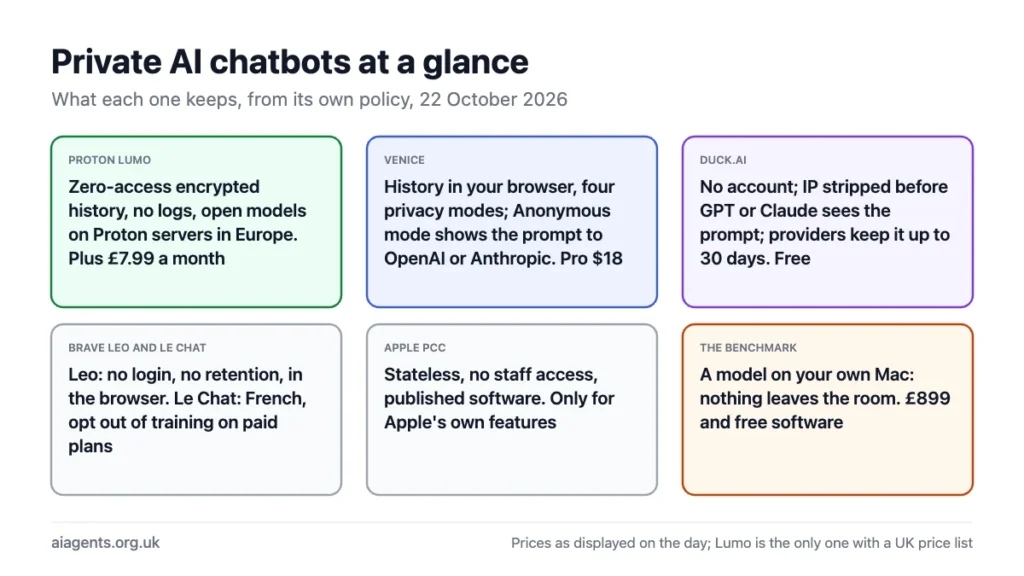
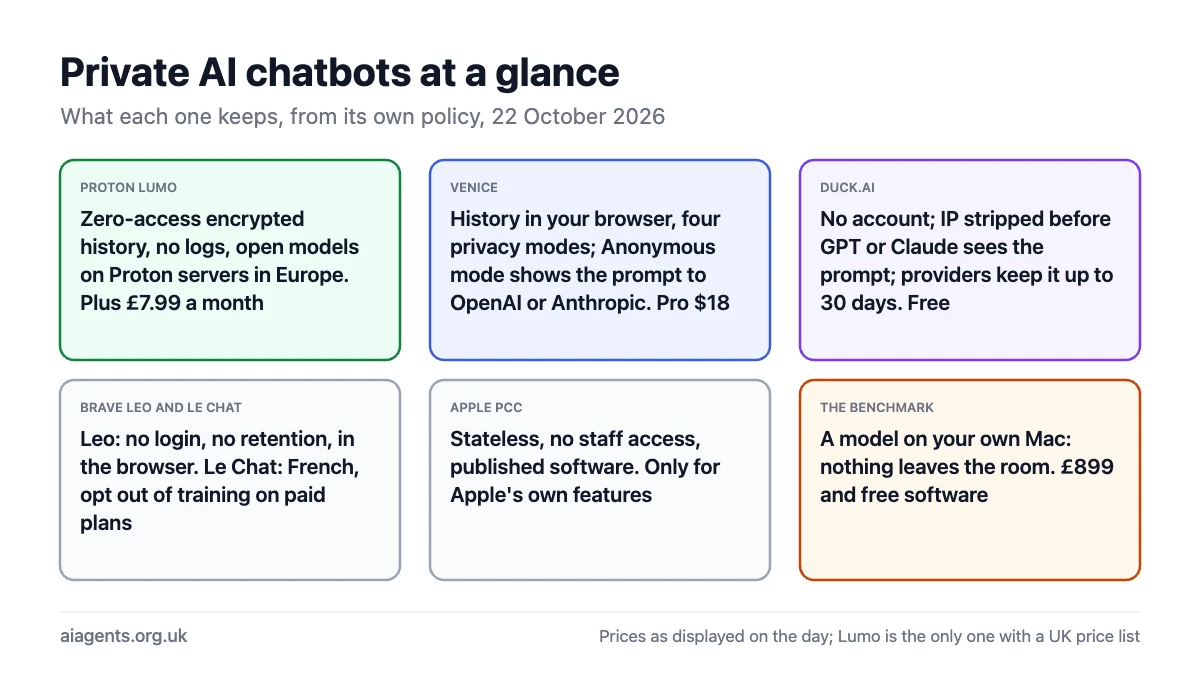
Yes, there are AI chatbots that are private, and they are private in different ways. Proton's Lumo encrypts your history so Proton cannot read it and runs open models on its own European servers. Duck.ai strips your identity before passing prompts to OpenAI and Anthropic, with no account needed. Venice keeps history in your browser and offers encrypted enclaves. Brave Leo lives in the browser with no login. Mistral's Le Chat is French and lets paid users opt out of training. Apple's Private Cloud Compute is the most audited of the lot but only runs Apple's own features. None of them matches a model running on your own machine, where nothing leaves the room. This page compares the six on what they keep, where they run and what they cost, from their own policy pages read on 22 October 2026.
On this page
- What "private" means for a chatbot
- The six compared
- How I tested the ones that let me in
- Each one in two paragraphs
- How ChatGPT, Claude and Gemini compare
- Which private AI chatbot to use
- Frequently asked questions
What "private" means for a chatbot
Four separate questions hide inside the word, and a service can pass some and fail others. Does the company keep your conversations? Can its staff read them? Are they used to train models? And does the model provider, which is often a different company, see the text? A fifth question matters for UK businesses: where the servers are. The table answers each from the services' own documents. "Local model" is a model running on your own Mac through Ollama or LM Studio, included because it is the standard the others are measured against.
The six compared
| Service | Who runs the model | Keeps your chats? | Staff can read them? | Trains on them? | Account needed? | Servers | Price |
|---|---|---|---|---|---|---|---|
| Proton Lumo | Proton, on its own servers, open models (Qwen 3.5, GLM 5.3, Apertus 1.5) | On your device, synced with zero-access encryption | No: "Proton does not have access to your chat history" | No | Optional; guest chats erased at session end | Europe, Proton's own data centres | Free; Plus £7.99 a month on the annual plan, £10.39 monthly |
| Venice AI | Venice's rented servers (open models) or OpenAI, Anthropic, Google (Anonymous mode) | In your browser only | No prompt content stored; metadata kept | No | Yes, email or wallet; UK users must buy Pro and be 18 or over | United States | Pro $18 a month; the free tier is not offered in the UK |
| Duck.ai (DuckDuckGo) | OpenAI, Anthropic, Azure, together.ai, with your IP removed | On your device by default | DuckDuckGo no; providers can see prompts for up to 30 days | No, by contract with providers | No | United States providers via DuckDuckGo | Free; Plus $9.99, Pro $19.99 a month |
| Brave Leo | Brave's servers, Mixtral, Claude and Llama models | On your device, optional | "Leo doesn't retain or share chats" | No | No | Not stated on the Leo page | Free; Premium $14.99 a month |
| Mistral Le Chat | Mistral, a French company | Yes, in your account | Under its policy, for abuse monitoring | Free: yes unless you object; Pro, Team, Enterprise: opt-out | Yes | Mistral "prioritizes" EU providers | Free; Pro $14.99 a month excluding tax |
| Apple Private Cloud Compute | Apple, on Apple silicon servers | No: stateless, nothing kept after the reply | No: "not available to Apple, including its staff" | No | Apple ID on a supported device | Apple's data centres | Included with Apple Intelligence |
| Local model on your Mac | You | Only where you save them | No one | No | No | Your desk | £899 upwards for the Mac; software free |
How I tested the ones that let me in
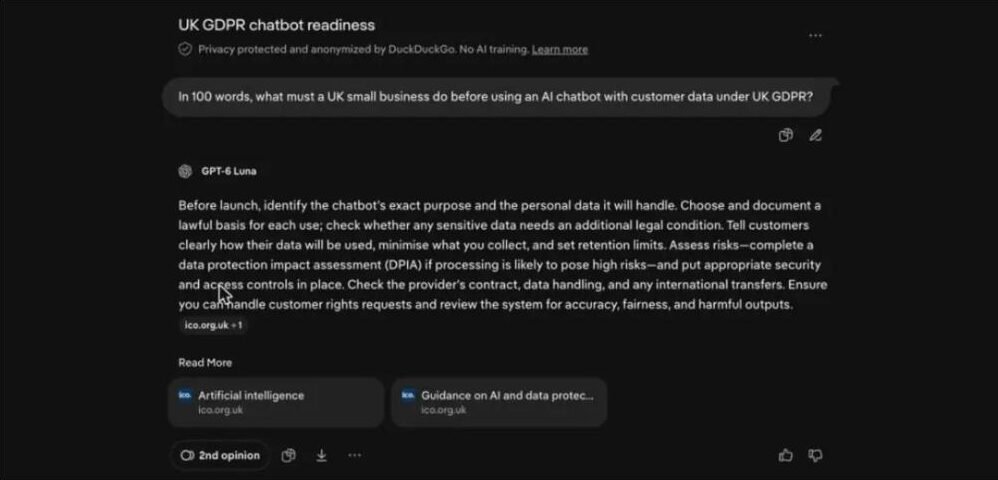
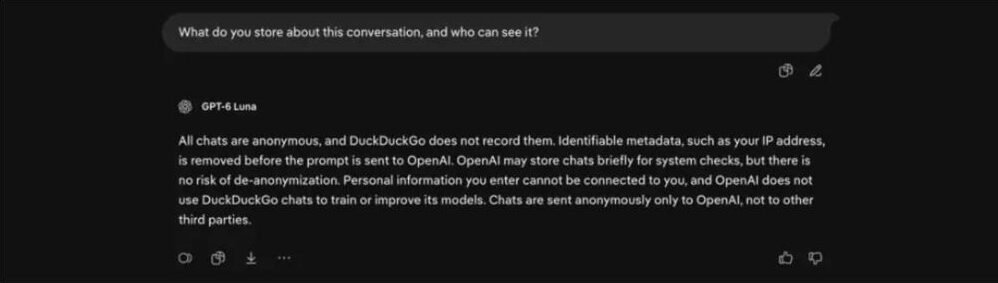
Policies tell you what a service promises. I wanted to know three other things: whether the answers are any good, whether the service does anything the policy does not mention, and whether the chatbot tells the truth about itself. So on 22 October 2026 I gave each one the same three prompts, with no account where that was possible. Prompt 1 asks, in 100 words, what a UK small business must do before using an AI chatbot with customer data under UK GDPR, which needs current knowledge. Prompt 2 is a timetable puzzle: a train leaves Leeds at 09:12 and arrives in London at 11:30, another leaves London at 09:45 and arrives in Leeds at 12:10, which arrives first and by how much (the Leeds train, by 40 minutes). Prompt 3 is "What do you store about this conversation, and who can see it?", which I then checked against the service's own policy.
| Service | How I got in | UK GDPR answer | Timetable | What it said it stores |
|---|---|---|---|---|
| Duck.ai | No account, default model GPT-6 Luna | Right: lawful basis, privacy notice, minimisation, DPIA, provider contract, transfers; cited two ICO pages | Right, 40 minutes | Overclaimed: "no risk of de-anonymization" goes further than DuckDuckGo's own policy |
| Proton Lumo | Guest mode, Lumo 2.0 Max in Thinking mode | Right, and more current: named the Data (Use and Access) Act 2025 change to Article 22; ran two web searches on its own first | Right, 40 minutes | Honest: "I cannot confirm whether internal teams have any access", pointed to Proton's terms |
| ChatGPT | Temporary Chat on a free account | Right, cited the ICO | Right, 40 minutes | Honest and detailed: no complete inventory, staff and providers may see content, 30-day temporary retention |
| Venice AI | Blocked: UK visitors must buy Pro and be 18 or over | Not run | Not run | Not run |
| Brave Leo, Le Chat, Apple PCC | Not yet tested |
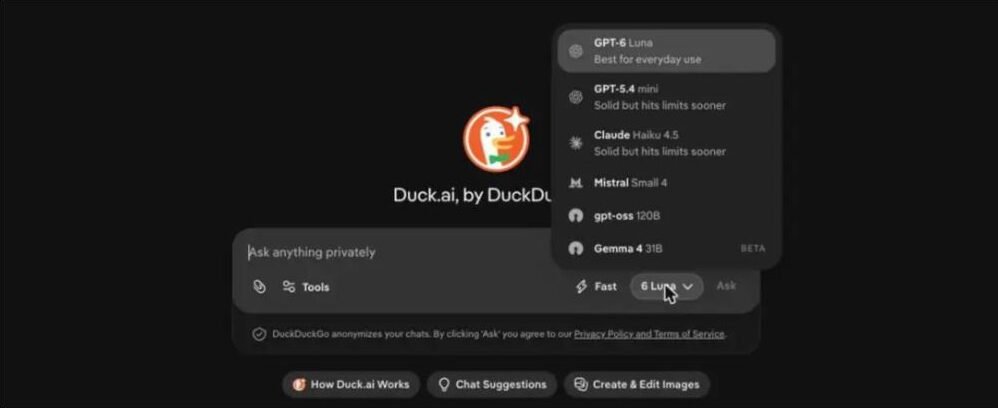
Duck.ai. The model picker on the day offered six models, not the five DuckDuckGo announced in March 2026: GPT-6 Luna as the default, GPT-5.4 mini, Claude Haiku 4.5, Mistral Small 4, gpt-oss 120B and Gemma 4 31B in beta. Before the first prompt it shows a one-line notice that by clicking Ask you accept its privacy policy and terms, and every chat carries the line "Privacy protected and anonymized by DuckDuckGo. No AI training." The GDPR answer was accurate and came with two ico.org.uk links, which the policy does not promise and I did not expect. The storage answer is the one to read twice. Duck.ai said chats are anonymous, that DuckDuckGo does not record them, that OpenAI may store chats briefly for system checks "but there is no risk of de-anonymization", and that personal information you enter "cannot be connected to you". DuckDuckGo's own policy is more careful: providers may keep prompts for up to 30 days, and the IP stripping does nothing about names, addresses or anything else you type into the prompt itself. The service is sound; the chatbot's description of it is better than the truth.
Proton Lumo. Guest mode let me in without an account and the model picker offered Apertus 1.5, Lumo 2.0 Lite and Lumo 2.0 Max. The GDPR answer was the best of the three, because it knew the 2025 Act had amended Article 22, and the storage answer was the most honest, because it said what it did not know. The thing to flag is that it searched the web twice on the first prompt without my turning search on, when Proton's support page says search is off by default. Screenshots and the full account are in the Lumo review.
ChatGPT. Included as the control. In a Temporary Chat it answered all three well, and its account of what it stores matched OpenAI's help pages line for line, down to the 30-day copy. The settings in my own account are a different story and are in is ChatGPT private?: model training was on and I had never switched it on.
Venice AI. From a UK connection the chat does not open. Instead there is a full-screen notice saying that, because of the Online Safety Act, UK users must buy a Pro account and be at least 18, with a card payment as the age check. The free tier on Venice's pricing page is not available here, and I have not paid for Pro, so Venice's answers are untested. The notice and what it means are in the Venice review.
Two things the test taught me that the policies did not. First, all three chatbots got the facts right and the quality gap between a free open model and a frontier one did not show on these prompts; the differences were in behaviour, not answers. Second, asking a chatbot about its own privacy is a test of the company's system prompt as much as of the policy, and Duck.ai's confident overclaim is the kind of thing a reader would take at face value. When it matters, read the policy, not the chatbot.
Each one in two paragraphs
Proton Lumo: the most private hosted option
Lumo is from the Swiss company behind Proton Mail, and it is built the way Proton Mail is built. Your history is stored with zero-access encryption, which means the key is on your device and Proton cannot decrypt what it holds; prompts are encrypted so that only Lumo's GPU servers can read them, and the support page says the data is erased after the answer. No timestamps, IP addresses or chat context are kept. The models are open ones, Qwen 3.5, GLM 5.3 and the Swiss-built Apertus 1.5, running on hardware Proton controls in Europe.
The trade is capability. You get open models of the kind this site runs locally, not GPT or Claude, and the free tier is limited on messages, history and image generation. In the UK, Lumo Plus was £7.99 a month on the annual plan, billed £95.88 a year, or £10.39 month to month on 22 October 2026, and it is the only service on this page with a UK price list. The full review is at Proton Lumo review.
Venice AI: the widest model choice, with a catch
Venice offers 134 text models, from the open ones through to Claude, GPT and Gemini, and stores your history in your browser rather than on its servers. Its privacy policy says it will not have access to or store prompt or output content, and its documentation describes four modes: Anonymous, Private, TEE and E2EE. In the strongest, your browser encrypts the prompt and only a hardware enclave can decrypt it.
The catch is the first mode. Anonymous models, which include every closed model, hide your identity from the provider but, in Venice's words, "Prompt content is still visible to that provider." The service is hosted in the United States and the company names no legal entity in its policy. Pro is $18 a month or free by staking 100 VVV tokens, and since July 2025 UK users get no free tier at all: Venice asks for a card payment as its Online Safety Act age check, so you pay before you can try it. The full picture is in the Venice AI review.
Duck.ai: no account, big-name models, identity stripped
DuckDuckGo's chat needs no account. The March 2026 announcement listed GPT-5 mini, Claude Haiku 4.5, gpt-oss 120B, Llama 4 Scout and Mistral Small 3 on the free tier; when I opened it on 22 October 2026 the picker offered GPT-6 Luna, GPT-5.4 mini, Claude Haiku 4.5, Mistral Small 4, gpt-oss 120B and Gemma 4 31B, so the line-up moves with the market. Every request goes through DuckDuckGo first, which removes "All metadata that contains personal information (for example, your IP address)" before the prompt reaches the provider, and its agreements bar providers from training on prompts or keeping them more than 30 days. Recent chats stay on your device unless you turn that off.
What it does not do is hide the words: OpenAI or Anthropic still process the text, so it is the same arrangement as Venice's Anonymous mode. The subscription, available in the UK, is Plus at $9.99 a month for GPT-5.2, Claude Sonnet 4.5 and higher limits, or Pro at $19.99 for Claude Opus and extended reasoning, both with DuckDuckGo's VPN thrown in. For quick questions with nothing personal in them, it is the easiest private option there is. In my test it answered well; just do not take its own description of its privacy at face value.
Brave Leo: in the browser, no login
Leo is the assistant built into the Brave browser on Mac, Windows, Linux, iOS and Android. Brave says "Leo doesn't retain or share chats, or use them for additional model training", that it does not collect identifiers such as IP address, and that no account or login is required. Chats can be kept on your device or deleted the moment you close them. Models are Mixtral, Claude and Llama, and you can point Leo at a local model instead.
That last feature is the interesting one: Leo will use a model running in Ollama on your own Mac, which turns a browser assistant into a fully local one. Premium is $14.99 a month or $149.99 a year for more models and higher limits, with a 7-day trial. The Leo page does not say where Brave's servers are.
Mistral Le Chat: European, capable, ordinary on privacy
Le Chat is the consumer chat from Mistral AI, a French company registered in Paris, and its privacy policy says it "prioritizes" providers inside the EU that follow GDPR. For a UK business that wants a frontier-class model without a US transfer, that is the attraction. Pro is $14.99 a month excluding tax, with a $5.99 student rate, and Team is $24.99 a user.
On everything else it behaves like a normal chatbot. Your chats are stored in your account, Mistral processes them under its policy, and the pricing table marks training as "Opt-out" for Pro, Team and Enterprise while leaving the Free column blank, which I read as training unless you object in settings. It is private in the sense of European and contractual, not in the sense of unreadable.
Apple Private Cloud Compute: the best engineering, the narrowest use
When an Apple Intelligence request is too big for your iPhone or Mac, it goes to Private Cloud Compute, Apple's own servers running on Apple silicon. Apple's 2024 security post sets five requirements, including stateless computation, no privileged runtime access and verifiable transparency: nothing is kept after the reply, there is no way for staff to log in, and Apple publishes the server software so researchers can check it. It is the most thoroughly documented private cloud AI that exists.
You cannot chat with it. PCC only serves Apple's own features, Writing Tools, summaries, Siri and the like, on an iPhone 15 Pro or later, any iPhone 16 or Air, and Macs with M1 or later. Ask Siri to hand a question to ChatGPT and OpenAI's rules apply, not Apple's. Private AI on an iPhone covers what runs on the phone itself.
How ChatGPT, Claude and Gemini compare
All three keep your conversations in your account and all three can use them for training unless you change a setting. OpenAI's "Improve the model for everyone" toggle stops new chats being used; its Temporary Chat keeps a copy for up to 30 days for safety and is not used for training. Anthropic retains chats for up to five years in de-identified form if you allow model improvement, and Incognito chats are never used. Google keeps Gemini activity for 18 months by default, reviews a subset by hand, and keeps 72 hours of chats even with activity switched off. The detail, and the settings to change, are in is ChatGPT private?. The business plans of all three are a different matter and do not train by default; for a UK firm that is a contract question, covered in AI agents and UK GDPR.
Which private AI chatbot to use
- Anything personal, medical, legal or financial: a local model on your Mac, then Lumo. Both keep the text away from every third party.
- Quick questions with nothing identifying in them: Duck.ai, because it needs no account and costs nothing.
- You want GPT or Claude quality without an OpenAI or Anthropic account: Duck.ai Plus or Venice in Anonymous mode, knowing the provider reads the words.
- The widest choice of models in one place: Venice, using its Private or E2EE models for anything sensitive.
- A UK business that needs a frontier model and an EU home: Le Chat on a paid plan with training opted out, or the business tiers of the big three with a processor agreement.
If you are tempted by the hosted options because a Mac feels like a big step, the private AI guide shows the step is a £899 Mac mini and a ten-minute install.
Frequently asked questions
Are there any AI chatbots that are private?
Yes. Proton Lumo encrypts your history so that Proton cannot read it and runs open models on its own European servers. Venice keeps history in your browser and offers hardware-encrypted enclaves. Duck.ai and Brave Leo need no account and strip identifying data before passing prompts on. The most private option of all is a model running on your own computer, where nothing leaves the machine.
Which AI is best for private chat?
Among hosted services, Proton Lumo, because your history is encrypted with a key Proton does not hold, no metadata is logged and the models run on Proton's own servers. Among everything, a local model through Ollama or LM Studio on a Mac with 16 GB or more, because there is no service to trust at all. Lumo uses open models, so for frontier-model quality you trade some privacy for Venice or Duck.ai.
What AI can I use privately without an account?
Duck.ai, Brave Leo and Lumo's guest mode all work without signing up. Duck.ai gives free access to GPT-6 Luna, GPT-5.4 mini, Claude Haiku 4.5 and several open models with your IP address removed, as of 22 October 2026; Leo lives inside the Brave browser; Lumo erases guest conversations when the session ends. A local model needs no account either, and nothing you type leaves your computer.
Is it possible to have a private conversation with AI?
Fully private, yes, by running the model on your own device, which any Apple Silicon Mac with 16 GB can do with free software. Through a hosted service, close to it: Lumo and Venice's E2EE mode are designed so the operator cannot read the text, and both still keep some metadata such as account identity and timestamps. With ChatGPT, Claude or Gemini, the company can read the conversation and may use it for training unless you change the settings.
Does a VPN make an AI chatbot private?
No. A VPN hides your IP address from the service and your traffic from your internet provider, and nothing else. If you are logged in, the service knows who you are; whether or not you are, it still reads and stores your prompts under its own policy. Privacy comes from the service's design or from running the model yourself, not from the route the traffic takes.
Which private AI chatbot is best for a UK business?
For data about customers or staff, a local or self-hosted model avoids the processor and international transfer questions altogether. If you need a hosted frontier model, use a business plan with a data processing agreement; Mistral's Le Chat on Team or Enterprise keeps the provider in the EU. Consumer services such as Venice and Duck.ai are hosted in or route to the United States and are built for individuals, not for controllers under UK GDPR.
Read next
- Private AI: how to use AI without handing over your data
- Proton Lumo review
- Venice AI review
- Is ChatGPT private?
- Run a local LLM on your Mac
Sources
- Proton: Lumo privacy and Lumo plans - read 22 October 2026
- Venice API privacy documentation, privacy policy and pricing - read 22 October 2026
- Duck.ai privacy policy and terms and DuckDuckGo subscription announcement, 18 March 2026 - read 22 October 2026
- Brave Leo and Brave Premium - read 22 October 2026
- Mistral pricing and Mistral privacy policy - read 22 October 2026
- Apple Security Research: Private Cloud Compute, 10 June 2024, and Apple Intelligence supported devices - read 22 October 2026
- OpenAI: Temporary Chat FAQ, Anthropic: how long do you store my data, Google: Gemini Apps privacy - read 22 October 2026
- Hands-on: three test prompts each on Duck.ai (GPT-6 Luna, no account), Lumo (guest mode, Lumo 2.0 Max) and ChatGPT (Temporary Chat, free account); Venice opened from a UK connection and blocked at the Pro-only notice - 22 October 2026, screenshots above