What UK adults actually do with AI
Headlines about AI tend to arrive as numbers with a long fuse. The Guardian reported research suggesting that up to three million low-skilled UK jobs could disappear by 2035 because of automation and AI. A BBC News headline said AI could impact a million jobs in London. Both describe projections and possible impact. Neither counts jobs that have already gone.
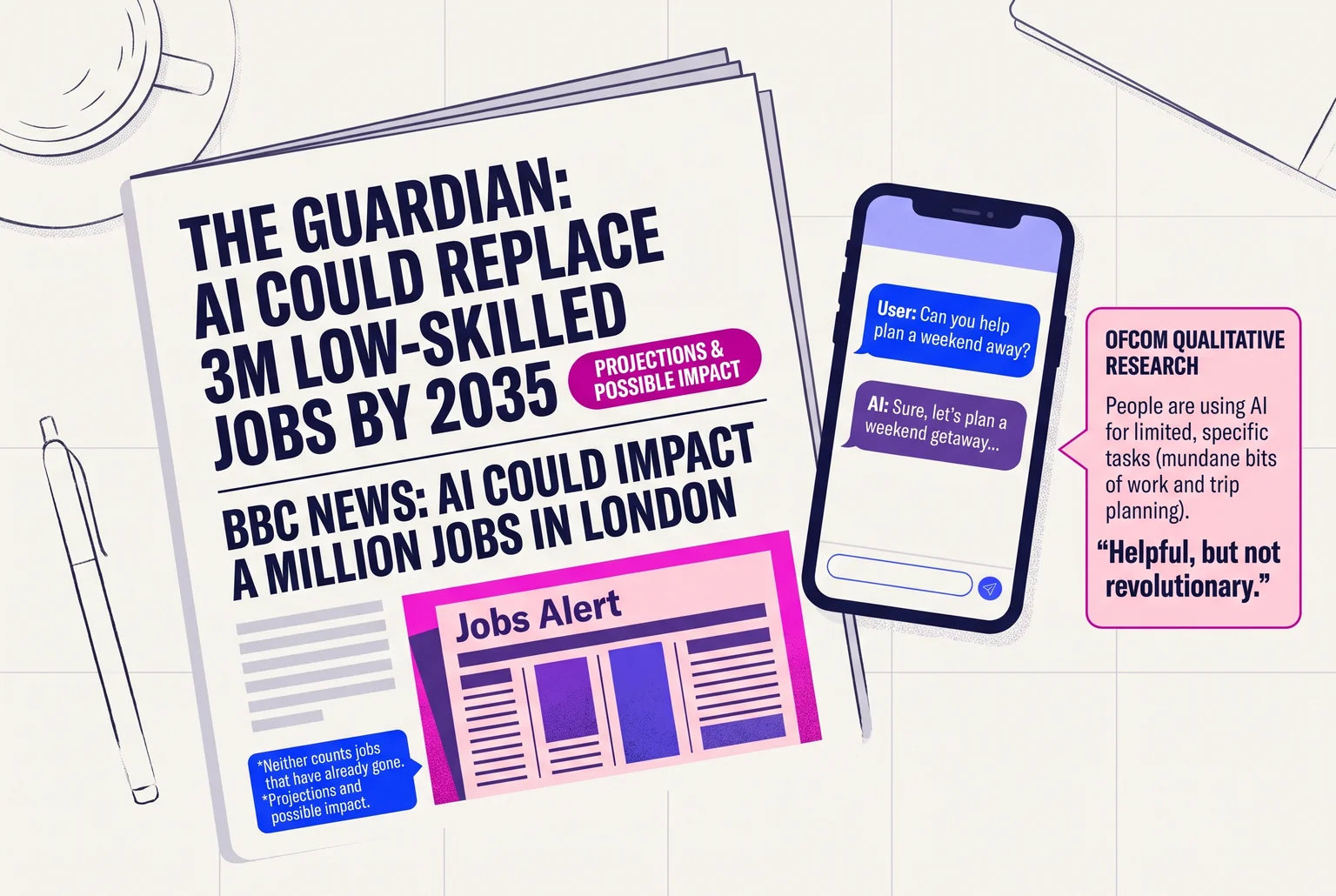
Meanwhile, the person reading those headlines may have asked a chatbot to help plan a weekend away. Ofcom's qualitative research found people using AI for limited, specific tasks, such as mundane bits of work and trip planning. Participants could find it helpful without seeing it as revolutionary.
This post looks at that everyday layer, using recent UK survey data from bodies such as Ofcom, the ONS and the Department for Science, Innovation and Technology. It sticks to what people report doing rather than what analysts predict they will do.
A quick definition helps. "AI" here means the tools people actually meet: chatbots such as ChatGPT and Gemini, voice assistants on phones and smart speakers, and the recommendation systems that suggest what to watch or buy next. Some of these people choose to use. Others work quietly in the background.
Dates matter, because the figures move fast. Ofcom's 2025 report said 31% of UK adults claimed to have used AI tools such as ChatGPT or Gemini, up from 23% in 2023. The report came out in May 2025, but the fieldwork ran from September to November 2024. The figure is also self-reported. It does not tell you how often people use AI, or whether they use it daily.
It is no longer Ofcom's latest number, either. A later Ofcom report, published in April 2026 with fieldwork in autumn 2025, put the share of UK adults using AI tools at 54%. That is a big jump in about a year, and the next section starts from there.
Four surveys, four different answers
Ask how many people in the UK use AI and you get a spread of numbers, because each survey asks a different question of a different group at a different time.
The Office for National Statistics asked adults in Great Britain whether they had knowingly used AI in the previous 12 months. In its June 2026 release, 41% said they had for work or education, 27% at home and 23% for hobbies or interests. A third, 33%, said they had not knowingly used AI at all. Those settings overlap, since one person can use AI at work and at home, so the figures cannot be added together. The word "knowingly" also leaves out the AI running quietly inside other apps.
The Department for Science, Innovation and Technology (DSIT) asked only about chatbots. In its Wave 4 tracker, 60% had used a chatbot for personal or work purposes in the previous three months. That includes people who tried one once. Frequency is where it gets more useful: 44% used a chatbot at least monthly and 23% at least weekly. Monthly use was 40% for personal purposes and 28% for work.
Ofcom's earlier numbers sit lower again because they cover internet users and a narrower idea of use. Its June 2024 survey found that 41% of UK internet users aged 16 and over had used a generative-AI tool in the past year, and 18% in the past month. Its 2025 report measured ChatGPT reach at 13% of UK adult internet users in May 2025. That counts one service in one month, so it is not an estimate of everyone using generative AI.
Put side by side, the numbers do not conflict so much as answer different questions. "Have you ever tried it" produces a high figure. "Did you use it this month" produces a lower one. "Did you use it this week" is lower still. The DSIT chatbot data shows that drop clearly, from 60% in three months to 23% weekly.
The ONS also shows a sharp split by age. 63% of 16 to 29-year-olds and 60% of 30 to 49-year-olds had used AI for work or education, compared with 27% of 50 to 69-year-olds and 3% of people aged 70 and over. Age is the clearest dividing line in these figures, and the fuller picture of who uses AI and who stays away comes later.
None of the sources gives a single current rate for the whole country. The most defensible summary is that a majority of adults have tried a chatbot recently, around a quarter use one weekly, and a sizeable minority have not knowingly used AI at all.
What UK adults use AI for: answers, writing and ideas
Among people who use AI, the most common reasons are practical. In Ofcom's 2026 adults survey, 47% of AI users gave work or education as a reason, 45% said finding factual information, 43% curiosity, 39% writing or editing and 38% fun or creative tasks. People could pick several, so the shares overlap. Someone checking a fact on their lunch break and drafting an email in the afternoon is counted twice.
Looking things up sits near the top in other surveys too. In a YouGov study of recent generative-AI users, 46% used it for quick answers or lightweight fact-finding and 44% for writing support. The typical use is small: what a word means, how long to roast a chicken, how to word a polite complaint to a landlord.
Writing is the clearest single task. Among generative-AI users in DSIT's online sample, 58% had used it to write or edit documents, ahead of 46% who used it for work and 40% who used it to create or edit images, video or sound. That online sample is made up of people already comfortable on the internet, so it likely overstates how common this is across the whole population.

The same DSIT survey asked why people use it. The top answer was saving time, at 65%. Getting ideas or inspiration followed at 55%, and summarising or explaining something at 48%. Summarising ranks lower than writing, but nearly half of users still lean on it to turn a long document or a confusing topic into something shorter.
Voice assistants belong in a separate category. Ofcom reported that 54% of adults had used one in the previous three months, which is a different measure from chatbot use and covers a different kind of technology. Among daily digital-assistant users in YouGov data, the tasks are playing music (67%), checking the weather (62%) and setting timers or alarms (49%). Asking a smart speaker for a kitchen timer is far more common than asking a chatbot for a business plan, but the two sets of figures should not be added together or ranked against each other.
The same goes for AI summaries at the top of search results and for people actively searching with an AI tool. Each is measured separately, so a single league table of everyday tasks would mix questions that were never asked the same way.
Translation and meal or trip planning are familiar uses, but these surveys give no UK-wide figure for either. The tasks with numbers behind them are looking things up, writing and editing, getting ideas, summarising, and creative work, roughly in that order of how often people report them.
How AI shows up in jobs and degrees
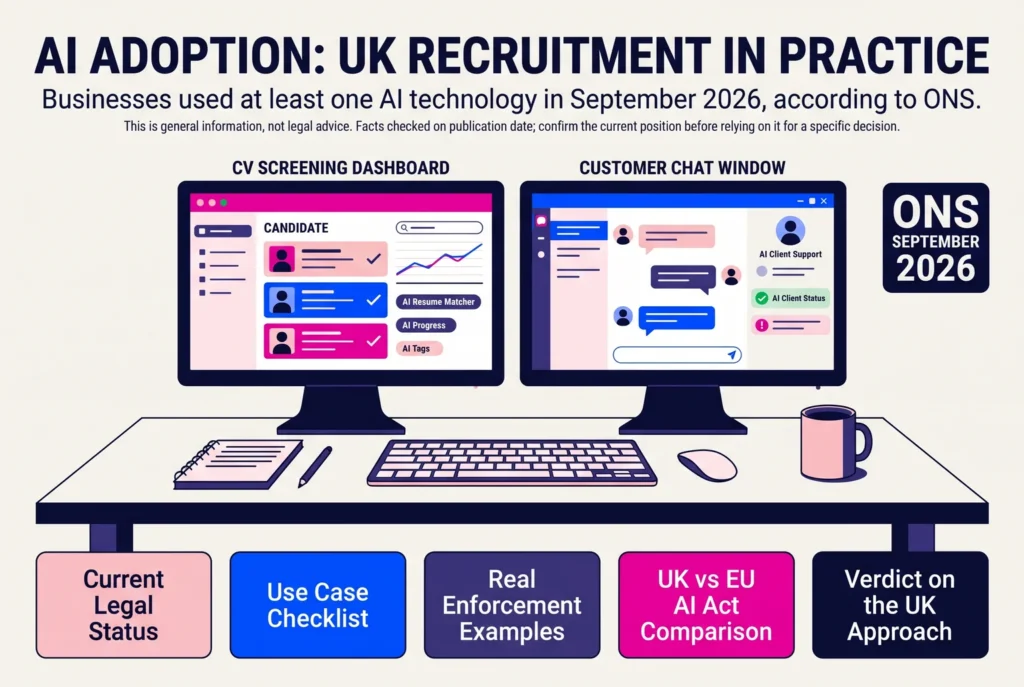
At work, the numbers depend on who is being asked. ONS reported that 30% of businesses used at least one AI technology in September 2026, rising to 38% among businesses with 10 or more employees. That is a business-level figure, and ONS treats the estimates as official statistics in development.
Workers give a different picture. In YouGov's 2026 survey, 32% of workers in Britain said they used AI for their current job. Employers report higher numbers, but they are counting something else. CIPD found that employers at 76% of organisations said employees used AI. One employee in an organisation of hundreds is enough to count, so that figure says little about how many individual workers are involved.
The more telling detail is who sets the rules. Among employee AI users in the YouGov survey, 71% used tools their employer neither required nor banned, and 25% said their organisation required some AI use. Most workplace use, in other words, is individual choice rather than a company programme.

Education shows the same pattern at a larger scale. HEPI's 2026 survey found that 95% of full-time UK undergraduates used AI in at least one way and 94% had used generative AI to help with assessed work. A year earlier the figures were 92% and 88%. Using it for help is not the same as handing it over, though. Some 12% of students said they had directly included AI-generated text in assessed work.
Younger pupils are using it too. Ofcom found that 56% of children aged 8 to 17 had used AI, and 51% of those users said they used it for schoolwork or homework.
These surveys cover different groups, dates and methods, so they should not be stacked into one national figure. They agree on the direction. Classrooms and lecture halls are further ahead than most offices, and in both, much of the use is happening without an official policy telling people to do it.
Age, education and region: who uses AI and why some don't
Age shows the widest gap. DSIT found that 59% of UK adults had used generative AI in the previous three months, with use at 75% or higher among adults under 45, 18% among those aged 75 to 84, and 8% among those aged 85 or over. Ofcom's separate tracker points the same way, with AI-tool use at 79% of 16 to 24-year-olds and 74% of 25 to 34-year-olds. Ofcom measures AI tools more broadly, so its figures can't be compared directly with DSIT's.
Education matters too. Use was 75% among people with degree-level qualifications or above, 48% among those with another qualification, and 19% among those with none. Region varies less, from 69% in London to 51% in North East England. These are descriptive associations. They don't show that age, qualifications or location cause the differences.
Income is harder to pin down, because the DSIT results don't break use down by individual income. A Turing Institute study of parents and carers offers a rough proxy: 61% of respondents in social grades ABC1 reported household generative-AI use, against 44% in C2DE. That describes households with children, not adults in general.
Non-users mostly give practical reasons. In DSIT's online follow-up, 44% said they preferred to do things without AI, 33% cited privacy or security concerns, 32% said they didn't know enough to use it, and 31% worried about inaccuracy. People could pick several answers, so the shares overlap. Ofcom's 2024 survey found a similar mix of indifference: among internet users who had never used a generative-AI tool or were unsure, 38% said they were not interested and 35% did not feel the need.
Many people who stay away, then, have simply decided they don't need it.
Using AI while doubting it: what UK adults worry about
Use and worry sit side by side in the same people. A YouGov survey found that 93% of British adults reported at least one concern about AI, while 51% used AI tools at least weekly. Few people seem to treat concern as a reason to stay away.
The concerns are specific. In DSIT's 2025/26 survey, 74% cited potentially inaccurate information as a risk, 69% privacy and security, 64% false or misleading information, and 63% job losses. Jobs worry people in particular ways. King's College London reported that 57% of the public thought AI would lead to widespread unemployment, and 69% of workers were worried about the economic impact of AI job losses. These measure different things: perceived risk, expected unemployment and personal worry are not the same estimate.
The positive side is smaller but real. In the same DSIT survey, the leading perceived benefit was easier access to information or advice, cited by 47%. An earlier DSIT tracker found 43% expected AI to have a positive impact on society overall and 33% a negative one.

Caution is clearest with news and fakes. Among adults aware of AI, 57% would trust an AI-written news story less than a human-written one, 27% about the same and 7% more. In Ofcom's 2024 poll, 43% said they had seen at least one deepfake online in the previous six months, while 9% were confident identifying one.
Later Ofcom data shows 44% feeling confident they can tell whether content was made by a person or AI, with 24% not confident. Confidence is self-reported and may not match how well people spot AI content. Labels have wide support, with 85% backing platforms attaching AI labels to content, though only 34% said they had ever seen one.
Where the press is right, and where it runs ahead of the numbers
Headlines about wide adoption are broadly correct. DSIT found that 56% of UK adults had used text- or speech-generating AI in the previous three months, and 59% had used at least one broader generative-AI category. The caveat is who those people are. Use reached 75% or more among adults under 45 but only 18% of 75 to 84-year-olds and 8% of those aged 85 or over, so "everyone is using AI" describes younger adults far better than the whole country. DSIT's detailed activity and frequency results also came from online respondents only, which leans the picture towards people already comfortable online.
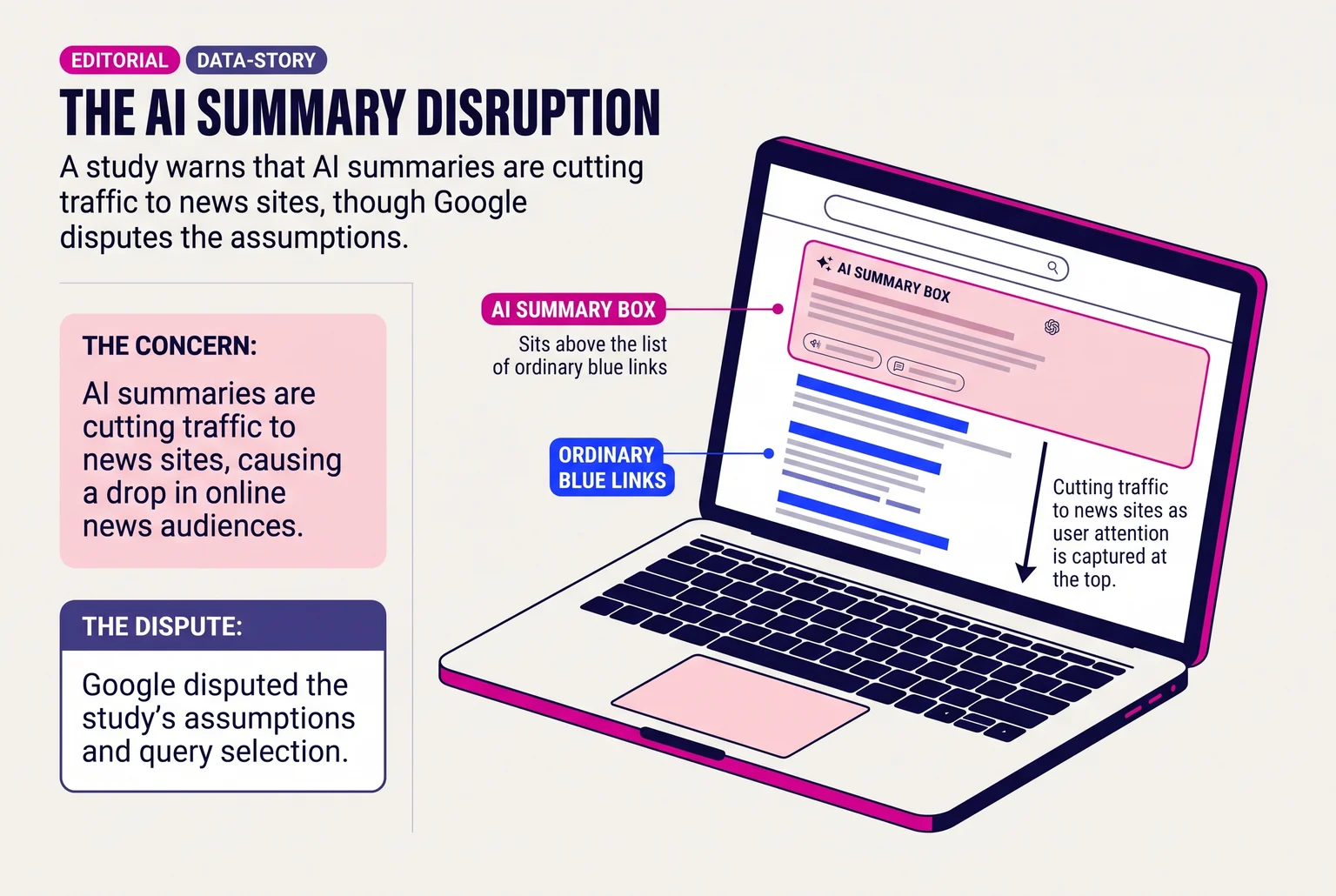
Search is a similar case. Ofcom reported that 82% of adults used Google Search and 53% often saw AI summaries in results, usually without looking for them. AI is being added to search, and nothing in the data shows it replacing the old kind. Ofcom's separate qualitative study used 24 online interviews and could not reliably pin down what participants meant by "AI search". The Guardian's report of an Authoritas estimate that AI summaries are cutting traffic to news sites is a fair concern for publishers, though the paper also noted that Google disputed the study's assumptions and query selection.
Jobs is where headlines stretch furthest. City A.M.'s line that AI will take half of UK entry-level jobs reports a prediction attributed to Anthropic's CEO, not an employment outcome. Sky's list of the 40 jobs most at risk draws on Microsoft research that, by Sky's own account, looked at where chatbots could be useful, not which jobs would be replaced. Public worry is real, with 63% in DSIT's survey naming job loss as a risk, but that counts concern, not jobs lost.
The forecasts may yet prove right. The survey data just measures something else: what people are doing this month.
Trying AI sensibly, and reading the numbers
Roughly half of UK adults use AI in some form, but the exact figure depends on who asked what. Ofcom put it at 54%, DSIT at 59% for generative AI, and ONS found 33% reporting no known AI use over 12 months. Each survey used its own definitions, time periods and populations, so check the date and the wording before comparing any two.
If you want to try it, start with a low-stakes task such as tidying an email. Check anything that matters against an authoritative source, since the NCSC warns that chatbots can give convincing but incorrect answers. Keep sensitive details out of public tools. For health, money or legal decisions, ask a qualified person, as Which? advises against relying on chatbots for high-stakes advice.
Choosing not to use it is also common, and the surveys show plenty of company.
Sources
- AI could replace 3m low-skilled jobs in the UK by 2035, research finds — The Guardian
- Adults’ media use and attitudes 2025 — Ofcom
- Passive social media use, AI companionship, and online side hustles: UK adults’ media and online lives revealed — Ofcom
- Public opinions and social trends, Great Britain: June 2026 — Office for National Statistics
- Public attitudes to data and AI tracker survey: Wave 4 report — Department for Science, Innovation and Technology
- Online Nation 2024 — Ofcom
- Online Nation 2025 — Ofcom
- Adults’ Media Use and Attitudes 2026 — Ofcom
- Are British users open to seeing ads on generative AI platforms? — YouGov
- DSIT Public Engagement Survey 2025/26 — Department for Science, Innovation and Technology
- Audio Listening in the UK 2025 — Ofcom
- 30% of Brits use digital assistants daily — here’s what they’re doing — YouGov
- Business insights and impact on the UK economy: 8 October 2026 — Office for National Statistics
- How are Britons using AI at work? — YouGov
- Labour Market Outlook: Autumn 2025 — CIPD
- Student Generative AI Survey 2026 — Higher Education Policy Institute
- Children and Parents: Media Use and Attitudes Report 2025–26 — Ofcom
- Understanding the impacts of generative AI use on children — WP1 report — The Alan Turing Institute
- DSIT Public Engagement Survey 2025/2026 — full report — Department for Science, Innovation and Technology
- Britons are concerned about AI but half still use it every week — YouGov
- One in five Britons think AI will create civil unrest, study finds — King’s College London
- Public Attitudes to Data and AI Tracker: Wave 4 key findings — Department for Science, Innovation and Technology
- Deepfakes: demean, defraud, disinform — Ofcom
- How can tech firms help users spot deepfakes? — Ofcom
- From apps to AI search: how the UK goes online in 2025 — Ofcom
- AI summaries causing ‘devastating’ drop in online news audiences, study finds — The Guardian
- Tech boss: AI will take half of entry-level jobs in the UK — City A.M.
- The 40 jobs most at risk of AI – and 40 it can’t touch — Sky News
- Adults’ media use and attitudes — Ofcom
- ChatGPT and large language models: what’s the risk? — National Cyber Security Centre
- Can you trust AI? ChatGPT and other AI chatbots put to the test — Which?