30% of UK businesses used AI in September 2026, up from 9% in September 2023, according to the Office for National Statistics. More than half of UK adults (54%) now use AI tools such as ChatGPT, Copilot or Gemini, according to Ofcom. Business use rises with size: 29% of firms with fewer than 10 staff, 38% with 10 or more, and 51% of the largest. Use of AI agents, which act on their own rather than answer questions, is still early, and no official UK figure measures it separately yet. This page brings together the most reliable UK figures, explains why different surveys disagree, and is updated as new data is published.
UK AI statistics at a glance
- 30% of UK businesses used AI in September 2026, up from 9% in September 2023 (ONS).
- 51% of businesses with 250 or more staff use AI; 29% of those with fewer than 10 (ONS).
- 60% of information and communication businesses use AI, the highest of any industry (ONS).
- 54% of UK adults use AI tools, rising to 79% of 16 to 24-year-olds (Ofcom, 2026).
- 6% of AI-using firms with 10 or more staff cut headcount because of AI; under 1% added staff (ONS).
- Over 40% of agentic AI projects will be cancelled by the end of 2027, Gartner predicts.
On this page
- How many UK businesses use AI?
- Why do the surveys disagree?
- How many UK adults use AI?
- What is AI doing to UK jobs?
- How many businesses use AI agents?
- AI in UK accountancy
- Trust and regulation
- Download the data and cite this page
- Frequently asked questions
- Sources
How many UK businesses use AI?
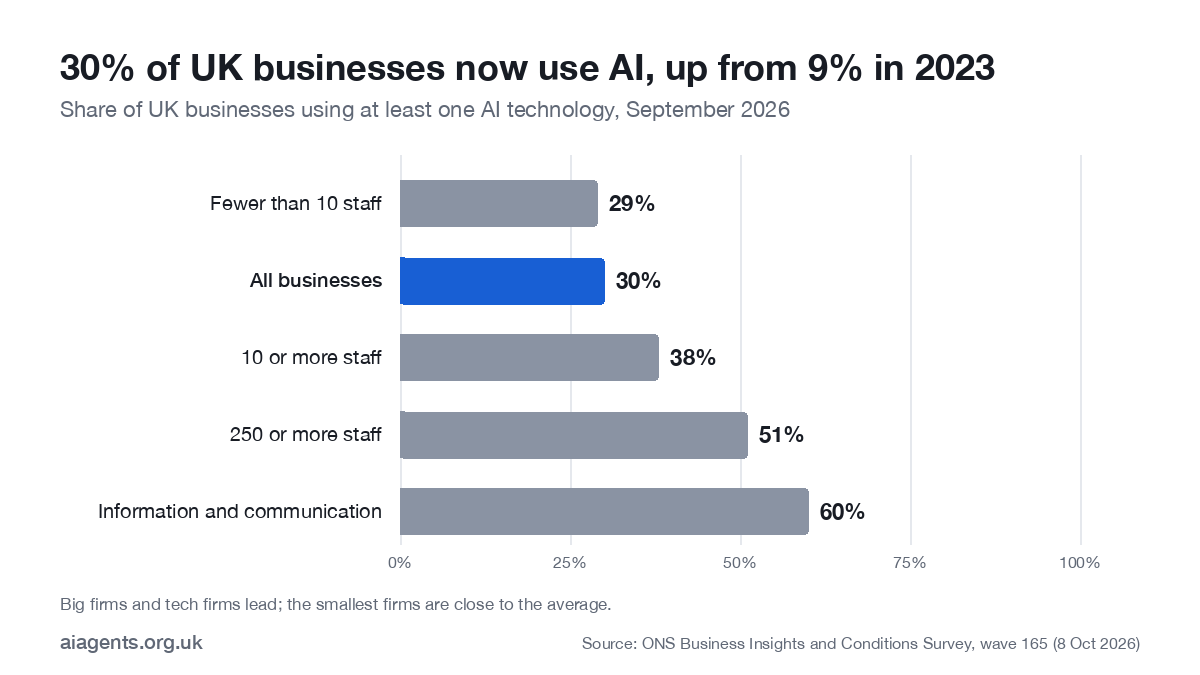
The most reliable figure comes from the ONS Business Insights and Conditions Survey, which samples businesses across the UK economy every fortnight. In wave 165, published on 8 October 2026, 30% of businesses said they used at least one AI technology in September 2026. That is broadly unchanged since June 2026 and up 20 percentage points from 9% in September 2023.
| Group | Share using AI, September 2026 | Change |
|---|---|---|
| All UK businesses | 30% | +20 points since September 2023 (9%) |
| Fewer than 10 employees | 29% | n/a |
| 10 or more employees | 38% | +3 points since June 2026; +26 since September 2023 |
| 250 or more employees | 51% | n/a |
| Information and communication industry | About 60% | Highest of any industry |
What they use it for is mostly writing and images. Among businesses with 10 or more staff, 21% use text generation with large language models (up 16 points since September 2023) and 19% use visual content creation (up 15 points). The ONS labels these figures official statistics in development.
Why do the surveys disagree?
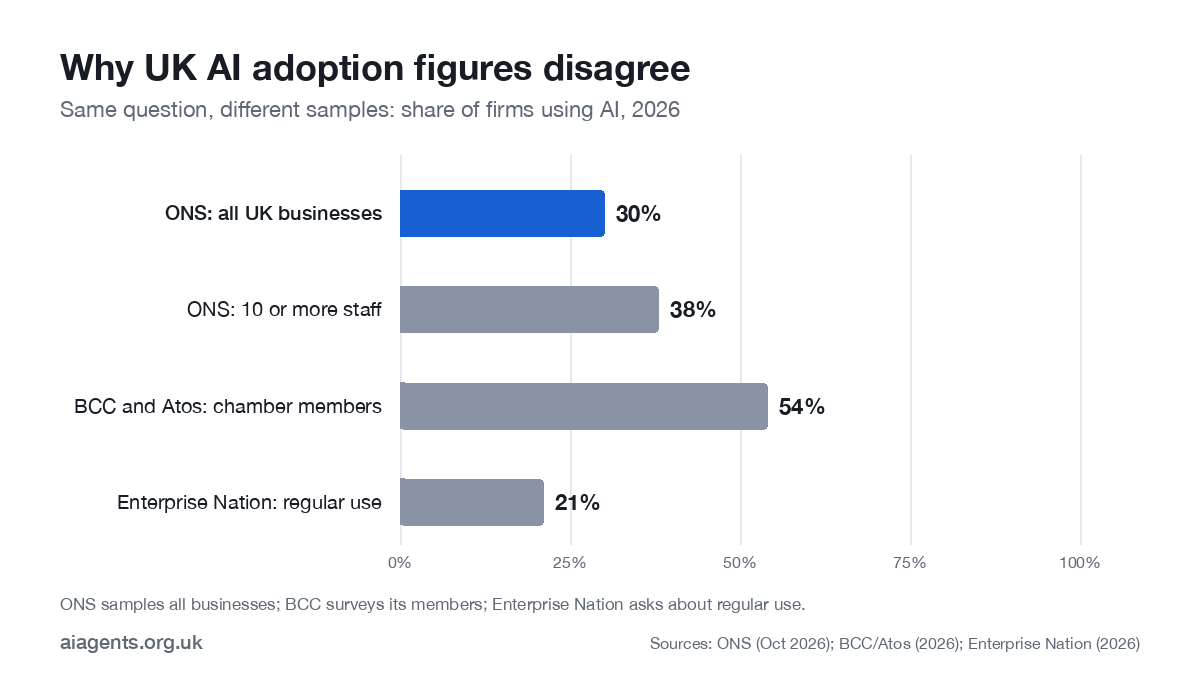
You will see UK AI adoption quoted as anything from about 20% to over 50%. The numbers are not contradictory; they measure different groups. The British Chambers of Commerce survey with Atos found 54% of firms actively using AI in 2026, up from 35% in 2025, 25% in 2024 and 23% in 2023, but it surveys chamber members, who tend to be more engaged than the average business, and 94% of respondents were SMEs. Enterprise Nation asked small firms about regular use and found 21%, with 6% having AI built into their daily work.
| Survey | Who it asks | Headline 2026 figure | Best used for |
|---|---|---|---|
| ONS BICS | A representative sample of all UK businesses | 30% use AI | The whole-economy figure |
| BCC and Atos | Chamber of Commerce members, mostly SMEs | 54% actively use AI | The trend among engaged firms |
| Enterprise Nation | UK small firms | 21% use AI regularly | How deep small-firm use goes |
For a single number to quote about the UK economy, use the ONS figure. For the direction of travel among engaged small firms, the BCC series is the longest-running.
How many UK adults use AI?
More than half. Ofcom's Adults' Media Use and Attitudes report, published on 2 April 2026 and based on 7,533 adults surveyed in late 2025, found 54% of UK adults use AI tools such as ChatGPT, Copilot or Gemini. Use is far higher among younger adults: 79% of 16 to 24-year-olds and 74% of 25 to 34-year-olds. About one in eight AI users (12%) use the tools for conversation, rising to 19% of 25 to 34-year-olds.
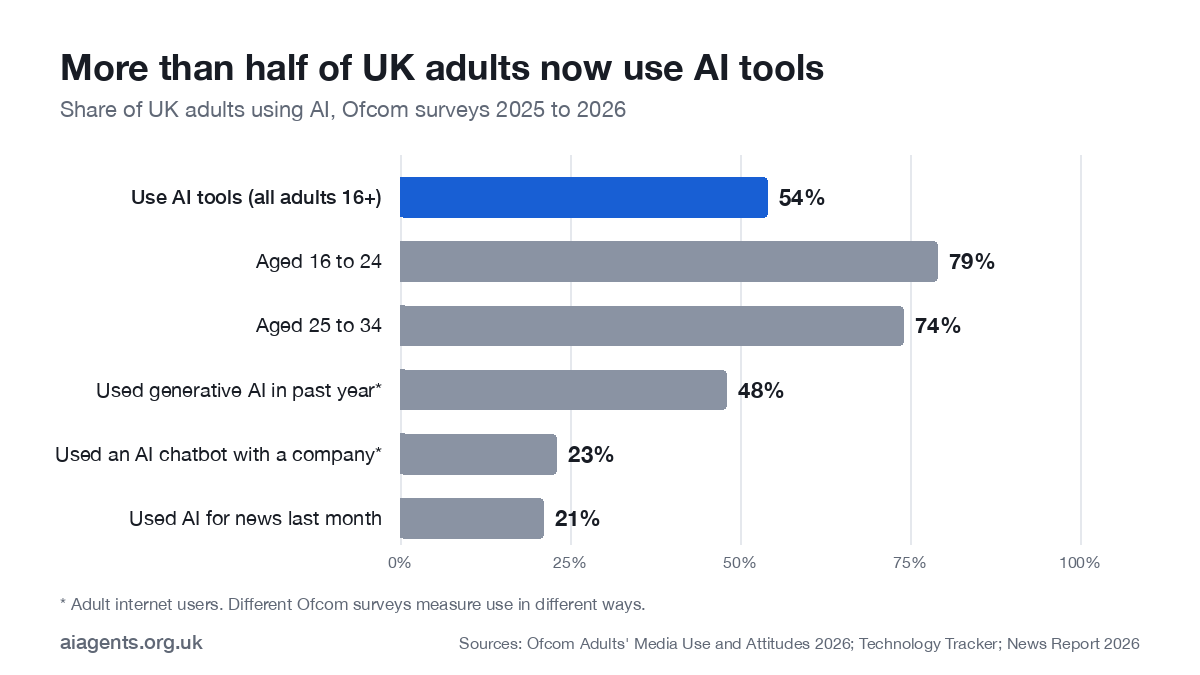
- 48% of adult internet users used generative AI tools in the past year, and 23% interacted with a company's AI chatbot, most often in retail (Ofcom Technology Tracker, reported 25 September 2026).
- 8% of adult internet users used AI to help manage their broadband or mobile services (same source).
- 21% of adults used AI services for news in the previous month, 13% using ChatGPT, and 56% trust AI-produced news less than human journalism (Ofcom News Report 2026, reported 15 September 2026).
What is AI doing to UK jobs?
So far, less than the headlines suggest. Among UK businesses with 10 or more staff that use AI, 6% reported a reduced headcount as a result and fewer than 1% an increase, both broadly stable over the past year (ONS, October 2026). Administrative and clerical roles are the most affected, cited by 38% of AI-using firms, followed by creative and design roles at 24%. The BCC and Atos survey found 95% of SMEs using AI reported no impact on headcount.
How many businesses use AI agents?
No official UK statistic separates AI agents from other AI yet. The ONS measures AI technologies broadly, and the fastest-growing uses are text and image generation, not software that plans and acts on its own. The closest proxies:
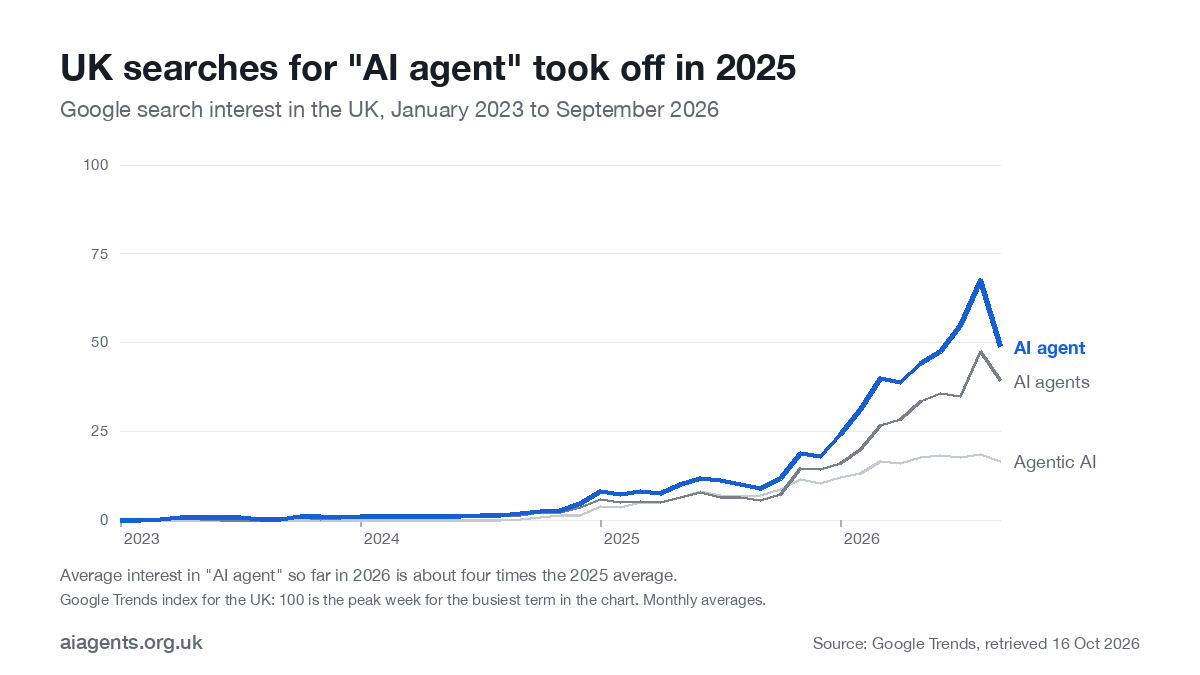
There is no official count of AI agent use yet, but interest is climbing fast: UK Google searches for "AI agent" so far in 2026 are about four times the 2025 average and more than 25 times the 2024 average.
- 6% of UK small firms have AI built into their daily work (Enterprise Nation, 2026).
- Over 40% of agentic AI projects will be cancelled by the end of 2027, and only about 130 of the thousands of vendors claiming agentic AI are genuine, according to Gartner (reported June 2025).
- 33% of enterprise software applications will include agentic AI by 2028, up from under 1% in 2024, Gartner predicts.
The gap between trying AI and running agents is where most small firms are. The guide to AI for small business covers how to close it safely.
AI in UK accountancy
Accountants are among the heaviest professional users. Karbon's 2026 State of AI in Accounting report found 83% of accounting professionals optimistic about AI and 87% using ChatGPT. The leading uses are client communication (77%), meeting transcripts and summaries (59%) and research (58%), while concern about data security is at a three-year high. Small firms lean on them too: 64% of UK SMEs turn to their accountant for advice on digital and AI (Enterprise Nation). More in AI for accountants.
Trust and regulation
Trust lags use. 56% of UK adults trust AI-produced news less than human journalism (Ofcom News Report 2026). On regulation, the ICO opened a call for evidence on agentic AI on 8 October 2026, closing on 20 November 2026, and secured data protection changes from ten foundation model developers. Every ICO publication on AI agents is listed in the ICO AI guidance tracker.
Download the data and cite this page
All figures on this page are in a single spreadsheet-ready file: download the UK AI statistics 2026 data (CSV). Each row gives the figure, its date and its source link.
You are welcome to use these figures and charts with a link back. Suggested citation: aiagents.org.uk, "UK AI adoption statistics 2026", updated 16 October 2026, https://aiagents.org.uk/uk-ai-adoption-statistics/. Journalists can ask for more detail through the contact page.
Frequently asked questions
What percentage of UK businesses use AI?
30% of UK businesses used at least one AI technology in September 2026, according to the Office for National Statistics. That is up from 9% in September 2023. Among businesses with 10 or more employees the figure is 38%, and among those with 250 or more it is 51%.
What percentage of UK adults use AI?
54% of UK adults aged 16 and over use AI tools such as ChatGPT, Copilot or Gemini, according to Ofcom's 2026 Adults' Media Use and Attitudes report. Use is highest among 16 to 24-year-olds (79%) and 25 to 34-year-olds (74%).
Why do UK AI adoption statistics give different numbers?
Because they ask different groups different questions. The ONS samples all UK businesses (30% in September 2026). The British Chambers of Commerce surveys its members, who are more engaged than average (54%). Enterprise Nation asks about regular use (21%). None of them is wrong; they measure different things.
How many UK businesses use AI agents?
No official UK statistic yet separates AI agents from other AI. The ONS measures AI technologies broadly, and most current use is text generation and image creation rather than agents that act on their own. Enterprise Nation found 6% of small firms had AI built into their daily work in 2026, which is the closest proxy.
Is AI reducing jobs in UK businesses?
So far, only a little. Among UK businesses with 10 or more employees that use AI, 6% reported a reduced headcount as a result and fewer than 1% an increase, according to the ONS in October 2026. Administrative and clerical roles are the most affected.
Next: see what these numbers mean in practice in AI for small business in the UK.
Read next
- AI for small business in the UK: where AI agents pay off
- ICO AI guidance tracker: what the regulator has said about AI agents
- What is agentic AI? Meaning, examples and UK rules
Sources
- Google Trends, UK search interest (retrieved 16 October 2026) - relative interest over time
- Office for National Statistics, Business insights and impact on the UK economy, 8 October 2026 (BICS wave 165) - business AI use, size bands, industries, jobs
- Ofcom, UK adults' media and online lives revealed, 2 April 2026 - 54% of adults use AI tools; age breakdown
- ISPreview, Ofcom: 1 in 12 UK adults use AI to help manage their telecoms services, 25 September 2026 - Ofcom Technology Tracker figures
- Resultsense, One in five UK adults use AI to follow the news, says Ofcom, 15 September 2026 - Ofcom News Report 2026 figures
- Staffing Industry Analysts, AI adoption among UK SMEs climbs to 54% in 2026 (BCC and Atos) - BCC series 2023 to 2026
- Enterprise Nation, Digital and AI adoption among UK SMEs (2026) - regular use, AI in daily work, sources of advice
- CFOtech UK, Accountants embrace AI tools as scepticism increases (Karbon 2026), 23 January 2026 - accountancy figures
- RCR Wireless, Gartner: more than 40% of agentic AI projects will fail by 2027, 27 June 2025 - Gartner predictions
- ICO, ICO secures changes from leading AI developers as scrutiny extends to AI agents, 8 October 2026 - call for evidence