There are two useful ways to sort the types of AI agents: by how they decide, which is how computer science textbooks do it, and by what they do for you, which is how you should choose one. The textbook list has five levels, from simple reflex agents that react to a rule up to learning agents that improve with experience. The buyer's list also has five: personal assistant, task, coding, browser and multi-agent systems. This page gives both, with examples, and says which type fits which job.
Key facts
- By how they decide: simple reflex, model-based reflex, goal-based, utility-based, learning. Each level adds memory, goals or judgement.
- By what they do: personal assistant, task, coding, browser, multi-agent. This is the list to buy from.
- Most mature: coding agents. Most common in small firms: task agents. Most hyped: multi-agent systems.
- Start with: one task agent on a repetitive, low-risk job.
On this page
- How do computer scientists classify AI agents?
- What types of AI agent can you actually buy?
- Type by type
- Which type for which job?
- Frequently asked questions
- Sources
How do computer scientists classify AI agents?
Russell and Norvig's standard AI textbook sorts agents by their internal machinery. The categories are older than large language models but still describe what is going on inside a modern agent.
| Type | How it decides | Everyday example | Modern AI equivalent |
|---|---|---|---|
| Simple reflex | If this, then that; no memory | A thermostat | A rule in Zapier or an email filter |
| Model-based reflex | Keeps a picture of the world it cannot see directly | A robot vacuum mapping a room | An assistant that remembers your inbox state between runs |
| Goal-based | Chooses actions that move towards a goal | Satnav picking a route | An agent told "get every invoice paid" that plans the steps |
| Utility-based | Weighs options against preferences, rather than success alone | Satnav that trades time against tolls | An agent choosing the cheapest acceptable supplier |
| Learning | Improves its own rules from feedback | A spam filter that learns from what you mark | An agent that adjusts its drafting from your edits |
Most products you can buy sit at goal-based with a little learning layered on: the model plans towards the goal you set, and your corrections shape its future drafts. Fully learning agents that rewrite their own behaviour are rare in production and are the ones regulators worry about most, because they can drift from their purpose. See AI agents and UK GDPR.
What types of AI agent can you actually buy?
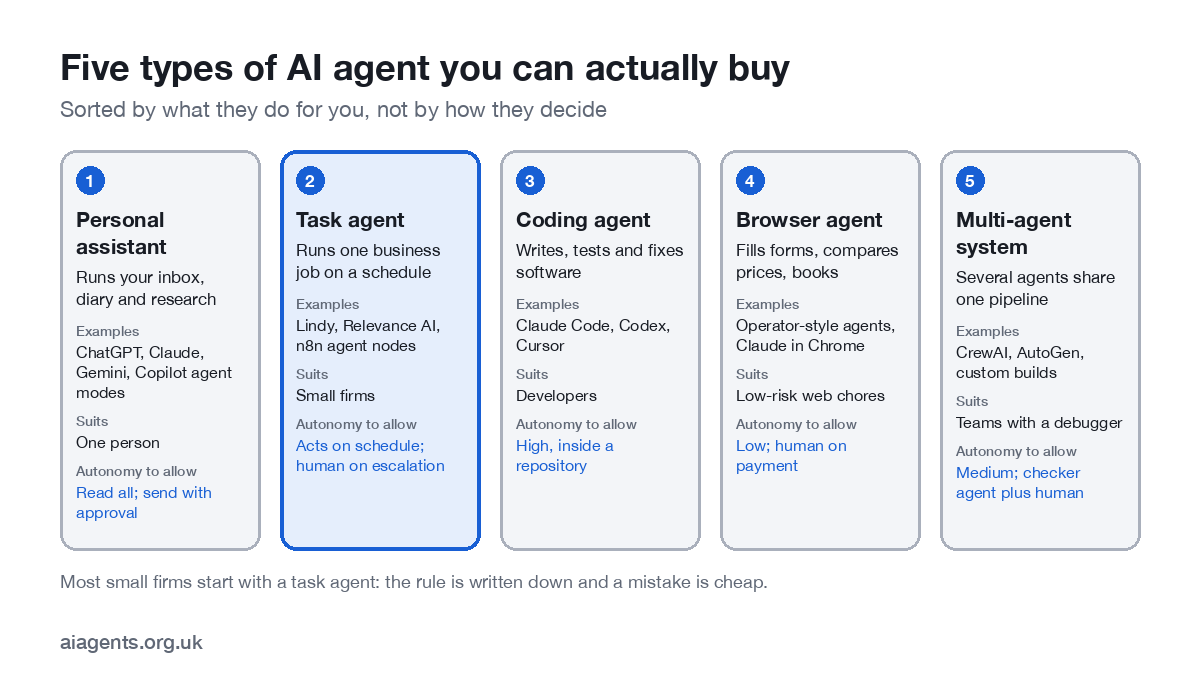
When you are choosing a product, the internal machinery matters less than the job. These five categories cover almost everything on the market in 2026.
Type by type
1. Personal assistant agents
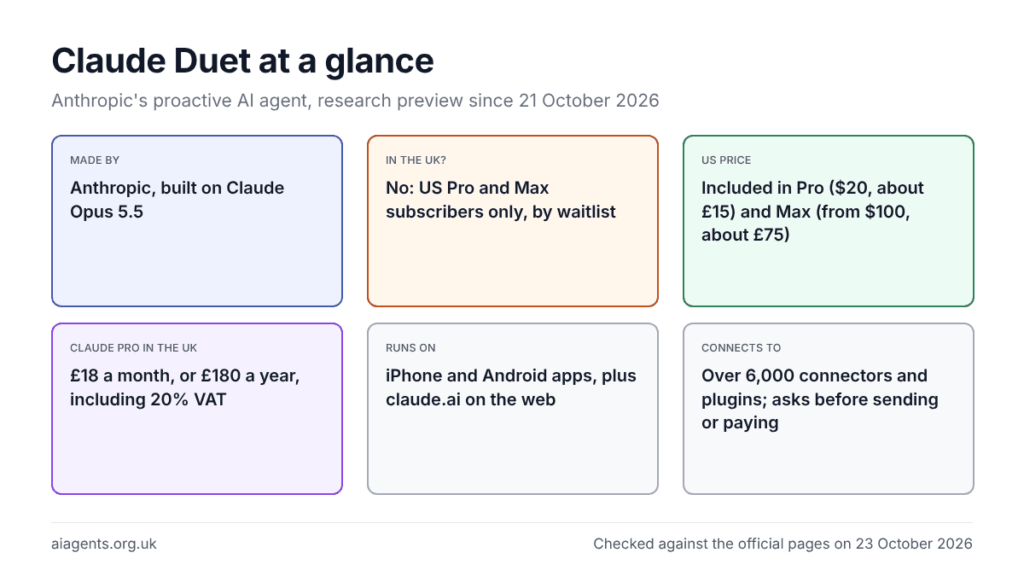
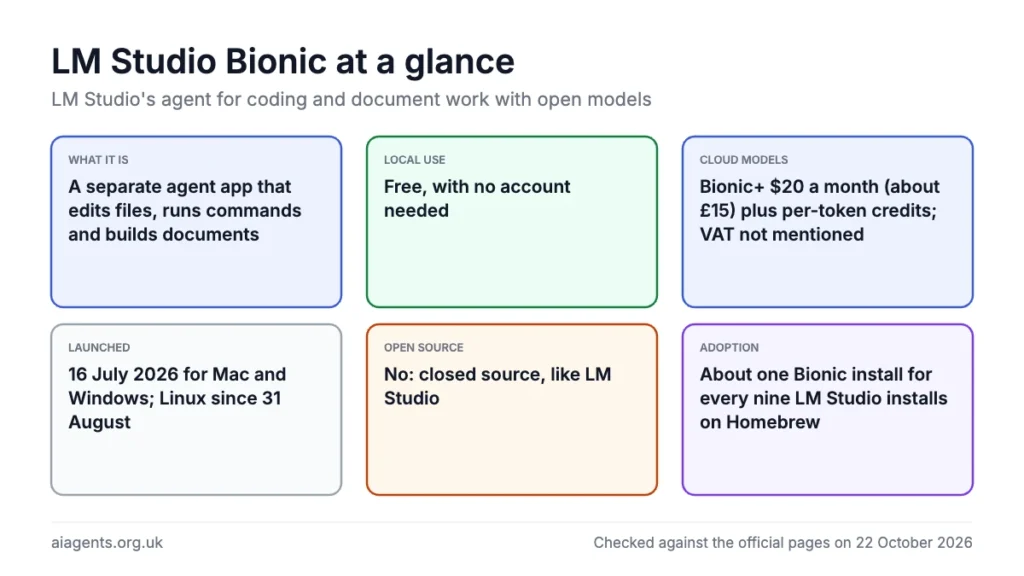
One person's admin: inbox, diary, reminders, research and notes. The assistant tiers of ChatGPT, Claude, Gemini and Copilot are the cloud versions; on-device tools such as Ollama, LM Studio, Jan and Msty run the same jobs on your Mac. Autonomy ranges from draft-and-wait to running on a schedule. Our full guide: Personal AI assistant: the 2026 guide.
2. Task agents
One repeating business job, end to end. Chase invoices, triage the support inbox, qualify leads, reconcile bank feeds. Built in no-code agent platforms or in workflow tools with AI steps. This is where most small-business value sits, and where a mistake is cheapest to catch, because the job is narrow.
3. Coding agents
Write, run, test and fix code. Claude Code, Codex, Cursor and similar. The most mature category by some distance: most agent techniques used elsewhere, from tool use to self-checking loops, were proven here first. If you want to see what a capable agent looks like, watch a developer use one.
4. Browser agents
Operate websites on your behalf: fill forms, compare prices, book things. Browser extensions and the agent modes of the main assistants. Capable and fragile: websites change, and an agent reading a web page can be instructed by text on that page. Keep payments behind a human.
5. Multi-agent systems
Several agents passing work between them, each with a role: a researcher, a writer, a checker, a manager. They tackle bigger jobs and parallelise, but they multiply cost, latency and failure modes, and debugging a conversation between agents is hard. Mostly enterprise pilots and developer frameworks today. Gartner expects more than 40% of agentic AI projects to be cancelled by the end of 2027, and the elaborate ones are first in line.
Which type for which job?
| You want to… | Type | Autonomy to allow | First check |
|---|---|---|---|
| Clear your own inbox and diary | Personal assistant | Read everything; send with approval | Where does the data go? |
| Chase invoices or triage support for the firm | Task | Act on a schedule; human on escalation | Is the rule written down? |
| Build software faster | Coding | High, inside a repository | Tests and version control |
| Fill forms, compare prices, book | Browser | Low; human on payment | Can it be manipulated by the page? |
| Run a research-and-report pipeline | Multi-agent | Medium; checker agent plus a human | Do you have someone to debug it? |
If you are still unsure what an agent is at all, start with What is an AI agent? For the wider category and the vendors relabelling old software, see What is agentic AI?
Frequently asked questions
How many types of AI agent are there?
Textbooks list five by how they decide: simple reflex, model-based reflex, goal-based, utility-based and learning agents. In practice, buyers meet five by what they do: personal assistant, task, coding, browser and multi-agent systems. Both lists are on this page.
What is the most common type of AI agent?
Task agents that automate one repeating business job, such as chasing invoices or triaging support, are the most common in small firms. Coding agents are the most mature and widely used overall.
What is a multi-agent system?
Several agents that pass work between them, for example a researcher, a writer and a checker. They handle bigger jobs but cost more, are harder to debug and are mostly used by firms with technical teams.
Is a chatbot a type of AI agent?
Not in the useful sense. A chatbot answers and waits. An agent takes a goal, uses tools, checks its results and keeps going. Many products called chatbots are now mild agents, which is why the label matters less than the behaviour.
Which type should a small business start with?
A task agent on one repetitive, rule-bound job with cheap mistakes, usually invoice reminders or inbox triage. Add a personal assistant agent for the owner once the first one runs cleanly.
Next: see 25 AI agent examples for what each type does in practice.
Read next
- The best new AI agents on Product Hunt, reviewed
- What is an AI agent? A plain-English guide for the UK
- AI agent vs chatbot vs AI assistant: the difference
- 25 AI agent examples that do real work
Sources
- Russell and Norvig, Artificial Intelligence: A Modern Approach (agent types) - the textbook classification
- Anthropic, Building effective agents (December 2024) - workflows versus agents
- RCR Wireless, Gartner: more than 40% of agentic AI projects will fail by 2027 - cancellation forecast