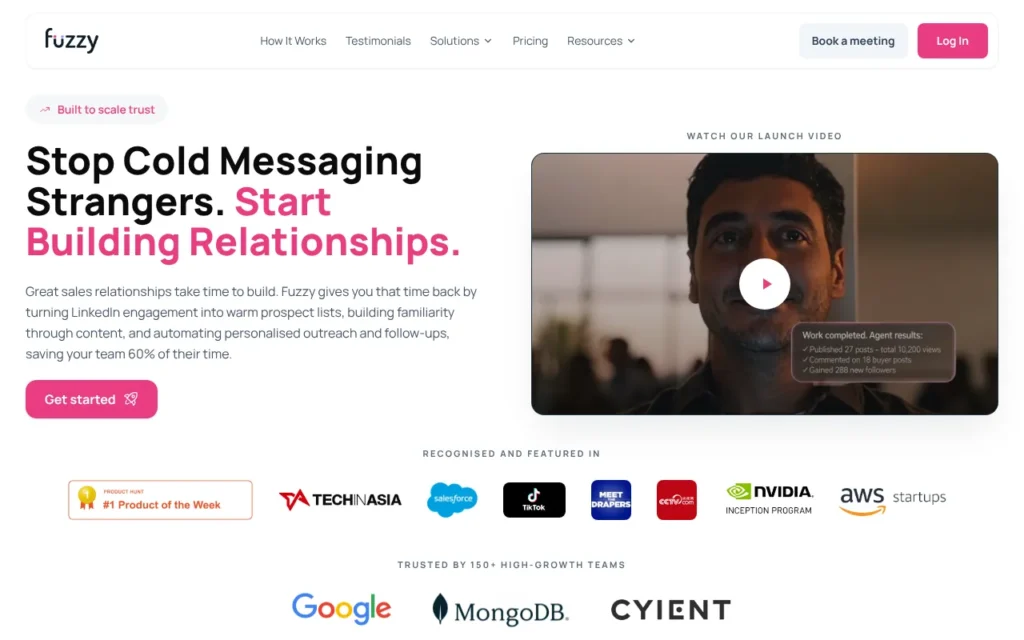
Fuzzy AI is a LinkedIn sales tool that warms up prospects before you message them. It finds buyers active in your market, comments on their posts in your voice, then runs LinkedIn and email sequences that you approve. It is for B2B founders and sales teams. There is no free plan, and Starter costs $149 a month (about £112). It was #1 Product of the Day and of the Week on Product Hunt in July 2026. Sound idea, but the price and account risk are high. My rating: ★★☆☆☆ 2/5.
Key facts
- What it does: Builds familiarity with LinkedIn prospects through comments and content, then runs personalised LinkedIn and email outreach to the people who engage.
- Made by: Fuzzy Sequence Pte. Ltd., trading as Fuzzy AI (Singapore)
- Launched on Product Hunt: 20 July 2026, #1 Product of the Day, #1 Product of the Week and #6 Product of the Month
- Price: Starter $149 a month (about £112); Growth $299 (about £225); Scale $599 (about £450); Enterprise on request
- Free plan or trial: None. Every plan is paid from day one, with no money-back guarantee
- Works with: LinkedIn (Sales Navigator optional), Google and Outlook; contact data from Firmable, Exa and ContactOut
- Best for: B2B founders and small sales teams whose buyers are active on LinkedIn
- Our rating: ★★☆☆☆ 2/5
On this page
- What is Fuzzy AI?
- Watch the demo
- How it did on Product Hunt
- What Product Hunt users said
- How much does Fuzzy AI cost?
- What I like
- What I'd want fixed
- Who should use it?
- Is it safe to use? Privacy and permissions
- Using it in the UK
- Other launches from the same team
- Alternatives to Fuzzy AI
- My verdict
- Frequently asked questions
What is Fuzzy AI?
Most LinkedIn outreach tools send as many messages as they can. Fuzzy does the opposite. It first builds a feed of the people you want to reach, plus people engaging with your competitors' posts. It then drafts comments on their posts in your voice and helps you post your own content. When a prospect starts liking or commenting, Fuzzy moves them into a personalised outreach sequence.
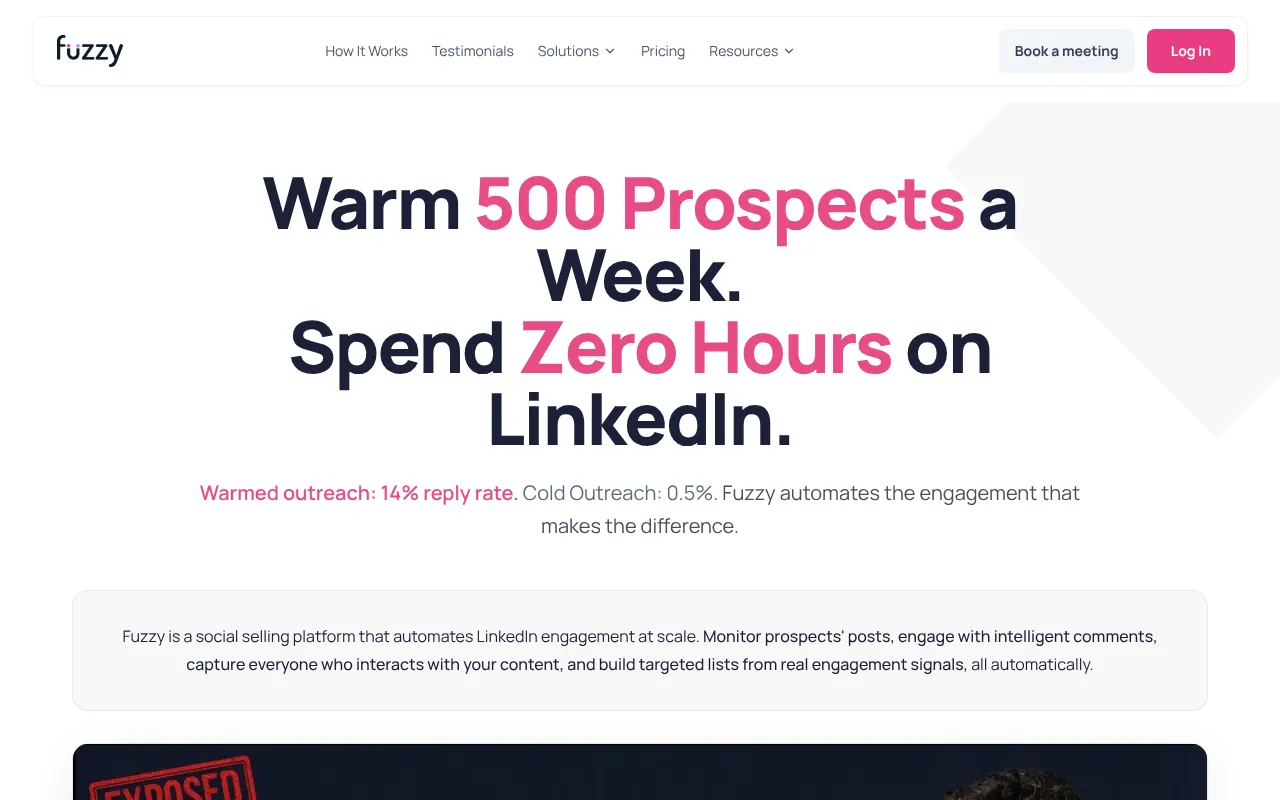
You describe your ideal buyer in plain language, and Fuzzy finds matching people without needing a Sales Navigator seat. It can look up verified work emails and phone numbers, charged per successful result. A memory feature learns your writing style and past results, and every message is shown for review before it goes out. That review step is on by default.
It is an agent rather than a chatbot because it works on its own over days and weeks. It watches for engagement, decides when a comment is worth posting, paces activity and moves people between stages. Fuzzy's own guidance says warming takes a few days to a couple of weeks before outreach starts.
Watch the demo
The official launch video, released on launch day, introduces Fuzzy's idea of warming prospects on LinkedIn before you reach out.
Video: Growth Fuzzy on YouTube.
How it did on Product Hunt
Fuzzy AI finished #1 Product of the Day on 20 July 2026, went on to #1 Product of the Week, and placed #6 for the month.
| Launch | Date | Daily rank | Other awards | Upvotes |
|---|---|---|---|---|
| Fuzzy AI | 20 July 2026 | #1 Product of the Day | #1 Product of the Week; #6 Product of the Month (July 2026) | 577 |
Upvotes as shown on Product Hunt's product page on 17 October 2026.
It has no Golden Kitty Award. Product Hunt pages showed between 573 and 589 upvotes for this launch when I checked, so I have used the product page figure. For a first launch from a small team, a weekly win is a strong start. It shows the warm-first pitch landed with founders and sales people. It does not show how well the comments and messages land with real buyers.
What Product Hunt users said
- No review score is shown yet. The launch drew dozens of comments, and the makers answered most questions.
- Praise centred on the warm-first idea and keeping outreach human. One commenter suggested "warm and fuzzy" as a tagline, and the hunter backed it after a demo.
- The biggest worry was LinkedIn account safety. The makers said they use residential proxies, random timing and daily limits, and that no user had been banned so far.
- Others worried about the same person seeing repeat comments, or comments posted on weak overlaps. The makers pointed to a pacing layer and said you can review, edit or veto every comment.
- A Salesforce user asked about CRM sync and got no clear answer. Fuzzy's own site now says there is no named CRM connector.
How much does Fuzzy AI cost?
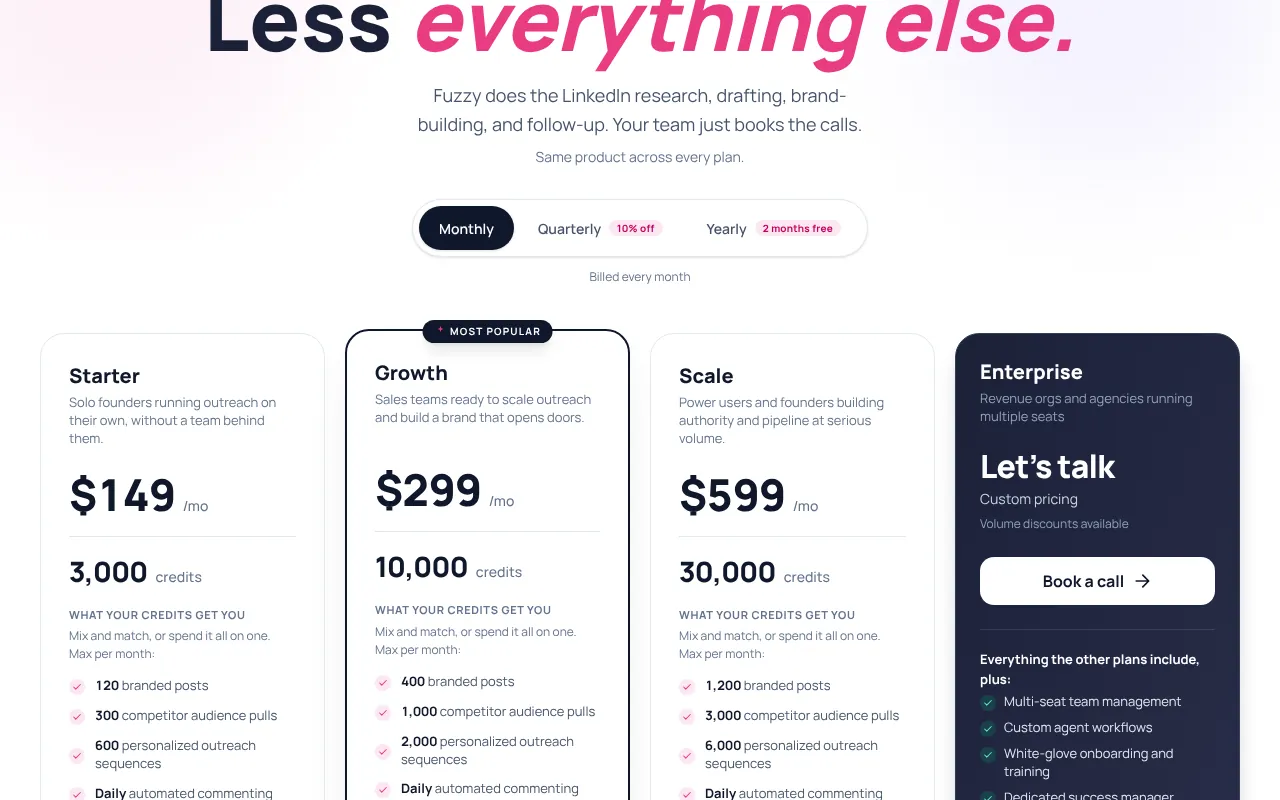
Fuzzy AI has three self-serve plans from $149 a month and custom Enterprise pricing. Plans differ only in credits.
| Plan | Price | What you get |
|---|---|---|
| Starter | $149 a month (about £112) | 3,000 credits, 1-10 expected positive replies a month, all features |
| Growth | $299 a month (about £225) | 10,000 credits, 5-25 expected positive replies a month, all features |
| Scale | $599 a month (about £450) | 30,000 credits, 15-50 expected positive replies a month, all features |
| Enterprise | Custom | Multiple seats, SSO, service levels, API and webhooks, dedicated success manager |
Prices are in US dollars, paid by card through Stripe, and VAT is not mentioned. Quarterly billing saves 10% and yearly billing gives two months free (Growth works out at $239 a month, about £180). There is no free plan, no self-serve trial and no money-back guarantee; the 14-day free offer was for launch week only.
What I like
- The warm-first approach is more respectful than blasting cold messages, and it suits how people actually buy on LinkedIn.
- Every message is reviewed before it is sent by default, so nothing goes out in your name without your say.
- The memory of your writing style and past results should make drafts sound more like you over time.
- Pricing is honest about results: it states expected positive replies per plan rather than promising meetings.
- The company publishes a clear "when not to use Fuzzy" list, including if your buyers are not on LinkedIn.
- Team features flag when a colleague is already engaging with the same prospect.
What I'd want fixed
- $149 a month with no trial is a big ask for a solo founder. Starter expects only 1-10 positive replies a month.
- LinkedIn's User Agreement bans bots and other unauthorised automated methods for commenting, liking and messaging. Fuzzy automates these actions, so your account is at risk.
- There is no HubSpot, Salesforce, Pipedrive or Zapier connection, even though one marketing page mentions CRM sync.
- The privacy policy is short and says nothing on GDPR, data location or sub-processors. Security certifications are only discussed for Enterprise.
- The demo on Fuzzy's own site sits behind a contact form.
Who should use it?
Fuzzy suits a B2B founder or small sales team selling to people who post and comment on LinkedIn, with the budget to spend $149 or more a month and the patience to wait weeks for warm-up. Skip it if your buyers are not active on LinkedIn, if you need CRM sync, or if losing your LinkedIn account would hurt your business. For cheaper LinkedIn prospecting with a free trial, look at Waalaxy.
Is it safe to use? Privacy and permissions
- You connect your LinkedIn account through a guided login, and optionally Google or Outlook. Fuzzy then comments, messages and runs sequences as you, from its servers through residential proxies, according to the makers.
- LinkedIn's User Agreement bans using bots or other unauthorised automated methods to send messages or to comment on, like or share posts. Fuzzy says it works within LinkedIn's guidelines and paces activity, but the risk to your account is yours.
- The privacy policy, from a Singapore company, covers prospect names, job titles, companies, emails and websites. It names no storage location or sub-processors, and Fuzzy says it has no published GDPR, SOC 2, ISO or DPA statement. It does say Google Workspace data is not used to train general AI models.
- Under UK GDPR you are responsible for the prospect data you collect and contact. Read AI agents and UK GDPR before you start.
Using it in the UK
- No country restrictions are mentioned, so you can sign up from the UK. Fuzzy pushes new users towards a booked demo call.
- You pay in US dollars by card, and VAT is not mentioned.
- The terms fall under Singapore law and the courts of Singapore, and no data location is given.
Other launches from the same team
- None. Fuzzy AI is the team's only Product Hunt launch. A 2016 product called Fuzzy.ai is unrelated.
Alternatives to Fuzzy AI
- Waalaxy - pick it for cheaper LinkedIn and email prospecting; from €19 a month per user (about £16), with a 14-day free trial.
- Taplio - pick it if you mainly want to post and engage on LinkedIn in your own voice; from $39 a month (about £29), with a 7-day trial and a 30-day money-back guarantee.
- Ami AI - pick it if you want an agent to run whole outbound campaigns over email and LinkedIn, with pay-as-you-go pricing from $1.50 per person prospected (about £1.13).
My verdict
| Area | Score |
|---|---|
| Usefulness | 3/5 |
| Getting started | 2/5 |
| Value for money | 2/5 |
| Trust and privacy | 2/5 |
| UK fit | 2/5 |
| Overall | ★★☆☆☆ 2/5 |
I like Fuzzy's thinking: earn attention first, then ask. But at $149 a month with no trial, and with LinkedIn's rules against automated commenting, I would not risk my own profile on it. I would try it only for a B2B team with a spare LinkedIn budget and buyers who live on the platform.
Frequently asked questions
Is Fuzzy AI free?
No. Product Hunt labels it as having free options, but Fuzzy's pricing has no free plan, and the company says there is no self-serve trial or money-back guarantee. The cheapest plan, Starter, costs $149 a month (about £112).
Will Fuzzy AI get my LinkedIn account banned?
The makers say no user had been banned when they launched, and the tool uses daily limits, random timing and review-before-send. But LinkedIn's User Agreement bans unauthorised automated commenting and messaging, so there is always some risk. Start slowly and keep manual approval on.
Fuzzy AI vs Waalaxy: which is better?
Waalaxy is far cheaper, from €19 a month per user, and has a 14-day free trial, so it suits a small business testing LinkedIn outreach. Fuzzy costs much more but focuses on warming prospects with comments and content before any message, rather than on volume.
Read next
Sources
- Fuzzy AI on Product Hunt - checked 17 October 2026
- Fuzzy AI launches on Product Hunt - checked 17 October 2026
- Fuzzy AI launch on Product Hunt - checked 17 October 2026
- Product Hunt daily leaderboard, 20 July 2026 - checked 17 October 2026
- Product Hunt weekly leaderboard, week of 20 July 2026 - checked 17 October 2026
- Product Hunt monthly leaderboard, July 2026 - checked 17 October 2026
- Golden Kitty Awards hall of fame - checked 17 October 2026
- Bladen Lam on Product Hunt - checked 17 October 2026
- Fuzzy.ai (2016) on Product Hunt - checked 17 October 2026
- Fuzzy AI homepage - checked 17 October 2026
- Fuzzy AI pricing - checked 17 October 2026
- Fuzzy AI FAQ - checked 17 October 2026
- Fuzzy AI llms.txt company summary - checked 17 October 2026
- Fuzzy AI social selling - checked 17 October 2026
- Fuzzy AI demo page - checked 17 October 2026
- Fuzzy Sequence terms and privacy policy - checked 17 October 2026
- Introducing Fuzzy (YouTube) - checked 17 October 2026
- LinkedIn User Agreement - checked 17 October 2026
- Waalaxy pricing - checked 17 October 2026
- Taplio pricing - checked 17 October 2026
- Ami by AiSDR - checked 17 October 2026