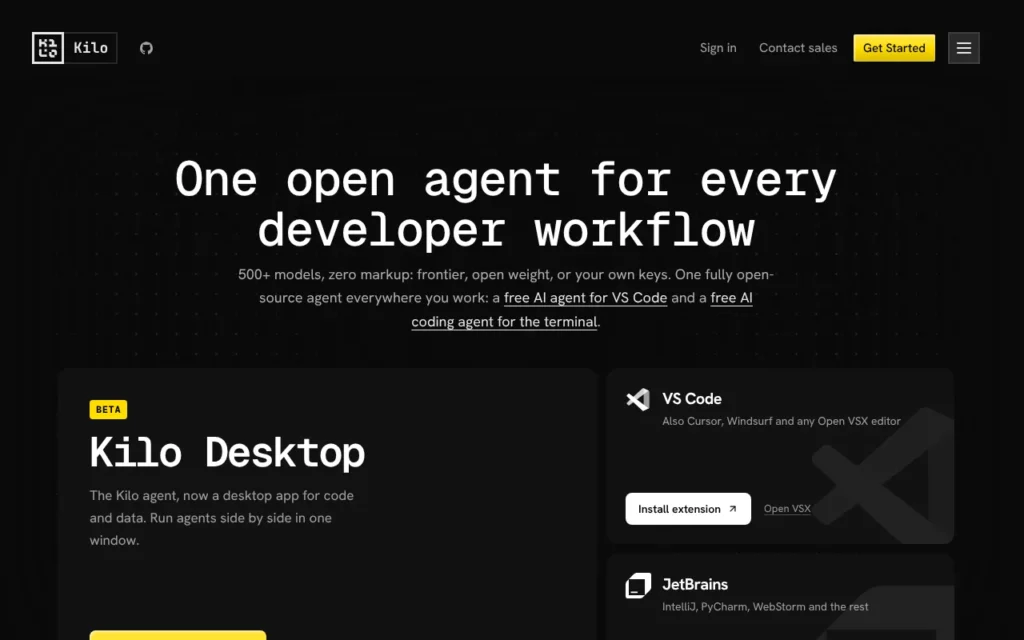
Kilo Code is an open-source AI coding agent that works inside VS Code, JetBrains editors and your terminal. It is for developers, and for technical founders who build their own tools. The extension is free. You pay AI providers' own rates for the models you use, plus a 5% fee on credit top-ups, or bring your own keys. Its VS Code launch was #1 on Product Hunt for the day, week and month. Anaconda bought Kilo in July 2026. My rating: ★★★½☆ 3.5/5.
Key facts
- What it does: Writes, edits and reviews code inside your editor or terminal, runs several agents in parallel and reviews pull requests automatically.
- Made by: Kilo Code, Inc., owned by Anaconda, Inc. (Austin, Texas, US) since July 2026. Kilo's site says it is made in Amsterdam, Netherlands.
- Launched on Product Hunt: 5 May 2026 (Kilo Code for VS Code), #1 Product of the Day, #1 Product of the Week and #1 Product of the Month (May 2026)
- Price: Free extension; AI usage at provider rates plus a 5% fee on top-ups; Kilo Pass from $19 a month (about £14); Teams $15 a user a month (about £11)
- Free plan or trial: Yes. The extensions are free and open source, with free models available. Teams and Enterprise come with a 14-day Enterprise trial.
- Works with: VS Code and editors based on it such as Cursor and Windsurf, JetBrains IDEs, the command line, Slack, iOS and Android; 500+ models, your own API keys, or local models through Ollama and LM Studio
- Best for: Developers and technical founders who want to choose their models and see what they spend
- Our rating: ★★★½☆ 3.5/5
On this page
- What is Kilo Code?
- Watch the demo
- How it did on Product Hunt
- What Product Hunt users said
- How much does Kilo Code cost?
- What I like
- What I'd want fixed
- Who should use it?
- Is it safe to use? Privacy and permissions
- Using it in the UK
- Other launches from the same team
- Alternatives to Kilo Code
- My verdict
- Frequently asked questions
What is Kilo Code?
Kilo Code is an AI coding agent that lives in your code editor. You describe a change. It reads your project, plans the work, edits files, runs terminal commands and shows you a diff to review. It works in VS Code, JetBrains IDEs and the command line, and there are cloud agents, a Slack bot and a mobile app for following sessions.
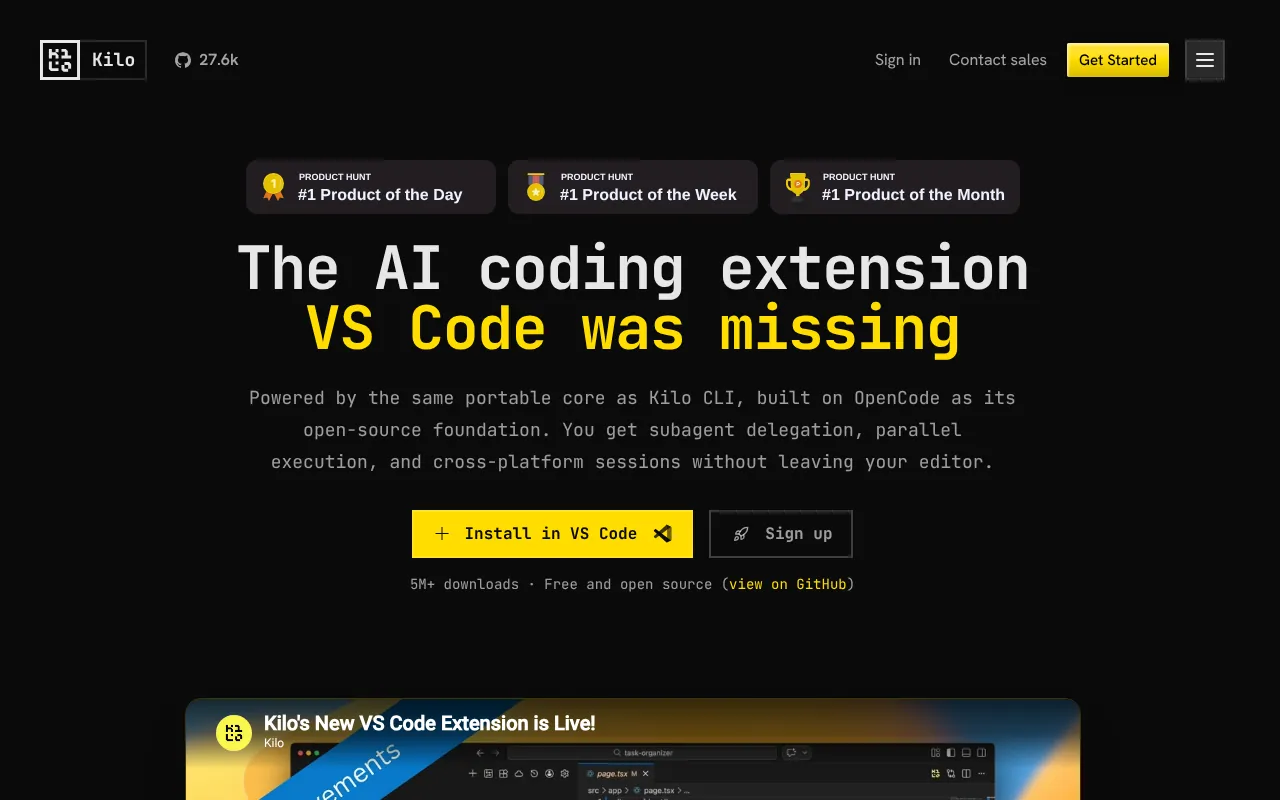
What makes it an agent rather than autocomplete is how much it does on its own. The rebuilt VS Code extension, released on 2 April 2026, can run several agents at once, hand parts of a job to subagents and keep each one in its own git worktree. You can send the same prompt to several models and compare the answers. The Code Reviewer checks a pull request as soon as you open it.
It is open in two ways. The code is MIT-licensed on GitHub and built on the open-source OpenCode core. And you choose the model: 500+ through Kilo Gateway at the provider's own price, your own keys, or a local model. Anaconda, Inc., based in Austin, Texas, announced on 15 July 2026 that it had bought Kilo, and says products, plans and support are unchanged for now.
Watch the demo
This is Kilo's launch video for the rebuilt VS Code extension, the version that topped Product Hunt in May 2026.
Video: Kilo on YouTube.
How it did on Product Hunt
Kilo Code's best result was the May 2026 VS Code launch, #1 for the day, the week and the month.
| Launch | Date | Daily rank | Other awards | Upvotes |
|---|---|---|---|---|
| Kilo Code for VS Code | 27 March 2025 | #5 Product of the Day | None | 344 |
| Kilo Code for JetBrains | 28 September 2025 | #1 Product of the Day | None | 674 |
| Kilo Code Reviewer | 27 January 2026 | #1 Product of the Day | #1 Product of the Week (week of 26 January 2026); #2 Product of the Month (January 2026) | 788 |
| Kilo Code for VS Code | 5 May 2026 | #1 Product of the Day | #1 Product of the Week (week of 4 May 2026); #1 Product of the Month (May 2026) | 878 |
| Kilo Code for JetBrains | 1 September 2026 | #1 Product of the Day | #1 Product of the Week (week of 31 August 2026) | 476 |
| Kilo Code for iOS and Android | 15 September 2026 | #3 Product of the Day | None | 428 |
Upvotes as shown on Product Hunt on 17 October 2026.
None of these has a Golden Kitty. Upvotes are from the product page, except the March 2025 launch, which is from the launches tab. The launches tab shows slightly higher counts for the newer launches, such as 889 for May 2026. Counting KiloClaw, the team has topped the daily chart four times since January 2026. That says Kilo knows how to launch and has a loyal developer following. It is less helpful for judging quality, so I lean on the reviews.
What Product Hunt users said
- The review score is 5.0 from 51 reviews. "Developer experience" and "AI assistant" are the most used tags.
- Reviewers like the model choice. Several say cheaper models handle simple jobs well, so you need not pay for the top model every time.
- The diff viewer, worktrees and running different models side by side get regular praise, and JetBrains users like the plugin. One accountant used it to build internal tools.
- Complaints are few. One reviewer wants a clear breakdown of typical costs, others ask for more quickstarts and templates, and one Linux user hit a sign-in bug.
- One reviewer warned that running several models in parallel could get expensive.
How much does Kilo Code cost?
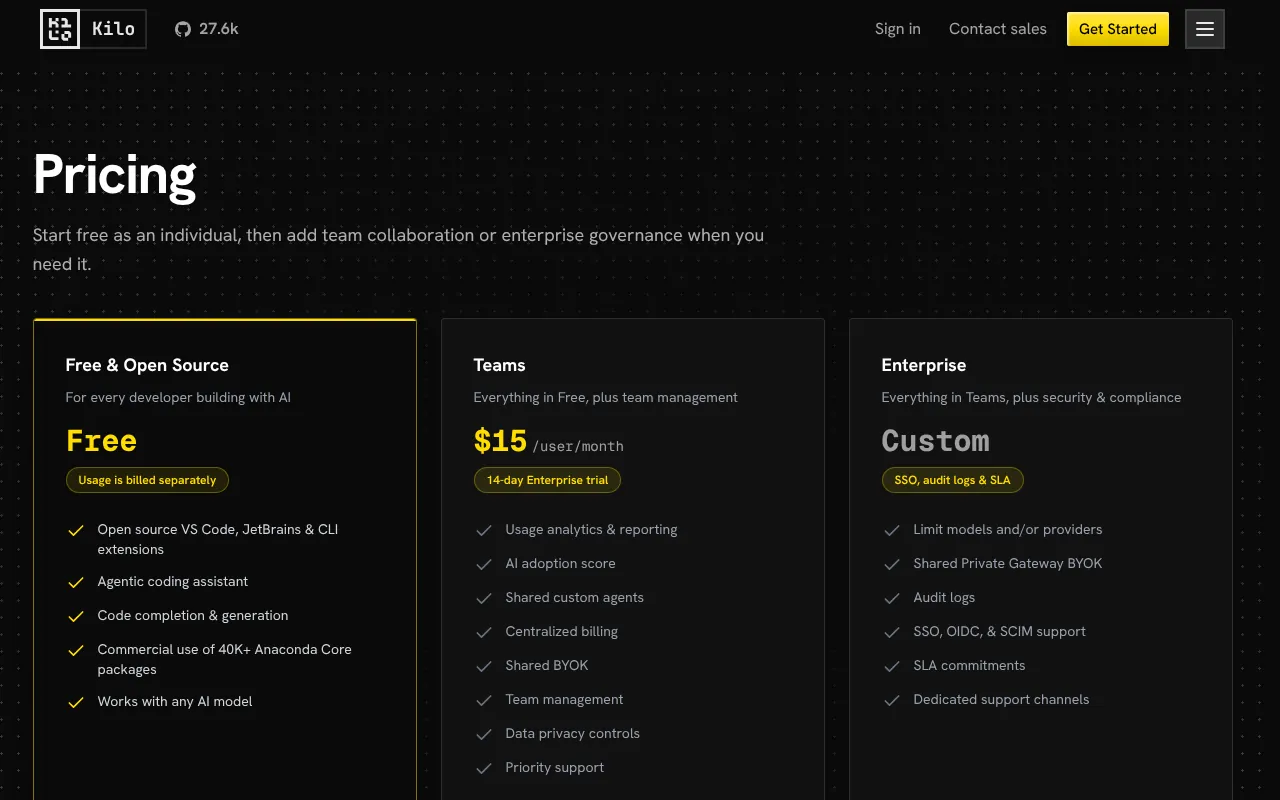
The extension is free; you pay for AI usage, and only teams pay a platform fee.
| Plan | Price | What you get |
|---|---|---|
| Free and open source | Free | VS Code, JetBrains and command-line extensions, with free models, your own keys or local models |
| Kilo Gateway | $0 plus usage at provider rates | 500+ models from 60+ providers, pay as you go. A 5% processing fee applies to top-ups, so $20 of credit costs $21 (about £16). |
| Kilo Pass | Starter $19 a month (about £14), Pro $49 (about £37), Expert $199 (about £150) | A monthly credit subscription with up to 50% bonus credits. Starter gives up to $26.60 of credits a month. |
| Teams | $15 a user a month (about £11) | Usage analytics, shared agents and keys, central billing and priority support |
| Enterprise | Custom | SSO, audit logs, model limits and an SLA |
| Cloud compute | Code review $0.33 an hour (about 25p); cloud agents $0.60-$1.20 an hour (about 45p-90p) | Billed per second, separate from model costs |
VAT is not mentioned, and the terms say you pay any taxes. Fees are in US dollars and non-refundable, bought credits expire after a year, and the 5% fee is non-refundable too. Annual Kilo Pass billing adds a 50% bonus.
What I like
- The extensions are free and open source under the MIT licence, so you can inspect, fork or self-host them.
- There is no markup on model prices, and the 5% top-up fee is spelled out on the pricing page rather than hidden.
- You can bring your own keys or run local models with Ollama or LM Studio and pay Kilo nothing.
- Kilo Sandbox keeps the agent's writes inside your project and your .git folder read-only, even in auto-approve mode, and can block network access.
- Each tool can be set to Allow, Ask or Deny, including shell commands.
- The security page says paid plans support no data retention for prompts and outputs, with SOC 2 documents in its Trust Center.
What I'd want fixed
- New owner, new contract. The terms are now with Anaconda, Inc. under Delaware law, with most disputes going to arbitration.
- The rebuild took things away. Code indexing is temporarily unavailable, Orchestrator mode is deprecated and profiles are gone, and some blog commenters asked how to go back.
- Bought credits expire after a year and are non-refundable.
- The privacy policy does not say plainly whether your code or prompts are used for training. Prompts go through OpenRouter to your chosen model provider, under that provider's retention rules.
- It is hard to predict what a task will cost, as one reviewer pointed out.
Who should use it?
Kilo Code suits developers, technical founders and small agencies who want a capable coding agent without being tied to one AI company. It is also good if you want to keep costs visible or run local models. Skip it if you do not write code: an agent like Happycapy that builds things in the cloud will suit you better. If you already pay for Claude, try Claude Code first.
Is it safe to use? Privacy and permissions
- It reads your project, edits files and runs terminal commands. Per-tool permissions and Kilo Sandbox limit what it can touch, with writes kept to your workspace and an option to block the network.
- Kilo's services are hosted in the US. Your prompts are passed through OpenRouter to the model provider you choose, under that provider's retention rules. Local models keep code on your machine.
- The privacy policy refers to UK and EU law, lawful bases and standard contractual clauses, but does not name UK GDPR and names no EU representative. My guide to AI agents and UK GDPR explains what to ask.
- The security page lists SOC 2 documents, encryption, a DPA and no data retention for prompts and outputs on paid plans.
Using it in the UK
- It works anywhere and installs from inside VS Code or a JetBrains IDE. Prices are in US dollars.
- VAT is not mentioned. The terms say you pay any taxes, and payments go through Stripe and other processors.
- Data is hosted in the US. For enterprises, Kilo lists data-residency options and EU inference and compute, which may suit firms that need data kept in Europe.
Other launches from the same team
- KiloClaw (hosted OpenClaw), 25 February 2026: #1 Product of the Day, #1 Product of the Week and #4 Product of the Month (February 2026)
- PinchBench, 26 March 2026: #4 Product of the Day
- Kilo Code's own earlier launches, from March 2025, are in the table above.
Alternatives to Kilo Code
- Claude Code - Anthropic's coding agent for the terminal, IDE, Slack and web, included with Claude Pro (£18 a month plus VAT in the UK). Pick it if you want one subscription and are happy with Anthropic's models.
- OpenCode - the open-source agent Kilo's extension is built on, for the terminal, desktop or IDE, with 75+ providers and local models. Pick it if you want the core without a Kilo account.
- Happycapy - a cloud agent computer with a free plan. Pick it if you are not a developer and want an agent to build a simple site or tool for you.
My verdict
| Area | Score |
|---|---|
| Usefulness | 4/5 |
| Getting started | 4/5 |
| Value for money | 4/5 |
| Trust and privacy | 3/5 |
| UK fit | 3/5 |
| Overall | ★★★½☆ 3.5/5 |
If I wrote code every day, I would try Kilo Code on the free models first, then add my own API key. The model choice and honest pricing are the draw. I would keep an eye on how Anaconda's ownership changes the terms, and use the sandbox from day one.
Frequently asked questions
Is Kilo Code free?
Yes. The VS Code, JetBrains and command-line extensions are free and open source. You can use free models, your own API keys or local models at no cost from Kilo. If you buy credits through Kilo, you pay provider rates plus a 5% fee, and Kilo Pass starts at $19 a month (about £14).
Is Kilo Code safe?
It can edit files and run commands, so treat it like a new developer on your team. Use per-tool permissions and Kilo Sandbox, which keeps writes inside your project and protects your git history. For sensitive code, a local model keeps everything on your machine.
Kilo Code vs Claude Code: which should I choose?
Claude Code is Anthropic's own agent, included in Claude subscriptions from $20 a month. Kilo Code is open source, lets you pick from 500+ models and charges only for what you use. Choose Claude Code for simplicity and Kilo Code for choice and cost control.
Read next
Sources
- Kilo Code on Product Hunt - checked 17 October 2026
- Kilo Code launches on Product Hunt - checked 17 October 2026
- Kilo Code for VS Code launch on Product Hunt, May 2026 - checked 17 October 2026
- Kilo Code reviews on Product Hunt - checked 17 October 2026
- KiloClaw on Product Hunt - checked 17 October 2026
- Product Hunt daily leaderboard, 27 March 2025 - checked 17 October 2026
- Product Hunt daily leaderboard, 28 September 2025 - checked 17 October 2026
- Product Hunt daily leaderboard, 27 January 2026 - checked 17 October 2026
- Product Hunt daily leaderboard, 5 May 2026 - checked 17 October 2026
- Product Hunt daily leaderboard, 1 September 2026 - checked 17 October 2026
- Product Hunt daily leaderboard, 15 September 2026 - checked 17 October 2026
- Product Hunt weekly leaderboard, week of 26 January 2026 - checked 17 October 2026
- Product Hunt weekly leaderboard, week of 4 May 2026 - checked 17 October 2026
- Product Hunt weekly leaderboard, week of 31 August 2026 - checked 17 October 2026
- Product Hunt monthly leaderboard, January 2026 - checked 17 October 2026
- Product Hunt monthly leaderboard, May 2026 - checked 17 October 2026
- Product Hunt monthly leaderboard, February 2026 - checked 17 October 2026
- Kilo homepage - checked 17 October 2026
- Kilo pricing - checked 17 October 2026
- Kilo Code for VS Code - checked 17 October 2026
- Kilo privacy policy - checked 17 October 2026
- Kilo terms of service - checked 17 October 2026
- Kilo security and compliance - checked 17 October 2026
- About Kilo - checked 17 October 2026
- Kilo Partner Program - checked 17 October 2026
- Kilo docs - checked 17 October 2026
- What's new in the Kilo Code VS Code extension - checked 17 October 2026
- The New Kilo Code for VS Code Is Now Generally Available, Kilo blog - checked 17 October 2026
- Kilo's New VS Code Extension is Live, Kilo on YouTube - checked 17 October 2026
- Anaconda Acquires Kilo Code to Power the Trillion-Token Enterprise, HPCwire - checked 17 October 2026
- Anaconda Acquires Kilo Code to Expand Into Agentic Software Development, Unite.AI - checked 17 October 2026
- Claude Code - checked 17 October 2026
- Claude pricing - checked 17 October 2026
- OpenCode - checked 17 October 2026