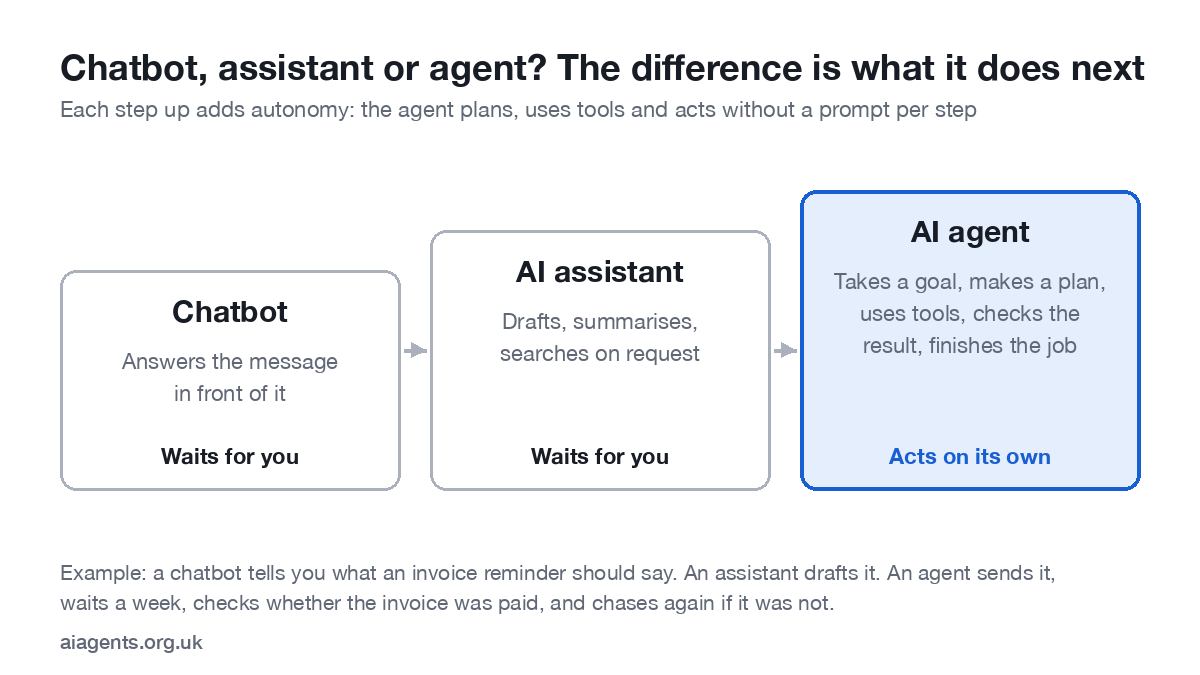
A chatbot answers. An AI assistant drafts and searches on request. An AI agent takes a goal, uses tools, checks its own results and keeps going until the job is done. The three words are used interchangeably in marketing, and the difference between AI agents and chatbots is simpler than the marketing suggests: it is what the system does after it has produced some text. This page sets the three side by side, with a worked example, and shows where each one is the right choice.
Key facts
- Chatbot: answers one message, waits for the next. No tools, no memory beyond the conversation.
- Assistant: answers plus drafts, summarises, searches, with your files and context. Still waits for you.
- Agent: goal in, finished task out. Plans, uses tools, checks, repeats. Acts on its own within limits.
- The test: remove the human prompt between steps. If it stops, it is a chatbot or assistant.
On this page
- What is the difference between a chatbot, an assistant and an agent?
- Side by side
- A worked example: the unpaid invoice
- Why are the labels unreliable?
- Is ChatGPT an AI agent?
- Which one do you need?
- Frequently asked questions
- Sources
What is the difference between a chatbot, an assistant and an agent?
Side by side
| Chatbot | AI assistant | AI agent | |
|---|---|---|---|
| What you give it | A message | A request plus your context and files | A goal |
| What you get back | An answer | A draft, summary or search result | A completed task and a log |
| Uses tools (email, browser, apps)? | No | Sometimes, when asked | Yes, as it decides |
| Remembers between sessions? | Rarely | Often | Yes, by design |
| Acts without a prompt per step? | No | No | Yes |
| Checks its own work? | No | Rarely | Yes, that is the loop |
| Typical cost | Free to low | £16-20 a month | £20-80 per user, or usage-based |
| Typical risk | Wrong answer | Wrong draft you catch | Wrong action you did not catch |
A worked example: the unpaid invoice
Ask each of the three to deal with an invoice that is 30 days overdue.
- The chatbot tells you what a good reminder email should say. You copy it, find the client's address, send it, and set yourself a reminder to check in a week.
- The assistant drafts the reminder in your tone, addressed to the right client, with the invoice attached. You read it and press send. Next week it will draft the follow-up if you ask.
- The agent finds every invoice over 30 days, sends the first reminder, waits seven days, checks the bank feed, sends a firmer reminder to those still unpaid, and tells you which ones need a phone call. You read the log on Friday.
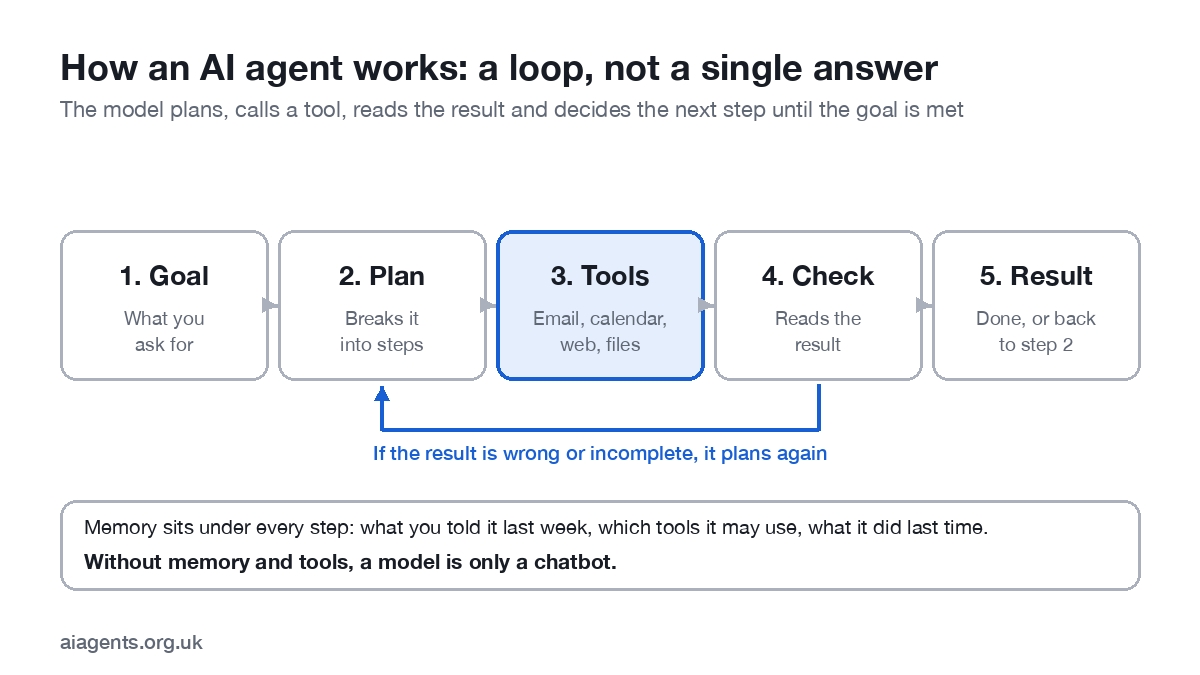
The agent is doing the same job a bookkeeper would, with the same tools. That is also why it carries more risk: a wrong reminder sent to a good client is an action in the world, not a draft on a screen. Narrow permissions and a human approval step on anything irreversible are how you keep the benefit without the exposure. See what the ICO expects.
Why are the labels unreliable?
Three things make the labels unreliable. First, every major assistant now has an agent mode, so the same product can be two things. Second, vendors relabel chatbots as agents; Gartner calls it agent washing and estimated only around 130 of thousands of self-described agentic vendors were building the real thing. Third, autonomy is a dial, not a switch: a tool that drafts replies you must approve is slightly agentic, and one that clears your inbox overnight is very agentic. Ask four questions of any product: can I give it a goal, which tools can it use, does it check its own results, and can I read a log of what it did.
Is ChatGPT an AI agent?
It depends which mode you use. Plain ChatGPT chat is an assistant: it answers and drafts when you ask. In July 2025 OpenAI added ChatGPT agent, a mode that worked a virtual browser, clicked through sites and filled in forms, and paused for confirmation before high-impact actions. Plus subscribers got 40 agent requests a month and Pro subscribers 400.
OpenAI has since retired it. On 9 July 2026 it launched ChatGPT Work, a third mode alongside Chat and Codex. Work takes on multi-step projects across your apps and files, runs scheduled tasks and, in the desktop app, can operate your computer. It pauses for approval on consequential actions and is included in existing plans; ChatGPT Plus is £16 a month plus VAT in the UK. Publishing the sites it builds publicly was not available in the UK at launch.
So if you searched for "ChatGPT agent", ChatGPT Work is what you will find today, and it is an agent by the definition on this page: you give it a goal, it plans, uses tools and checks back. The usual rule applies. Decide what it may reach before it starts, and keep a person on anything you cannot undo.
Which one do you need?
| Situation | Use | Why |
|---|---|---|
| Answering the same 20 questions on your website | Chatbot | Cheap, predictable, no actions to go wrong |
| Writing and research help for one person | Assistant | You stay in control of every send |
| A repeating job with clear rules and a cheap mistake | Agent | The loop saves the hours; the rules keep it safe |
| Decisions that affect people's rights or money | Assistant, or agent with a human reviewer | UK GDPR Articles 22A-22D require safeguards for solely automated significant decisions |
Frequently asked questions
What is the difference between an AI agent and a chatbot?
A chatbot answers the message in front of it and waits. An AI agent takes a goal, plans steps, uses tools such as email or a browser, checks the result and keeps going without a prompt for each step. The loop and the tools are the difference.
Is ChatGPT a chatbot or an AI agent?
Both, depending on mode. The chat window is a chatbot or assistant. Its agent mode, which browses, fills forms and completes multi-step tasks on its own, is an agent. The same is true of Claude, Gemini and Copilot.
Is an AI assistant the same as an AI agent?
An assistant drafts, summarises and searches when asked; an agent acts without being asked for each step. Many assistants are now mild agents, so the useful question is how much it does between your instructions.
Which is better for customer service, a chatbot or an agent?
A chatbot answers FAQs cheaply. An agent can resolve the ticket: look up the order, issue the refund within limits, update the record. Start with the chatbot behaviour, add agent actions one at a time with approvals.
Are AI agents more expensive than chatbots?
Usually, per task, because they take more steps and call more tools. They are cheaper per completed job, because a chatbot hands the job back to a person.
What happened to ChatGPT agent?
OpenAI retired the agent mode it launched in July 2025. On 9 July 2026 it introduced ChatGPT Work, which runs multi-step tasks across your apps and files, can use your computer from the desktop app, and pauses for approval on consequential actions. It is included in existing ChatGPT plans.
Related: what ChatGPT Work does, which plans get it and what replaced agent mode: ChatGPT agents in 2026.
Next: read What is an AI agent? for the full guide.
Read next
Sources
- AI Tools Review, ChatGPT Work explained (19 July 2026) - UK pricing and availability
- The Next Web, OpenAI launches ChatGPT Work (10 July 2026) - what Work does and how it asks for approval
- OpenAI Help Centre, ChatGPT agent (retired) - plans and limits of the 2025 agent mode
- Anthropic, Building effective agents (December 2024) - the workflow/agent distinction
- RCR Wireless, Gartner on agent washing (June 2025) - around 130 genuine agentic vendors
- Gravity, AI agent search statistics 2026 - "ai agent vs chatbot" search demand