
An AI agent is software you give a goal to, which then works out the steps, uses tools such as email, a browser or your accounting system, checks its own results and keeps going until the job is done or it needs you. A chatbot answers the message in front of it and waits. An agent acts. That one difference, acting rather than answering, is what the rest of this page is about: how agents work, what they can and cannot do today, what they cost in the UK, and what to check before you let one near your business.
Key facts
- Definition: a system with a goal, tools, a plan-act-check loop and, usually, memory. The loop and the tools are what make it an agent; how much it remembers varies by product.
- Chatbot vs agent: a chatbot waits for your next message; an agent takes the next step itself.
- Good first jobs: repetitive, rule-bound, cheap to check. Invoice chasing, inbox triage, lead qualification.
- UK cost: about £16-20 a month for a personal assistant tier; £20-80 per user for small-business agent platforms; £0 to run one on your own Mac.
- UK law: UK GDPR applies in full. The ICO is writing dedicated guidance on agentic systems.
On this page
- What is an AI agent?
- AI agent vs chatbot vs assistant
- How AI agents work
- Types of AI agents
- What AI agents can do: examples
- What AI agents can't do yet
- Are AI agents safe?
- What an AI agent costs in the UK
- How to choose your first agent
- Cloud agent or one on your own computer?
- Frequently asked questions
What is an AI agent?
The phrase is older than the current wave of AI. In computer science an agent is anything that perceives its environment and acts on it to reach a goal; a thermostat qualifies. What changed in 2023 and 2024 is that large language models learned to use tools, which means the perceiving, planning and acting can now happen in plain language across almost any software.
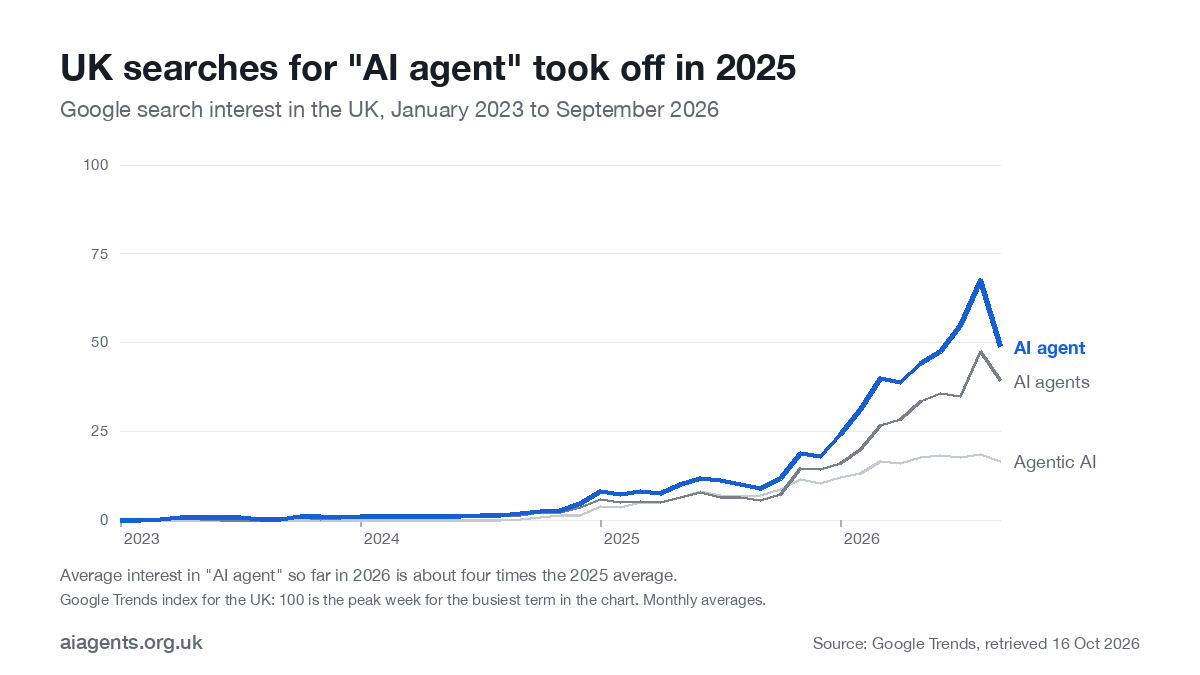
Interest is rising fast. UK searches for "AI agent" so far in 2026 are running at about four times the 2025 average, according to Google Trends.
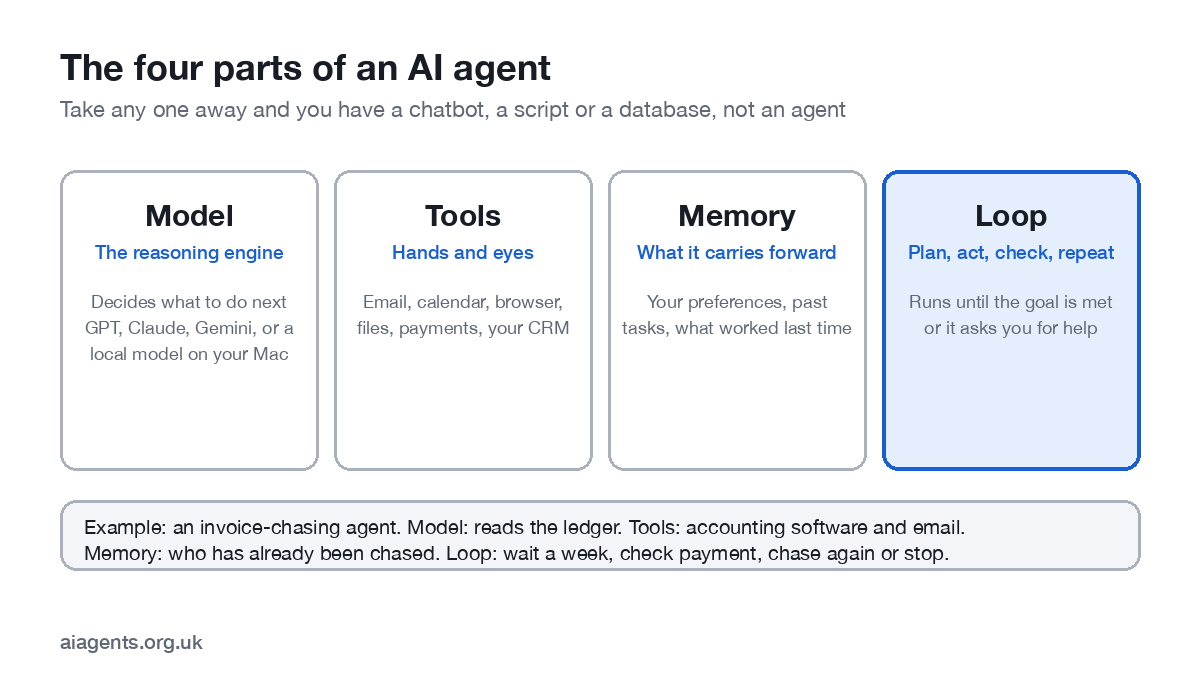
So a modern AI agent has four parts. A model, the reasoning engine, which may be a cloud model such as GPT or Claude or a smaller model running on your own machine. Tools: email, calendar, browser, files, your CRM, payments. Memory: what it carries from one task to the next. And the loop: plan, act, check, repeat until done. If you are reading product pages, this is a useful test rather than a strict rule. No tools means it is a chatbot. No loop means it is an assistant. No memory means every day starts from scratch, which is fine for some single-task agents. Anthropic's engineering guide draws the line in a similar place: an agent is a system where the model directs its own steps and tool use, rather than following a script.
AI agent vs chatbot vs AI assistant
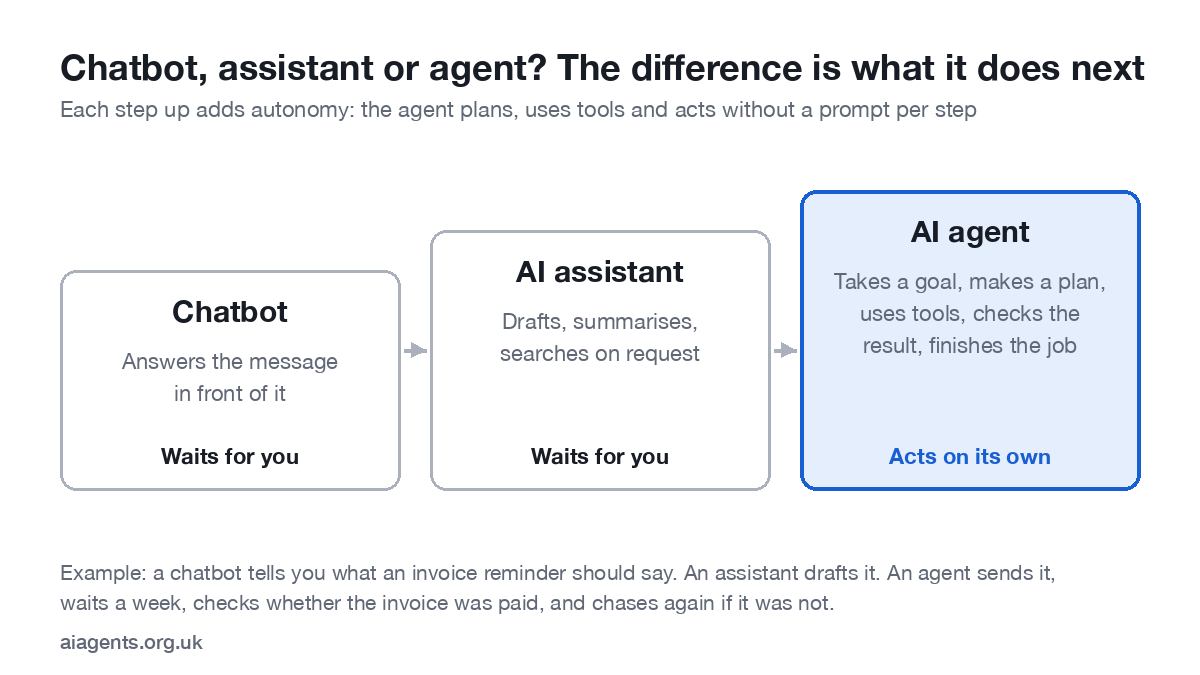
The three words get used interchangeably in marketing, and the difference is simpler than the marketing suggests. It is about what the system does after it has produced some text.
| Chatbot | AI assistant | AI agent | |
|---|---|---|---|
| Input | A message | A request, with your context | A goal |
| Output | An answer | A draft, a summary, a search result | A finished task, with a log |
| Uses tools? | No | Sometimes, on request | Yes, as it decides |
| Acts without a prompt per step? | No | No | Yes |
| Invoice example | Tells you what a reminder should say | Drafts the reminder | Sends it, waits, checks payment, chases again |
Most people searching for a personal AI assistant actually want a mild agent: something that handles the inbox and diary without a prompt for each step. If that is you, Personal AI assistant: the 2026 guide covers the options and prices.
How do AI agents work?
Every agent runs the same loop, however it is branded. A goal comes in. The model turns it into a plan. It calls a tool and reads what came back. It judges whether the goal is met; if not, it plans the next step. That loop runs until the task is finished, until it hits a step it has been told to ask about, or until it fails and hands back.
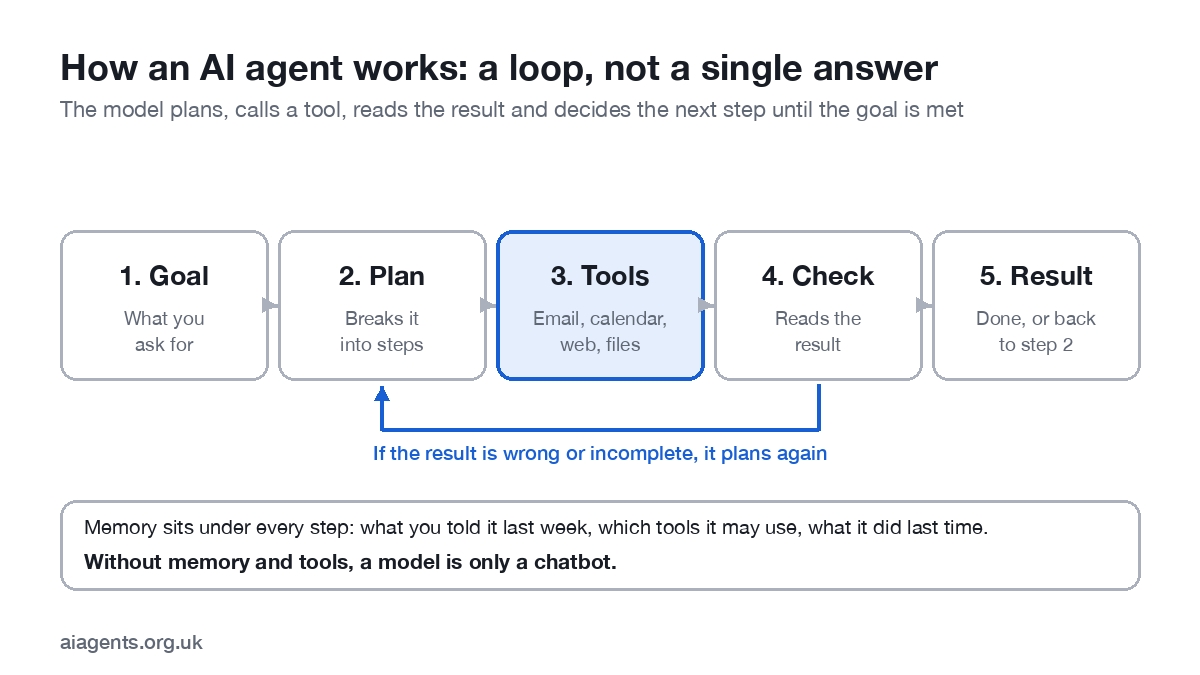
Two parts of that loop deserve your attention when you set one up. The tool list is the agent's permissions: an agent that can read your calendar is low risk, one that can send money is not, and you should be able to see and edit the list. The stop points are the actions that always need a human. Good platforms let you mark these; good practice is to mark anything irreversible, which means sending, paying, deleting and publishing.
Types of AI agents
Textbooks divide agents by how they decide (reflex, model-based, goal-based, utility-based, learning). For choosing a product, a split by what they do for you is more useful.
| Type | What it does | Typical products | Who it suits |
|---|---|---|---|
| Personal assistant agent | Inbox, diary, reminders, research for one person | Assistant tiers of ChatGPT, Claude, Gemini, Copilot; on-device tools | Individuals and sole traders |
| Task agent | One repeating business job, end to end | No-code agent builders, workflow tools with AI steps | Small firms automating admin, support or sales |
| Coding agent | Writes, runs, tests and fixes code | Claude Code, Codex, Cursor and similar | Developers; the most mature category |
| Browser agent | Operates websites on your behalf | Browser extensions and built-in agents | Form filling, booking, price checking |
| Multi-agent system | Several agents passing work between them | Enterprise platforms, developer frameworks | Larger firms with technical teams |
The wider term for all of this is agentic AI. If you want the category explained, with the difference between a workflow and a true agent and how to spot "agent washing", read What is agentic AI?
What can AI agents do? Examples that work today
The reliable examples share three traits: the task repeats, the rules are mostly clear, and a mistake is cheap to catch. These are the eight jobs UK firms tend to hand over first.
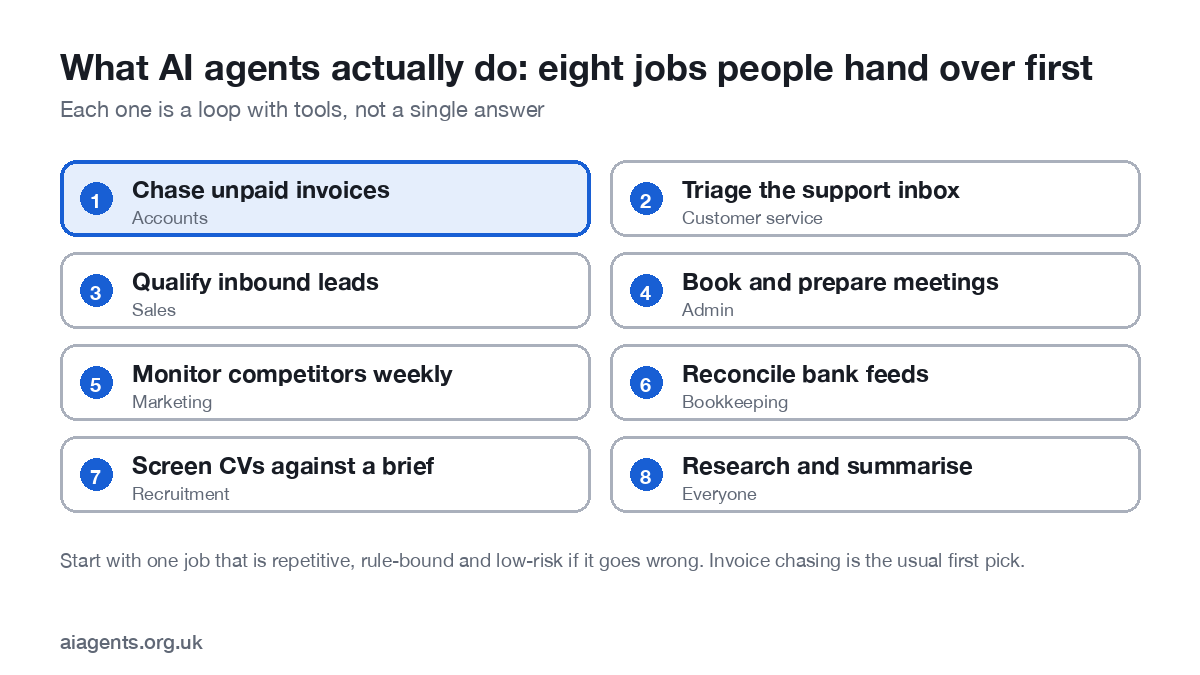
- Chase unpaid invoices. Reads the ledger, sends reminders in your tone, waits, checks whether payment arrived, escalates or stops.
- Triage the support inbox. Answers routine questions, routes the rest with a summary, tags and logs everything.
- Qualify inbound leads. Looks up the company, scores it against your rules, drafts a tailored reply, offers meeting times.
- Book and prepare meetings. Finds a slot, sends the invite, assembles a one-page brief from past emails.
- Monitor competitors. Checks named sites weekly, summarises what changed, flags price moves.
- Reconcile bank feeds. Matches transactions to invoices, queries the exceptions.
- Screen CVs. Scores applications against a written brief, drafts the shortlist; a human makes every decision.
- Research and summarise. Searches dozens of sources, cross-checks, writes a cited report.
Sector-by-sector guides, with costs in pounds, start with AI agents for UK small business. To compare ready-made agents, see AI agent marketplaces, rated and the best new AI agents on Product Hunt.
What AI agents can't do yet
- Long, open-ended tasks with many judgement calls. Agents drift, lose the thread, or confidently finish the wrong job. Keep tasks bounded.
- Resist manipulation. An agent that reads the web or your inbox can be steered by text written to steer it. This is why the tool list and stop points matter.
- Know what they do not know. They will guess rather than stop. Build in the stop.
- Replace a person wholesale. The ICO and the business surveys agree: in UK SMEs, AI is currently supporting staff rather than replacing them. Expect the same from an agent.
Gartner expects more than 40% of agentic AI projects to be cancelled by the end of 2027, mostly on cost and unclear value. The projects that survive are the narrow, well-logged ones.
Are AI agents safe?
An agent is as safe as the access you give it and the checks you keep. Three controls cover most of the risk. Narrow permissions: the agent can reach only the systems its job needs. A human on anything irreversible: sending, paying, deleting, publishing. A full log: every action, every tool call, kept where you can read it.
In the UK there is a fourth: data protection. The Information Commissioner's Office published its early thinking on agentic AI in January 2026 and has said UK GDPR applies in full, with dedicated guidance on agentic systems in its 2026/27 workplan. The questions it raises (what data the agent can reach, your lawful basis, whether it makes decisions about people, whether you need a DPIA, whether you can explain and correct what it did) are covered in AI agents and UK GDPR: what the ICO expects.
What does an AI agent cost in the UK?
| Option | Typical UK price (October 2026) | What you get | Best for |
|---|---|---|---|
| Assistant tier of a cloud model | About £16-20 a month | A capable general assistant with some tools; limited autonomy | Individuals trying it out |
| No-code agent platform | About £20-80 a month per user | Build task agents in plain English, connect your apps, approval steps | Small firms with one or two jobs to automate |
| Workflow tool with AI steps | Free tier, then about £15-50 a month | Fixed workflows with AI inside; the predictable option | Firms whose process is already written down |
| Developer frameworks | Model usage only, pay as you go | Full control, full responsibility | Firms with technical staff |
| On your own Mac | £0 beyond the hardware | Private, offline, no subscription; smaller models | Anyone handling client or personal data |
Prices are approximate, in sterling, and change often; check each vendor's UK page. The price that matters more is the cost of a mistake, which is why the first agent should be given a job where a mistake is cheap.
How to choose your first AI agent
- Pick one job that repeats weekly, follows rules you can write down, and would not hurt much if done wrong. Invoice reminders and inbox triage are the usual choices.
- Write the rules first. If you cannot describe the job to a new temp in a page, an agent will not manage it either.
- List the tools it needs and give it those only. Read access before write access.
- Mark the stop points. Anything irreversible needs a human.
- Run it for 30 days with every action logged and reviewed weekly. Widen its remit only when the log is boring.
- Write down your lawful basis and, if it touches customer data at scale, do a DPIA. See the ICO guide.
Cloud agent, or one on your own computer?
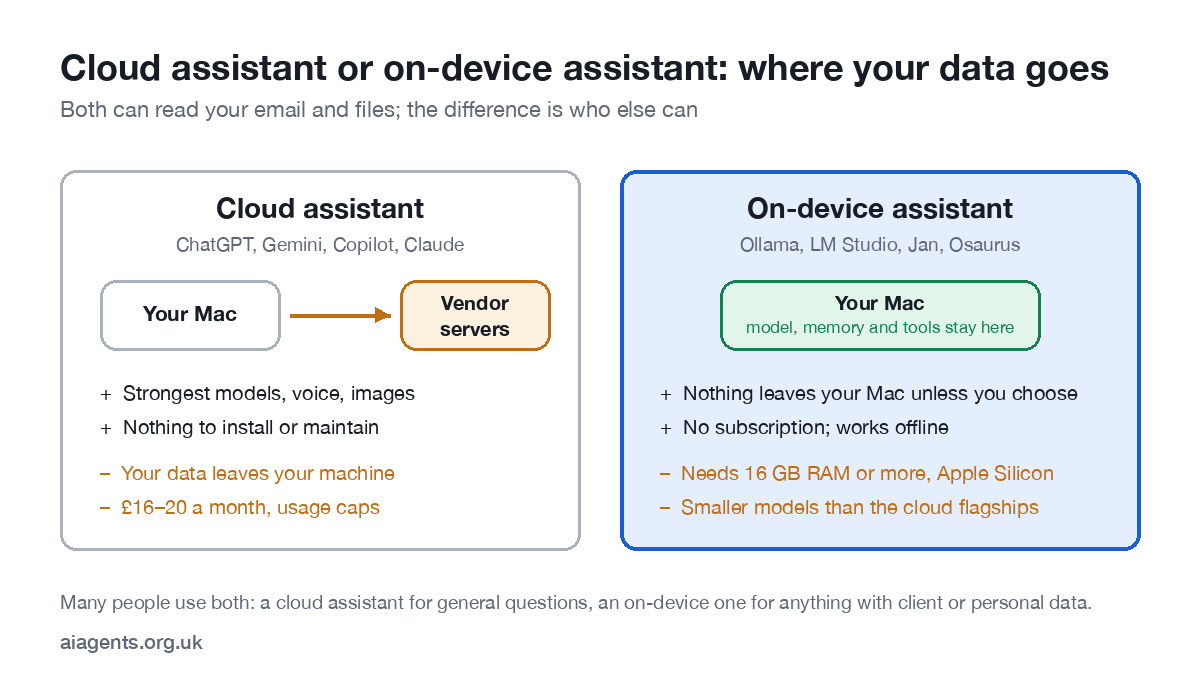
Most agents run in a vendor's cloud: your emails, files and instructions go to their servers, where the model lives. That is fine for many jobs and gives you the strongest models. For anything that touches client or personal data, a growing number of people run the agent on their own machine instead. On a Mac with Apple Silicon and 16 GB or more of memory, a local model can run the whole loop with nothing leaving the device, at no subscription cost, with the trade-off that local models are smaller than the cloud flagships.
Our setup guide is Run AI agents on your own Mac.
Frequently asked questions
What is an AI agent in simple terms?
An AI agent is software you give a goal to, which then works out the steps, uses tools such as email or a browser, checks its results and keeps going until the job is done or it needs you. A chatbot answers; an agent acts.
How is an AI agent different from a chatbot?
A chatbot answers the message in front of it and waits. An agent can take a goal, make a plan, use tools, check the result and repeat without a prompt for each step. The loop and the tools are the difference.
What can AI agents do?
Today's reliable uses are repetitive, rule-bound tasks: chasing invoices, triaging a support inbox, qualifying leads, booking meetings, monitoring competitors, reconciling bank feeds, screening CVs, and research with cited sources.
What can't AI agents do yet?
They are unreliable on long, open-ended tasks with many judgement calls, they can be manipulated through the content they read, and they do not know what they do not know. Anything irreversible should still need a human.
Are AI agents safe?
They are as safe as the access you give them. Narrow permissions, a human approval step for irreversible actions, and a full log cover most of the risk. In the UK, UK GDPR applies in full; see our ICO guide.
How much does an AI agent cost in the UK?
A personal assistant tier is about £16 to £20 a month. No-code agent platforms for small firms run from roughly £20 to £80 a month per user. Running an agent on your own Mac costs nothing beyond the hardware.
Do I need to know how to code?
No. Several platforms let you describe the agent in plain English and connect tools with a click. You do need to decide what it may touch and when it must ask you.
Related guides
- The best new AI agents on Product Hunt, reviewed
- AI agent marketplaces: 20 stores reviewed with UK prices
- Types of AI agents: the five you can actually buy
- AI agent vs chatbot vs assistant
- 25 AI agent examples by department
- What is MCP? The plug that connects agents to tools
- How much do AI agents cost in the UK?
- AI agents for small business in the UK
Related: ready to make one? How to build an AI agent walks through six steps, with or without code.
Next: if you are deciding whether to use one, read AI agents and UK GDPR first. If you are deciding which one, start with AI agents for UK small business.



Pingback: ChatGPT Dots (OpenAI Dots): UK Price, Setup and Safety
Pingback: Claude Code: UK Pricing, Install Guide and How to Use It
Pingback: Hermes Agent UK Guide: Install, Costs and Safety (2026)
Pingback: Meta Muse UK Guide: Availability, Price and Safety
Pingback: Surgeflow review: free browser agent, pros and cons (2026)