MCP, the Model Context Protocol, is an open standard that lets an AI agent plug into tools and data the way a laptop plugs into a USB-C dock: one connector, written once, works everywhere. Before MCP, every agent needed custom code for every service it touched. Since it was created by Anthropic in late 2024 and handed to the Linux Foundation in December 2025, it has become the common language for agents to use email, calendars, databases and websites. This page explains what it does, why it matters to someone who will never write code, and the one thing you must manage: each connector is a permission.
Key facts
- What: an open standard for connecting AI agents to tools and data. The USB-C of agents.
- Who: created by Anthropic (November 2024); donated to the Agentic AI Foundation, Linux Foundation, on 9 December 2025. OpenAI, Google, Microsoft, AWS are members.
- Scale: about 97 million SDK downloads a month by mid-2026; roughly 9,400 to 17,000 public servers.
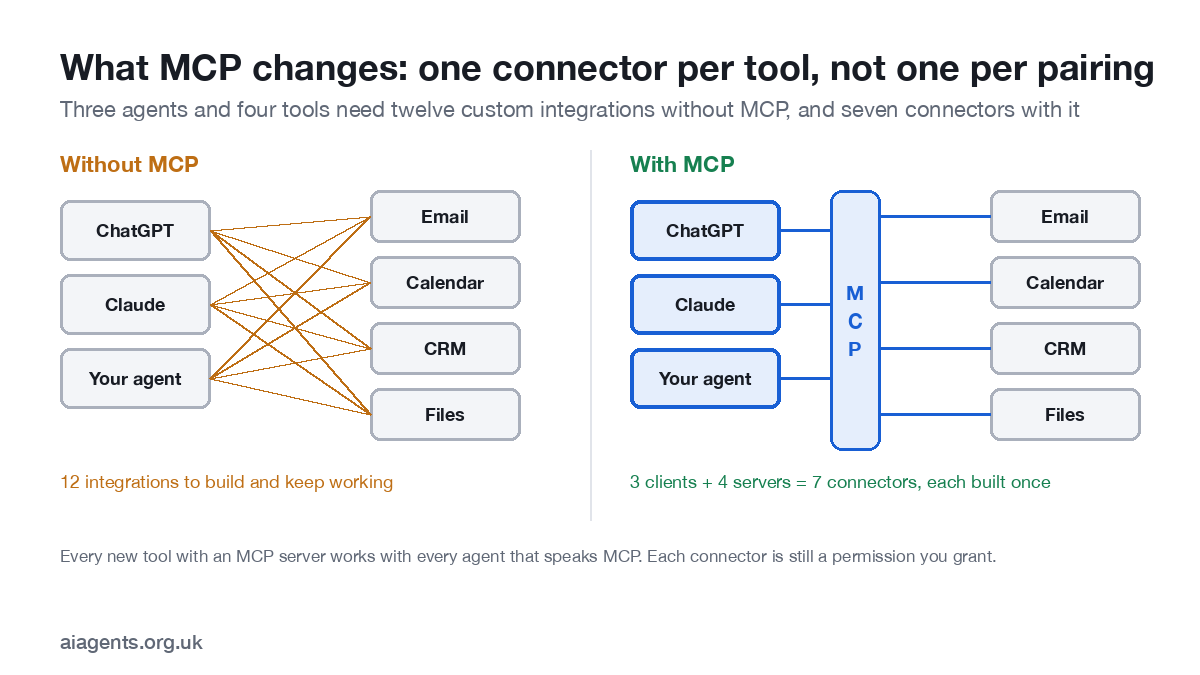
- Why you care: MCP support means an agent can use thousands of ready connectors. Each one is a permission you grant.
- Risk: 30+ security flaws filed in early 2026; "tool poisoning" is the attack to know.
On this page
- What is MCP in AI, and what problem does it solve?
- How MCP works
- Who is behind MCP?
- What does MCP mean for a non-developer?
- Is MCP secure?
- Does MCP work with local agents on a Mac?
- Frequently asked questions
- Sources
What is MCP in AI, and what problem does it solve?
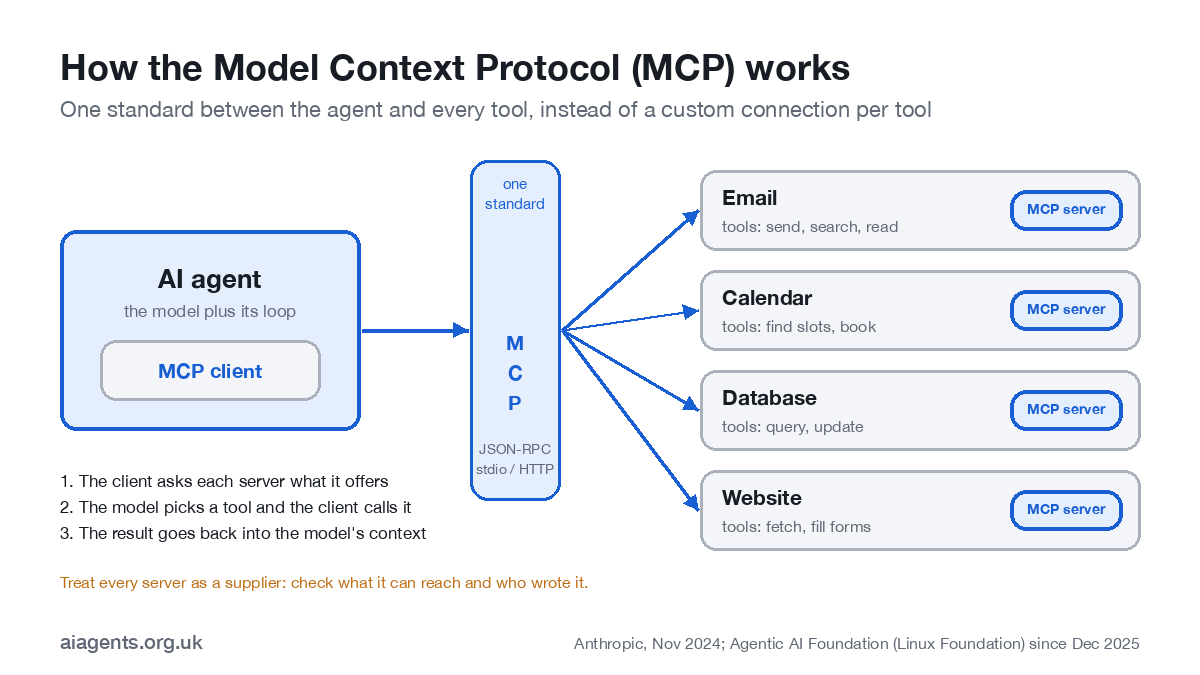
An agent is only as useful as the tools it can reach. Before MCP, connecting an agent to your calendar meant someone writing calendar-specific code for that agent; connecting it to your accounts software meant doing it again. Every agent product rebuilt the same hundred connectors, badly, and none of them worked with each other. MCP replaces that with a standard: a tool is wrapped once as an "MCP server", and any agent with an "MCP client" can discover what it offers and call it.
How does MCP work?
- A server wraps a tool. Someone writes a small MCP server for, say, your accounting software. It describes what it can do ("list unpaid invoices", "send a reminder") in a standard form.
- The agent connects. Your agent's MCP client connects to that server and reads the menu of actions.
- The model chooses. Given your goal, the model decides which actions to call and with what inputs.
- The server does the work and returns the result in the standard form; the model reads it and decides the next step.
- Repeat. This is the agent loop, with MCP as the plug between the model and the world.
The latest revision of the specification, dated 2026-07-28, made it stateless (it removed sessions and the start-up handshake), which is a technical change with a practical effect: connectors are simpler to run at scale and behind corporate gateways. Enterprise features such as audit trails and single sign-on were made the top priority in the March 2026 roadmap.
Who is behind MCP?
Anthropic published MCP in November 2024. On 9 December 2025 it donated the protocol to the Agentic AI Foundation, a directed fund under the Linux Foundation, with Block and OpenAI as co-founders and AWS, Google, Microsoft, Cloudflare and Bloomberg as platinum members. Google's agent-to-agent protocol, A2A, moved under the same foundation. The practical result is that MCP is nobody's product: Claude, ChatGPT, Gemini, Copilot in VS Code, Cursor and most agent platforms support it natively.
Adoption followed. Monthly downloads of the software kits rose from about 2 million at launch to about 97 million by mid-2026, and the number of public MCP servers was counted at somewhere between 9,400 and 17,000 depending on the directory. Fewer than 5% of those servers charge for use.
What does MCP mean for a non-developer?
- Buy agents that speak MCP. They can use the shared pool of connectors instead of waiting for the vendor to build each one.
- Read the server list as the tool list. The MCP servers connected to your agent are exactly what it can reach. This is the data-minimisation control UK GDPR asks for; see what the ICO expects.
- Prefer official or well-maintained servers. A connector for your bank written by a stranger is a connector for your bank written by a stranger.
- Expect it to be invisible. Done well, you will never see the letters MCP; you will see "connect your calendar" and it will work.
Is MCP secure?
MCP made agents more capable and, by the same move, gave attackers a new door. In January and February 2026 more than 30 MCP-related vulnerabilities were filed, including a remote-code-execution flaw rated 9.6 out of 10. The attack to understand is tool poisoning: a malicious connector hides instructions in its own description, and the model reads them as part of its briefing. The defence is the same as for any agent: a short list of connectors from sources you trust, read access before write access, a human approval step on anything irreversible, and a log you read.
Does MCP work with local agents on a Mac?
MCP is what makes a local agent on your Mac as capable as a cloud one. An agent harness running a local model can connect to the same MCP servers as ChatGPT or Claude, so your email, files and calendar tools work the same way while the model and its memory stay on your machine. Of the local tools, LM Studio has a built-in MCP client, AnythingLLM's agents can use MCP tools, and Jan has added support; Ollama relies on the client application. Setup is in Run AI agents on your own Mac.
Frequently asked questions
What does MCP stand for?
Model Context Protocol. It is an open standard for connecting AI agents to tools and data: email, calendars, databases, websites, files. One connector, written once, works with any agent that speaks MCP.
Who created MCP?
Anthropic, in November 2024. On 9 December 2025 it was donated to the Agentic AI Foundation under the Linux Foundation, with OpenAI and Block as co-founders and AWS, Google, Microsoft, Cloudflare and Bloomberg as platinum members.
Do I need to understand MCP to use an AI agent?
No. You need to know that it exists, that a tool with MCP support can use thousands of ready-made connectors, and that each connector is a permission you are granting. Treat the list of connected MCP servers as the agent's tool list.
Is MCP secure?
The protocol is neutral; the connectors vary. More than 30 MCP-related security flaws were filed in early 2026, and "tool poisoning", where hidden instructions in a connector steer the model, is a known attack. Use connectors from sources you trust and keep the list short.
What is the difference between MCP and an API?
An API is how one program talks to another in its own dialect. MCP is one shared dialect for agents to discover and call any tool, so the agent does not need custom code per service.
Related: to use MCP with a model running on your own computer, see LM Studio plugins and MCP.
Next: compare the local tools that use MCP in Ollama vs LM Studio vs Jan.
Read next
- Smithery review: a registry of MCP tools for AI agents
- AI agent marketplaces: 23 stores reviewed with UK prices
- Claude Code explained: UK pricing, install and how to use it
Sources
- SerpApi, The state of MCP: everything that changed in H1 2026 (June 2026) - governance, adoption figures, spec changes, CVEs
- Model Context Protocol, official documentation - the specification
- Kunal Ganglani, LM Studio vs Ollama 2026 (updated September 2026) - MCP support in local tools