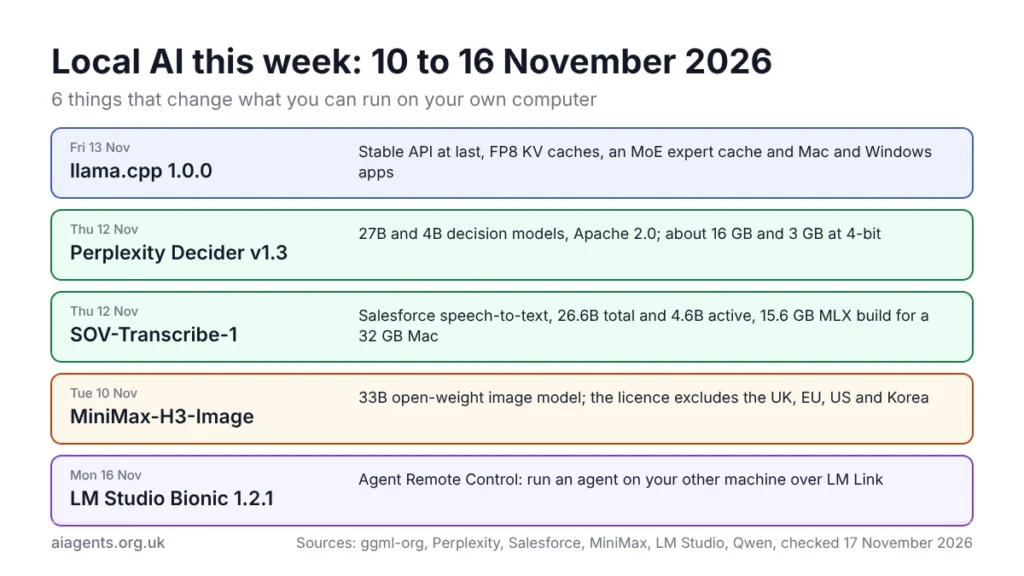
The biggest local AI story this week is llama.cpp reaching version 1.0.0 on 13 November, three and a half years after the first commit. The engine under Ollama, LM Studio and most other local AI apps now promises a stable API, adds FP8 KV caches and an expert cache for mixture-of-experts models, and has desktop apps for Mac and Windows from its own team. Around it: Perplexity published Decider v1.3, 27B and 4B models under Apache 2.0 that answer yes or no instead of writing text; Salesforce released a 26.6B speech-to-text model with 4-bit MLX builds for a 32 GB Mac; MiniMax put out a 33B open-weight image model whose licence excludes the UK; LM Studio let you drive an agent on another machine; and Alibaba launched Qwen4-Max with a promise of smaller open Qwen4 models to follow. Here is what each one means for what you can run on your own computer, checked against the makers' own pages on 17 November 2026.
This week in numbers
- llama.cpp v1.0.0 (13 November): semantic versioning from now on, 35 deprecated functions removed, FP8 KV caches, a host-memory MoE expert cache, four new text architectures and a /v1/audio/speech endpoint. ggml is 1.0.0 too. Over 150 model architectures supported.
- Perplexity Decider v1.3 (12 November): 26.1B dense on Qwen3.8-27B and a 4.5B Flash on Qwen3.5-4B, both Apache 2.0. About 16 GB and 3 GB at 4-bit. Community GGUF and MLX builds from 14 November; Ollama's library has pplx-decider (17 GB) and pplx-decider-flash (5.6 GB).
- SOV-Transcribe-1 (12 November): Salesforce, 26.6B total and 4.6B active, Whisper large-v3 encoder plus Gemma 4 26B A4B, Apache 2.0, seven languages, up to 30 minutes of audio. MLX 4-bit build is 15.6 GB, so a 32 GB Mac. No GGUF, not in Ollama.
- MiniMax-H3-Image (10 November): 33.1B dense diffusion transformer, 68.65 GB in BF16 plus a 66.7 GB text encoder. Community licence excludes the UK, EU, US and South Korea. Pruned GGUF builds of 6.9 to 14.1 GB exist.
- LM Studio Bionic 1.2.1 (16 November): remote control of agent sessions on your other machines over LM Link, llama.cpp 2.76.0 runtime packs, oMLX 0.4.0.
- Qwen4-Max (15 November): 2.4 trillion parameters, native vision, 1-million-token context, API only at 1.50 dollars in and 4.50 out per million tokens. Qwen says open weights for smaller Qwen4 models are coming.
- For a 16 GB Mac: Decider Flash (2.8 GB GGUF or 5.6 GB in Ollama) and the new Llama desktop app are the things to try. Decider 27B and SOV-Transcribe want 32 GB.
On this page
- llama.cpp 1.0: what changes for Ollama and LM Studio users
- Perplexity Decider v1.3: a 27B model that answers yes or no
- SOV-Transcribe-1: Salesforce's open speech-to-text model
- MiniMax-H3-Image: open weights, but not for the UK
- LM Studio Bionic 1.2.1: run an agent on your other machine
- Qwen4-Max and the small Qwen4 models to come
- Also this week
- What it means for a UK reader
- Frequently asked questions
- Sources
llama.cpp 1.0: what changes for Ollama and LM Studio users
Georgi Gerganov's team at Hugging Face tagged llama.cpp v1.0.0 and ggml v1.0.0 on 13 November. Until now every release was a build number (last week's roundup cited b12005), which said nothing about whether an update would break the app on top of it. From 1.0.0 a major version bump means a breaking change to the public C API, a minor one adds features or models, and a patch fixes bugs. The release is a clean-out as much as a milestone: 35 deprecated functions go, the NextN speculative-decoding API moves into the public header, and in come FP8 KV caches (long contexts in less memory), a host-memory cache for mixture-of-experts expert weights, support for Kimi K3.1 Pro, Ripple-65B, xing4_0 and the drama-3 text-to-speech model, a /v1/audio/speech endpoint on the server, security fixes and a redesigned web UI.
For a Mac owner the practical change is distribution: Homebrew, MacPorts, conda-forge and an XCFramework for iOS and macOS, plus new Llama desktop apps for macOS and Windows from the llama.cpp team and Hugging Face. If you use Ollama or LM Studio you will not see a 1.0 badge; both bundle their own build, and Bionic 1.2.1 already ships the 2.76.0 runtime pack. What you get is fewer surprise breakages underneath the app you actually use, and two features to watch: the FP8 KV cache and the MoE expert cache are what will let a 64 GB machine hold a longer context or a bigger sparse model than it could last month.
Perplexity Decider v1.3: a 27B model that answers yes or no
Perplexity released Decider v1.3 and Decider Flash v1.3 on 12 November, both on Hugging Face under Apache 2.0. They are decision models like the d3 and AutoTrust models Ollama added in October: give them a state (text, JSON or an image) and typed questions, and they return a calibrated probability for each answer in one forward pass, without generating a token. The big one is 26.1 billion parameters fine-tuned from Qwen3.8-27B; Flash is 4.5 billion, distilled from it on Qwen3.5-4B. New in v1.3 is locate, which pulls exact text spans out of the input with character offsets, so the same model can find the postcode in a letter. Perplexity's own figures put v1.3 at 76.99 per cent across five image-classification tasks and Flash at 72.77; like all vendor benchmarks they are Perplexity's until someone else runs them.
This is the most useful new download of the week for anyone building a local agent, because routing, gating and checking are the jobs a chat model does badly and slowly. At 4-bit the 27B weights are about 16 GB (mlx-community's MLX build is 15.4 GB plus a 1.9 GB locate adapter; PsychoLogic's IQ3_M GGUF is 12.6 GB), so a 32 GB Mac. Flash fits anywhere: vblanco's IQ4_XS GGUF is 2.8 GB plus a 0.7 GB vision projector. Ollama's library carries pplx-decider at 17 GB and pplx-decider-flash at 5.6 GB, used as ollama run pplx-decider-flash --ask "Is a refund being requested?"; check the tag dates, because those entries predate v1.3 and the new weights were still appearing as user uploads on 17 November. Wiring a decision model into an agent loop is covered in how to run AI agents on your Mac.
SOV-Transcribe-1: Salesforce's open speech-to-text model
Salesforce put SOV-Transcribe-1 on Hugging Face on 12 November under Apache 2.0. It joins the Whisper large-v3 audio encoder to Google's Gemma 4 26B A4B mixture-of-experts model: 26.6 billion parameters in total, 4.6 billion active per token. It transcribes up to 30 minutes of audio in English, French, German, Spanish, Italian, Portuguese and Dutch, and because the back half is a language model you can steer it with plain instructions: verbatim or tidied, how to write numbers, a list of names to bias towards. The model card says it was the top open-weight non-streaming speech-to-text system on Artificial Analysis on 12 November, seventh overall.
Officially it runs in vLLM and Transformers, which means a CUDA GPU. Unofficially the Mac path arrived within two days: nativ-community and TypeWhisper posted 4-bit MLX builds for mlx-audio at 15.6 GB, so a 32 GB Mac with room to spare. There is no GGUF and it is not in Ollama or LM Studio, so this is a terminal job for now. With only 4.6B parameters firing per token it should be far faster than a dense 27B model, which matters when the input is an hour of meeting audio. Where a self-hosted transcription box sits against the cloud services is in the self-hosted LLM guide.
MiniMax-H3-Image: open weights, but not for the UK
MiniMax released H3-Image on 10 November: a 33.1-billion-parameter dense diffusion transformer that generates and edits images of about 16 megapixels, up to 4096 by 4096, in six sampling steps, with up to 16 reference images. It went straight to the top of Hugging Face trending, with a ComfyUI release and pruned GGUF builds from 6.9 GB at Q2_K to 14.1 GB at Q5_K_M. Two things stop it being a Mac story. The DiT alone is 68.65 GB in BF16 and it needs the 66.7 GB MiniMax-H3 text encoder as a separate download, so even the pruned GGUFs lean on an encoder most people cannot hold in memory.
The second is the licence, and it is why this item is here. The MiniMax-H3-Image Community License grants rights only within an "Applicable Territory", and its definitions name the Excluded Territories as the European Union, the United Kingdom, the Republic of Korea and the United States of America. Section IV.4 says the works and their outputs may not be used, modified or displayed outside that territory; MiniMax says people in excluded territories can contact it for a separate licence. So a UK reader can read about it and that is all. It is the first open-weight release we have seen that names the UK specifically, and worth watching whether others follow. The general rules on open-weight licences are in is it safe to run Chinese AI models on your Mac?.
LM Studio Bionic 1.2.1: run an agent on your other machine
LM Studio shipped Bionic 1.2.1 on 16 November with Agent Remote Control. Any machine running Bionic, or the headless llmster daemon, can switch on "Allow remote agent control", after which your laptop can create projects and sessions on it, watch the agent work and pick a session up later; typing @ in the composer hands a task to a named device. It travels over LM Link, LM Studio's end-to-end encrypted link between your own devices built with Tailscale, which until now only let you use a big model loaded on one machine from another. The release also brings llama.cpp 2.76.0 runtime packs, oMLX 0.4.0 for Apple silicon and a fix for AGENTS.md instructions being lost after compaction.
The use case is one UK home users will recognise: a MacBook in the living room and a mini PC or Mac Studio with 64 GB or more under the desk. Give the agent the big machine, close the lid, and come back to a finished job. It is free, but it is a Bionic feature, so you need LM Studio's agent app rather than the classic chat app, and both ends must be on your device network. How Bionic compares with the Ollama and Jan routes is in Ollama vs LM Studio vs Jan.
Qwen4-Max and the small Qwen4 models to come
Alibaba's Qwen team launched Qwen4-Max on 15 November, the first model of the Qwen4 generation: a mixture-of-experts model with a 2.4-trillion-parameter backbone, native vision and a one-million-token context, at 1.50 dollars per million input tokens and 4.50 out on QwenCloud. None of that runs at home and the weights are not public. The line that matters here is the last one in Qwen's announcement: "The open weights of smaller Qwen4 models will be released." Qwen3.8-27B is the base of this week's Decider, last week's Arete and much of what people actually run on a 32 GB Mac, so a Qwen4 at that size would be the biggest local story of whichever week it lands. Which machine to have ready is in the best Mac or mini PC for local AI.
Also this week
- Hugging Face and OpenRouter (16 November): Hugging Face switched its Inference Providers router to OpenRouter's, so any open-weight model on the Hub that a provider serves can be called with a Hugging Face token and gets retried on another provider if one fails. The post's numbers: open-weight models went from 26.8 per cent of OpenRouter's tokens in October 2025 to 71.7 per cent in September 2026, and cost about four times less than closed ones.
- Ollama (9 and 10 November): v0.40.16 landed on the Sunday before this week with Ripple Preview in the library, Qwen3.8 Flash Next using about 27 GiB less memory on Apple silicon and CUDA 13.5 for Windows on Arm; the v0.40.17 release candidate on 10 November adds concurrent generation on MLX and mmap for Vulkan integrated GPUs. No stable release between 10 and 16 November.
- Zyphra ZONOS3-Mini (9 November): a text-to-speech model with 100 million active parameters, 43 languages and voice cloning, Apache 2.0, with GGUF files and a WebGPU version that runs in the browser with no install.
- Huawei MACaQ (11 November): an open toolkit that produces 2-bit, 3-bit and 4-bit GGUF files for llama.cpp across text, image, video and audio models; vblanco's Decider Flash GGUFs above were made with it.
- Runway Praxis-1 (13 November): a 27B open-weight model for controlling real robots, interesting as a sign of where open weights are going rather than something to run on a Mac.
- Meta Muse Ember (9 November): Meta's smallest and cheapest Muse model for repetitive agent tasks is API only. The weights are not open, whatever the headlines implied.
What it means for a UK reader
- 8 GB or 16 GB Mac or laptop: try Decider Flash (
ollama run pplx-decider-flash --ask "...") as the router or checker in a local agent, and install the new Llama desktop app if you want llama.cpp without Ollama or LM Studio in between. ZONOS3-Mini gives you offline speech in 43 languages in a browser tab. - 32 GB: Decider 27B at about 16 GB and SOV-Transcribe-1 at 15.6 GB in MLX are the two new downloads. Not both at once.
- 64 GB and up, or a 128 GB mini PC: nothing new this week needs the memory, but llama.cpp 1.0's FP8 KV cache and MoE expert cache are the features that will let these machines stretch further, and LM Studio's remote control is the reason to leave the big box switched on.
- Small business: Decider, SOV-Transcribe-1 and ZONOS3-Mini are plain Apache 2.0. MiniMax-H3-Image is not licensed for use in the UK at all; do not build on it without the separate licence MiniMax offers. A transcription model that never leaves your office is a clean answer to the questions in AI agents and UK GDPR.
Frequently asked questions
Do I need to update anything for llama.cpp 1.0?
Not if you use Ollama or LM Studio: both bundle their own llama.cpp build and will pick up 1.0-era changes in their normal updates. If you run llama.cpp directly from Homebrew or source, 1.0.0 removes 35 deprecated functions and the --defrag-thold flag, so scripts and wrappers that used them need a small edit. From now on only a major version bump means a breaking change.
What is a decision model and why would I run one locally?
A decision model such as Perplexity Decider reads text or an image and returns a probability for each option of a question you set, in one forward pass, without writing any text. That makes it fast and consistent for routing requests, checking a condition before an agent acts, grading an answer or extracting a span. Locally it keeps the text being classified on your machine, and Decider Flash at 2.8 to 5.6 GB fits any current Mac.
Can I run SOV-Transcribe-1 on a Mac?
Yes, with a 32 GB Mac and the terminal. The official paths are vLLM and Transformers on a CUDA GPU, but community 4-bit MLX builds for mlx-audio appeared on 12 and 14 November at 15.6 GB. There is no GGUF yet, so it is not in Ollama or LM Studio.
Can I use MiniMax-H3-Image in the UK?
Not under the published licence. The MiniMax-H3-Image Community License applies only within its Applicable Territory, which excludes the United Kingdom, the European Union, the United States and South Korea, and it says the works and their outputs may not be used outside that territory. MiniMax invites people in excluded territories to contact it for a separate licence.
More guides: pick the right machine in the best Mac or mini PC for local AI, set up the software with the Ollama guide or the LM Studio guide, compare the apps in Ollama vs LM Studio vs Jan, run an agent on it with how to run AI agents on your Mac, and see what it costs to go further in the self-hosted LLM guide.
Sources
- llama.cpp on GitHub, v1.0.0 release notes and Hugging Face blog, llama.cpp v1.0.0: a stronger foundation for the local AI ecosystem: versioning rules, API removals, FP8 KV cache, MoE cache, new models, distribution channels, desktop apps
- Perplexity, Decider v1.3: training, eval and use cases (12 November 2026), Hugging Face, perplexity-ai/pplx-decider-v1.3 and pplx-decider-flash-v1.3: parameters, base models, licence, locate, benchmarks
- Hugging Face, mlx-community pplx-decider-v1.3-4bit, PsychoLogic IQ3_M GGUF and vblanco Decider Flash GGUF: file sizes
- Ollama library, pplx-decider and pplx-decider-flash: build sizes, systemone endpoint, --ask usage
- Hugging Face, salesforce-sovereign-intelligence/SOV-Transcribe-1 model card and nativ-community SOV-Transcribe-1-4bit: architecture, parameters, languages, licence, ranking claim, MLX file size
- Hugging Face, MiniMaxAI/MiniMax-H3-Image model card, its Community License and Abiray MiniMax-H3-Image GGUF: parameters, file sizes, excluded territories
- LM Studio, Introducing Agent Remote Control (16 November 2026) and Bionic changelog: 1.2.1 contents
- Qwen on X, Qwen4-Max announcement (15 November 2026) and Qwen, Research: parameters, context, pricing, open-weights promise
- Hugging Face blog, Hugging Face and OpenRouter join forces (16 November 2026): routing change, usage and price figures
- Ollama on GitHub, Releases: v0.40.16 and v0.40.17-rc1
- Hugging Face, Zyphra/ZONOS3-Mini: parameters, languages, licence, GGUF and WebGPU
- The Brief, Huawei's MACaQ (11 November 2026): toolkit scope
- Runway, Praxis-1 is now available: 27B open-weight robot model
- The Decoder, Alibaba's Qwen4-Max (16 November 2026) and Yahoo Tech, Meta launches Muse Ember: Qwen4 open-weights plan, Muse Ember as a hosted model
More issues: see every issue of Local AI this week. Previous issue: 27 October to 6 November 2026.