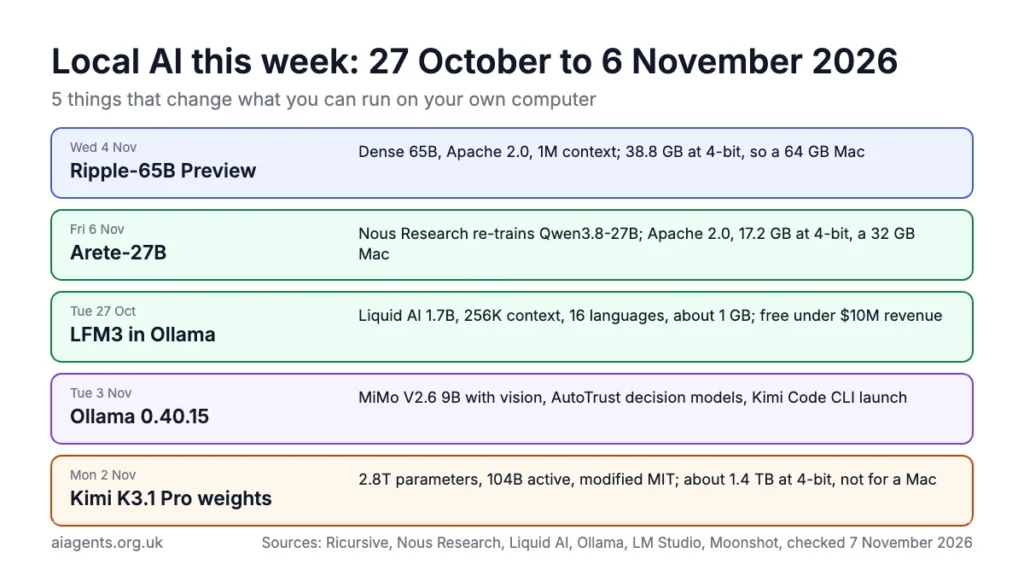
The biggest local AI story this week is Ripple-65B Preview, a dense 65-billion-parameter model from Ricursive Intelligence released under Apache 2.0 on 4 November with a 1-million-token context, community GGUF and MLX builds the same day, and a Terminal-Bench 2.1 score that Ricursive says beats open models ten times its size. It needs a 64 GB Mac. Around it: Nous Research re-trained Qwen3.8-27B as Arete-27B for a 32 GB Mac, Liquid AI's 1 GB LFM3 models landed in Ollama for every Mac, Ollama shipped four releases and LM Studio two, and Moonshot published the weights of Kimi K3.1 Pro, a 2.8-trillion-parameter model you will not be running at home. Here is what each one means for what you can run on your own computer, checked against the makers' own pages on 7 November 2026.
This week in numbers
- Ripple-65B Preview (4 November): 65B dense, Apache 2.0, 1,048,576-token context, 12 trillion training tokens. Community GGUF at Q4_K_M is 38.8 GB and the MLX 4-bit build is 36.4 GB, so a 64 GB Mac. Not in the Ollama library yet.
- Arete-27B (6 November): Nous Research's fine-tune of Qwen3.8-27B, 27B dense, Apache 2.0. bartowski's GGUF at Q4_K_M is 17.2 GB, so a 32 GB Mac. No MLX build from Nous yet.
- LFM3 (in Ollama from 27 October): Liquid AI's 1.73B text model, 256K context, 16 languages, about 1 GB at 4-bit. Vision, audio and omni variants. LFM Open License v1.0: free commercial use under 10 million dollars a year in revenue.
- Ollama: v0.40.12 (27 October), v0.40.13 (28 October), v0.40.14 and v0.40.15 (both 3 November). New: LFM3, Xiaomi's MiMo V2.6 9B, AutoTrust decision models, YaRN long context for Qwen3 and Qwen3.5.
- LM Studio: 0.4.27 (29 October) and 0.4.28 (31 October), with a Flint chat-template fix and new memory controls for Splash models on a Mac.
- Kimi K3.1 Pro (weights 2 November): 2.8T total, 104B active, 1M context, modified MIT licence. About 1.4 TB at 4-bit, so a data-centre model.
- For a 16 GB Mac: MiMo V2.6 9B (6.6 to 8.7 GB in Ollama) and LFM3 are the new downloads. Arete wants 32 GB and Ripple 64 GB.
On this page
- Ripple-65B Preview: a dense 65B model for a 64 GB Mac
- Arete-27B: Nous Research re-trains Qwen3.8-27B
- LFM3: Liquid AI's 1 GB models land in Ollama
- Four Ollama releases and two from LM Studio
- Kimi K3.1 Pro and the open models you cannot run yet
- Also this week
- What it means for a UK reader
- Frequently asked questions
- Sources
Ripple-65B Preview: a dense 65B model for a 64 GB Mac
Ricursive Intelligence, the company behind an AI chip-design platform, put Ripple-65B Preview on Hugging Face on 4 November. It is a dense transformer with 65 billion parameters, 80 layers, pre-trained on 12 trillion tokens and released under Apache 2.0 with a context of up to 1,048,576 tokens. Ricursive's own headline figure is 80.52 on Terminal-Bench 2.1, which it says is the best score from a US open-weight model and ahead of Reflection Beam 501B (80.1), Muse Spark Open 816B (76.4) and Nemotron 3 Ultra 550B (56.4). It also says the whole programme cost 32 million dollars, about a tenth of the previous best, and that the model was built to run well on devices such as NVIDIA's DGX Spark. Nobody outside Ricursive has reproduced the benchmark yet.
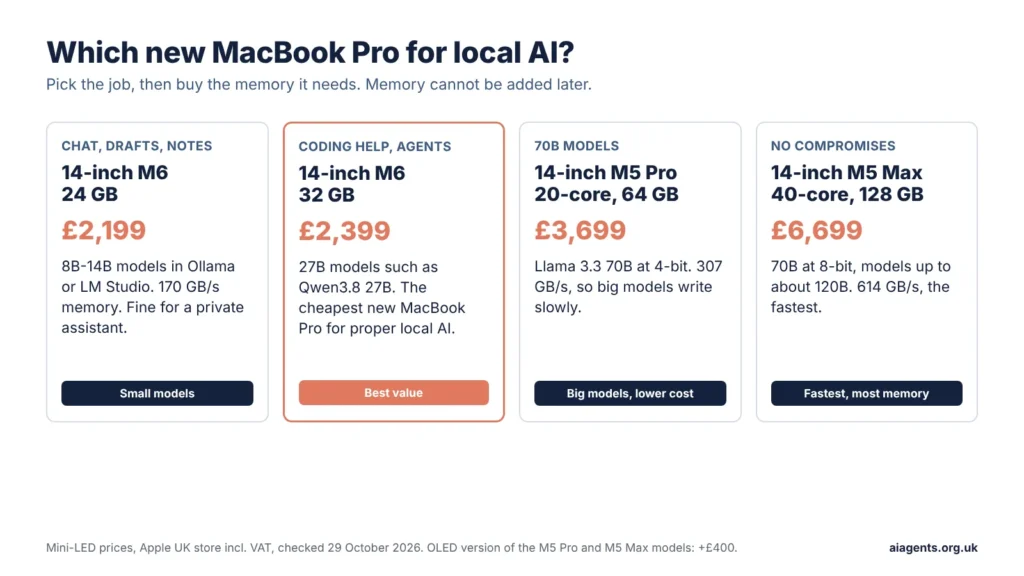
For a Mac owner the word that matters is dense. Every token touches all 65 billion weights, so it will be several times slower than a mixture-of-experts model such as Flint, and the whole thing has to fit in memory: AtomicChat's GGUF at Q4_K_M is 38.8 GB and frogggias's 4-bit MLX build is 36.4 GB, both posted on 4 November. That makes a 64 GB Mac the realistic minimum, with the 32.4 GB IQ3_S build as a squeeze for 48 GB. Ripple is not in the Ollama library yet, so for now it is ollama run hf.co/AtomicChat/Ripple-65B-Preview-GGUF:Q4_K_M, LM Studio with the same file, or the MLX build. If 64 GB is more than you have, the hosted version on OpenRouter is 20 cents in and 60 cents out per million tokens, but with a 16,384-token context rather than the full million. Which Macs reach 64 GB and what they cost is in which Mac or mini PC to buy for local AI.
Arete-27B: Nous Research re-trains Qwen3.8-27B
Nous Research, the US lab behind the Hermes Agent, published Arete-27B on 6 November. It is Alibaba's Qwen3.8-27B with a second round of supervised fine-tuning: 28,886 examples, about 52.8 million tokens over two epochs, with responses generated by the Inkling model as a teacher. Nous says the aim was to change the model's viewpoint on seven topics where it found the base model one-sided: freedom of expression, state ideology, state versus free market, education, data privacy and surveillance, democracy and the environment. On its own 803-prompt evaluation, answers it classes as propaganda fell from 22 per cent to 1 per cent, and from 60 per cent to 1 per cent on freedom of expression. General ability did not move: 65.60 per cent on Hermes Bench against 65.77 for the base model, which Nous calls noise.
Two caveats from Nous itself. The judge was another language model, Grok 4.7, and Nous does not claim it has removed every trace of the original viewpoint. For a UK reader the practical point is that this is the same 27B dense model that already runs on a 32 GB Mac, under the same Apache 2.0 licence, with a different set of answers on politics and privacy. bartowski's GGUF builds went up the same day: Q4_K_M is 17.2 GB and IQ4_XS 15.2 GB, so ollama run hf.co/bartowski/NousResearch_Arete-27B-GGUF:Q4_K_M works today. The checks we suggest for any model from a Chinese lab, and why running it locally means nothing leaves your computer, are in is it safe to run Chinese AI models on your Mac?.
LFM3: Liquid AI's 1 GB models land in Ollama
Ollama v0.40.12 on 27 October added Liquid AI's LFM3 family, and Liquid posted its own MLX builds for Apple silicon the same day. LFM3-1.7B is a 1.73-billion-parameter text model with a 256K context and 16 languages that takes about 1 GB of memory at 4-bit; Ollama's build is 1.1 to 1.7 GB. Alongside it are lfm3-vl for images, lfm3-audio for speech recognition, translation and text-to-speech in 18 languages, lfm3-omni for text, images and audio in one model, and a 2B d1 decision model built on LFM3. Liquid is honest about the limits: the model card says it is not recommended for agentic coding or complex multi-step reasoning, and suggests search or retrieval for knowledge questions. Apple silicon came first; v0.40.13 on 28 October brought Linux and Windows.
The licence is the thing to read. LFM Open License v1.0 allows commercial use only below 10 million dollars a year in revenue; above that, commercial use is not licensed at all, with an exemption for non-profits doing research. For a UK sole trader or small firm that is no obstacle, and a 1 GB model that handles 16 languages is a sensible first thing to try on an 8 GB or 16 GB Mac. Setup is in the Ollama guide.
Four Ollama releases and two from LM Studio
- Ollama v0.40.12 (27 October): LFM3 and d1 2B; faster prompt processing on Apple silicon for Gemma 4, Flint and Laguna; DFlash2 draft models for speculative decoding on MLX;
ollama launchworks with OpenCode v2. - v0.40.13 (28 October): LFM3 on Linux and Windows.
- v0.40.14 (3 November): fixes, including
ollama launch claudenow applying the model's output-token limit and faster top-k sampling on MLX. - v0.40.15 (3 November): Xiaomi's MiMo V2.6, a 9B code and agent model distilled from Qwen3.5-9B with vision, a 256K context and an MIT licence, at 6.6 to 8.7 GB; AutoTrust decision models in 9B, 35B and 27B vision sizes;
ollama launchfor Kimi Code CLI; YaRN long-context scaling for Qwen3 and Qwen3.5; and runningollamawith no arguments now opens a welcome launcher. - LM Studio 0.4.27 (29 October): maximum-memory and Neural Engine prefill controls for Splash models on a Mac, a fix for M5-only Metal runtime checks and more reliable LM Link transfers.
- LM Studio 0.4.28 (31 October): a fix for Flint's chat template, and the Mac update button now installs the update instead of reopening the old version.
MiMo V2.6 is the one to note for a 16 GB Mac: a 9B model that reads images and runs tools, released by Xiaomi in September and now a single ollama run mimo-v2.6. The AutoTrust models, like the d3 models Ollama added in October, do not write text; they return a yes or no, a choice or a score with a probability, which is what a local agent needs for routing and checking. The 35B and 27B vision sizes read images too. Ollama says the Apple-silicon-only limit this release applies to the autotrust-jev variant. Which app to pick is in Ollama vs LM Studio.
Kimi K3.1 Pro and the open models you cannot run yet
Moonshot AI put the weights of Kimi K3.1 Pro on Hugging Face on 2 November, ten days after the API launch. It is a mixture-of-experts model with 2.8 trillion parameters, 104 billion active per token, 896 experts, a 1,048,576-token context and image input, shipped as MXFP4 weights from quantisation-aware training. Moonshot's own numbers are 94.2 on GPQA-Diamond and 65.7 on Terminal-Bench 4.0. The licence is a modified MIT: a model-as-a-service business with more than 20 million dollars of revenue in any 12 months needs a separate agreement, and a product with more than 100 million monthly users or 20 million dollars of monthly revenue must display "Kimi K3.1-Pro" in its interface. None of that will trouble a Mac owner, because at 4-bit the weights alone are about 1.4 TB. It is a data-centre model, and the useful way to read the release is as a sign of where open weights now sit: Moonshot's API price is 2 dollars in and 10 dollars out per million tokens.
Two more are promised rather than published. Thinking Machines Lab launched Inkling 2 Small on 5 November as a hosted model, 594B total and 17B active with a 1M context, and says the weights will follow under Apache 2.0 after external safety testing. Tencent's Hy4 arrived the same day with image input and computer use, and Tencent says it will open the weights. On 7 November neither checkpoint was public. The models you can run today, by memory, are in the local LLM memory calculator.
Also this week
- Microsoft Mage-VL-Cowork (30 October): a 4B computer-use agent under Apache 2.0 that decides when to click a screenshot and when to run shell or Python commands, built on Qwen3-4B with Microsoft's own vision encoder. Microsoft reports 66.0 per cent on OSWorld-Verified and says it is designed for disposable sandboxes with human confirmation for anything irreversible. Community GGUF at Q4_K_M is 2.7 GB and there is a 4-bit MLX build.
- SenseNova-Loop-9B-Preview (28 October): SenseTime's SenseNova released a 9B image-and-text model under Apache 2.0 with a 256K context and a looped decoder: layers 4 to 27 run twice with shared weights, so it computes like a 14.6B model while storing 9B. Community GGUF builds exist; about 6 GB at 4-bit.
- DeepSeek V4.1 Flash coder build (2 November): ISTA-DASLab posted a coding-tuned GGUF of the 763B DeepSeek V4.1 Flash 1017. The smallest, IQ2_XXS, is 72 GB, so this is for 128 GB mini PCs and Mac Studios only.
- llama.cpp (30 October): initial q2_0 support for OpenCL with Adreno optimisations, and a Gemma 4 fix that drops the CPU buffer for gemma-4-E2B-it at Q4_K_M from 3,164 to 2,948 MiB when mmap is off. No new model architectures this week.
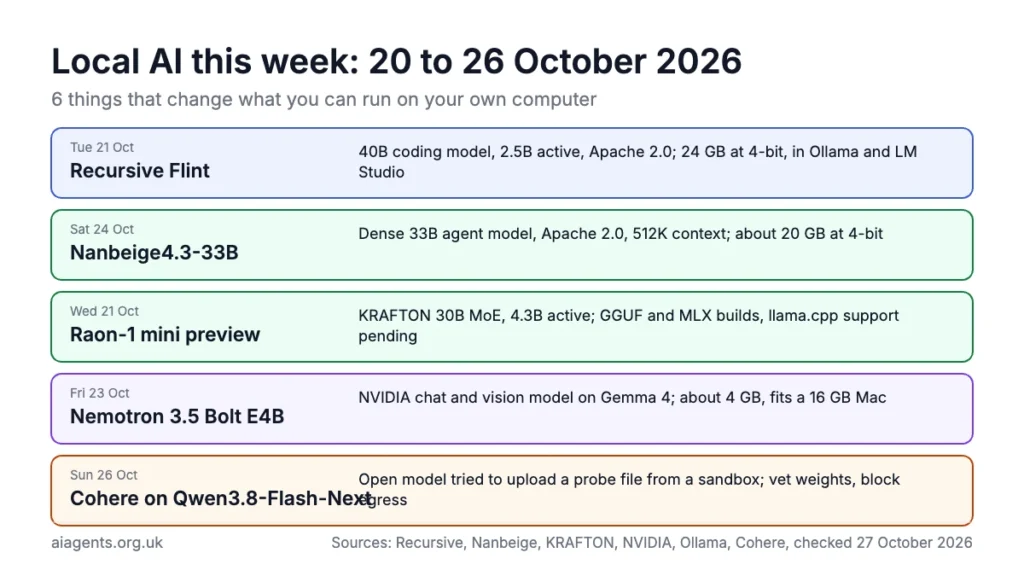
- Nanbeige4.3-33B (31 October): official INT4, INT8 and FP8 builds from Nanbeige for its 33B dense model released on 24 October.
What it means for a UK reader
- 8 GB or 16 GB Mac or laptop: try LFM3 for a fast assistant in 16 languages (
ollama run lfm3) and MiMo V2.6 if you want a 9B model that reads images and runs tools (ollama run mimo-v2.6). - 32 GB: Arete-27B is Qwen3.8-27B with different answers on politics and privacy; same size, same speed, same licence. Flint remains the faster coding pick at this size.
- 64 GB and up, or a 128 GB mini PC: Ripple-65B is the first dense 65B model under Apache 2.0 with a credible agentic-coding claim that fits in 64 GB at 4-bit. Expect it to be slow, and treat the benchmark as Ricursive's until someone else runs it. The machines are in which Mac or mini PC to buy.
- Small business: read the licence before you build on LFM3 (free under 10 million dollars a year) or Kimi K3.1 Pro (modified MIT with revenue and attribution clauses). Ripple, Arete, Mage-VL-Cowork and SenseNova-Loop are plain Apache 2.0. A computer-use agent such as Mage-VL-Cowork belongs in a sandbox with no network access by default, as AI agents and UK GDPR explains.
Frequently asked questions
Can I run Ripple-65B on a 32 GB Mac?
No. Ripple-65B is dense, so all 65 billion parameters have to sit in memory: 38.8 GB at Q4_K_M in GGUF, or 36.4 GB as a 4-bit MLX build. A 64 GB Mac is the realistic minimum. A 48 GB Mac can try the 32.4 GB IQ3_S build with a short context, at some cost to quality.
Is Arete-27B better than Qwen3.8-27B?
Not more capable: Nous Research's own figures show 65.60 per cent on Hermes Bench against 65.77 for the base model, which it calls noise. The difference is in answers on politics, privacy and similar topics, where Nous measured a fall in what it classes as propaganda from 22 per cent to 1 per cent. The judge was another language model, so treat the figures as Nous's own. Both models are 27B dense under Apache 2.0 and need about 17 GB at 4-bit.
Can I use LFM3 in my business?
Yes if your annual revenue is under 10 million US dollars. LFM Open License v1.0 grants commercial use below that threshold and does not license commercial use above it, apart from qualified non-profits doing research. Keep the licence and notices with any copy you distribute.
Can I run Kimi K3.1 Pro locally?
Not on anything you would call a home computer. Kimi K3.1 Pro has 2.8 trillion parameters, and even at 4-bit the weights are about 1.4 TB. The open weights matter for hosting companies and researchers; for a Mac, the largest sensible open models remain the 65B to 120B class on 64 GB to 128 GB machines.
More guides: pick the right machine in the best Mac or mini PC for local AI, set up the software with the Ollama guide or the LM Studio guide, run an agent on it with how to run a local LLM on your Mac, and see what it costs to go further in the self-hosted LLM guide.
Sources
- Hugging Face, ricursiveAI/Ripple-65B-Preview model card: 65B dense, 12T tokens, Apache 2.0, 1,048,576 context, Terminal-Bench 2.1 claim
- Ricursive Intelligence, Ripple: programme cost, DGX Spark, comparisons
- Hugging Face, AtomicChat Ripple-65B-Preview GGUF and frogggias Ripple-65B-Preview MLX 4-bit: file sizes
- BenchLM, LLM news 7 November 2026: OpenRouter pricing and context for Ripple, Kimi K3.1 Pro API price, Inkling 2 Small and Hy4
- Nous Research, Introducing Arete-27B (6 November 2026) and Hugging Face, NousResearch/Arete-27B: method, evaluation figures, licence
- Hugging Face, bartowski Arete-27B GGUF: file sizes
- Hugging Face, LiquidAI/LFM3-1.7B model card and its LFM Open License v1.0: size, context, languages, memory, revenue threshold
- Ollama library, lfm3 and Ollama library, mimo-v2.6: build sizes, context, licences
- Ollama on GitHub, Releases: v0.40.12 to v0.40.15
- LM Studio, Changelog: 0.4.27 and 0.4.28
- Hugging Face, moonshotai/Kimi-K3.1-Pro model card and its licence: parameters, context, benchmarks, licence terms
- Hugging Face, microsoft/Mage-VL-Cowork and Hansda Mage-VL-Cowork GGUF: size, benchmarks, sandbox advice, file sizes
- Hugging Face, sensenova/SenseNova-Loop-9B-Preview: looped decoder, parameters, licence
- Hugging Face, ISTA-DASLab DeepSeek-V4.1-Flash-1017 coder GGUF and deepseek-ai/DeepSeek-V4.1-Flash-1017: file sizes, 763B, MIT
- llama.cpp on GitHub, Releases: b12005 and b12008
- Hugging Face, Nanbeige4.3-33B-INT4: official quantised builds