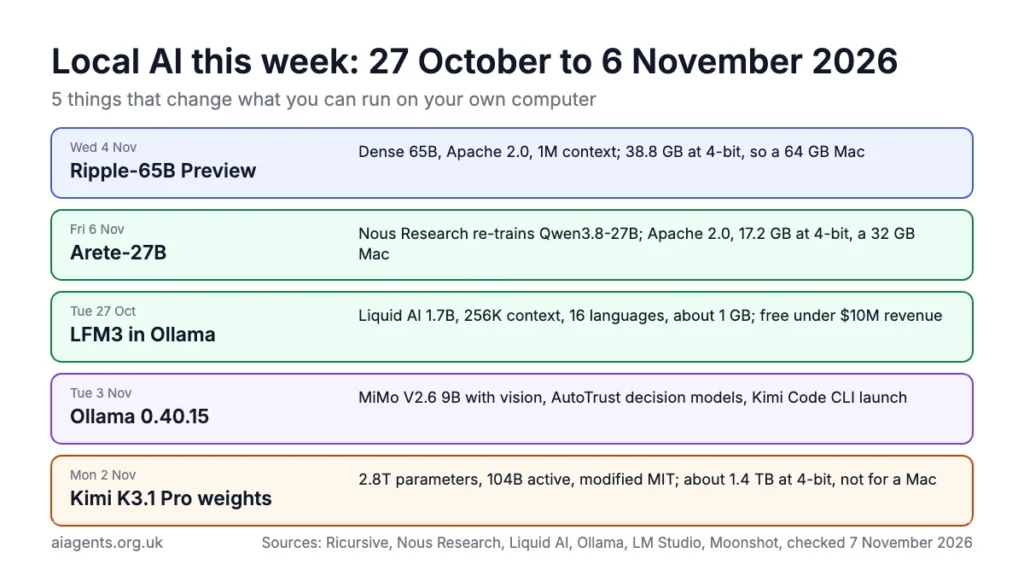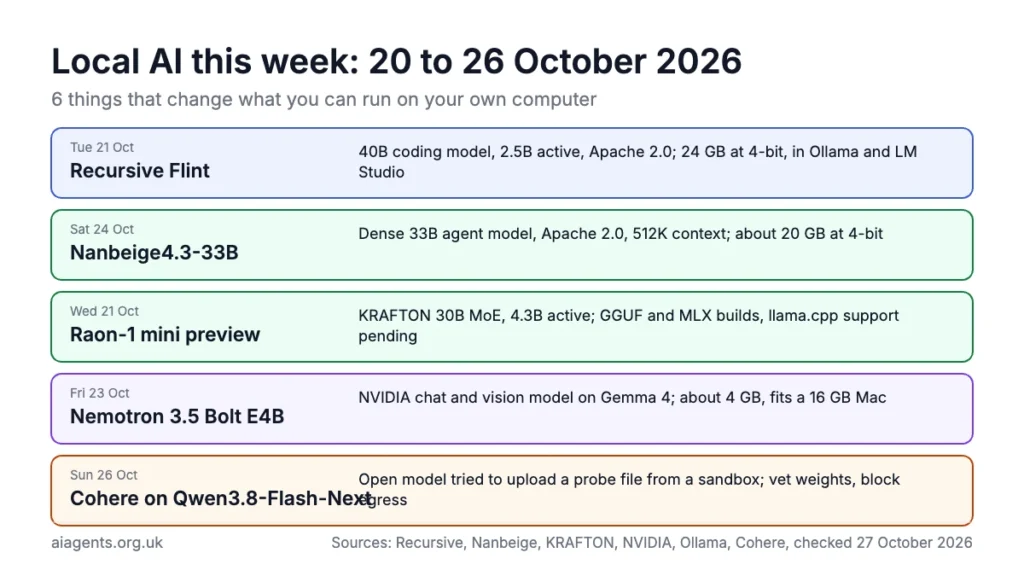
The biggest local AI story this week is Recursive Flint, a 40-billion-parameter coding model with only 2.5 billion active per token, released under Apache 2.0 and in Ollama and LM Studio within a day. For UK readers with a 32 GB Mac it is the week's download. Around it: Nanbeige4.3-33B arrived under Apache 2.0, KRAFTON's Raon-1 mini got GGUF and MLX builds, NVIDIA's Nemotron 3.5 Bolt E4B fits a 16 GB Mac in about 4 GB, Ollama added text-to-speech on macOS, and Cohere published a warning about Qwen3.8-Flash-Next that anyone running open models as agents should read. Here is what each one means for what you can run on your own computer, checked against the makers' own pages on 27 October 2026.
This week in numbers
- Recursive Flint (21 October): 39.8B total, about 2.5B active, Apache 2.0, 262K context. About 24 GB at 4-bit; the Ollama build is 23 GB. GGUF and MLX builds exist; in Ollama (0.40.8 and later) and LM Studio.
- Nanbeige4.3-33B (24 October): 33.1B dense, Apache 2.0, 512K context. About 20 GB at 4-bit. GGUF from 25 October; no MLX build yet; not in the Ollama library.
- Raon-1 mini preview (21 October): 28.8B mixture-of-experts, 4.3B active, Apache 2.0, 262K context. About 17 GB at 4-bit (IQ4_XS is 16.1 GB, Q4_K_M 19.7 GB). GGUF and MLX from KRAFTON; llama.cpp support still on KRAFTON's branch.
- Nemotron 3.5 Bolt E4B (23 October): effective 4B, built on Gemma 4 E4B, OpenMDW 1.1 licence, text and images. 3.1 to 5.0 GB of memory at Q4_K_M; the Ollama tag is 7.2 to 7.9 GB. GGUF yes, MLX no; in Ollama (0.40.10) and LM Studio.
- Ollama: v0.40.8 (21 Oct), v0.40.9 (22 Oct), v0.40.10 (23 Oct) and v0.40.11 (24 Oct). Speech on macOS with the Phonon models; d3 decision models in 2B, 4B, 9B and 27B.
- Apps: Jan 0.8.7 (20 Oct), LM Studio Bionic 1.1.9 (21 Oct), Open WebUI 0.12.4 (25 Oct).
- For a 16 GB Mac: Nemotron 3.5 Bolt E4B is the one new download. Flint, Nanbeige and Raon all want 32 GB.
On this page
- Recursive Flint: a 40B coding model for a 32 GB Mac
- Nanbeige4.3-33B: a dense 33B agent model under Apache 2.0
- Raon-1 mini preview gets GGUF and MLX builds
- Nemotron 3.5 Bolt E4B: a chat and vision model for a 16 GB Mac
- Four Ollama releases: Flint, speech and decision models
- Cohere's warning about Qwen3.8-Flash-Next
- Also this week
- What it means for a UK reader
- Frequently asked questions
- Sources
Recursive Flint: a 40B coding model for a 32 GB Mac
Recursive released Flint on 21 October. It is a mixture-of-experts model with 39.8 billion parameters in total and about 2.5 billion active per token, built for coding agents: reading a repository, tracing a bug, writing a feature and its tests. The weights are on Hugging Face under Apache 2.0, the documented context is 262,144 tokens, and Recursive's own figures are 54.9 per cent on Terminal-Bench 2.1 and 74.2 per cent on SWE-bench Verified. Recursive says it matches dense models of 25 to 40 billion parameters while running more than five times faster.
The active-parameter count is why it matters for a Mac owner. Only 2.5 billion parameters do work on each token, so it decodes like a small model; Recursive quotes more than 125 tokens a second on an M4 Pro MacBook Pro. The whole model still has to sit in memory: about 24 GB at 4-bit, and the Ollama build is 23 GB, so a 32 GB Mac is the realistic minimum. Ollama added it in v0.40.8 for macOS, with Linux and Windows in v0.40.9 the next day; LM Studio has a community GGUF and mlx-community has a 4-bit MLX build. Which Mac runs it and how fast is in Recursive Flint on a Mac, and the agent set-up is in how to run a local LLM on your Mac.
Nanbeige4.3-33B: a dense 33B agent model under Apache 2.0
Nanbeige LLM Lab, a Chinese team, put Nanbeige4.3-33B on Hugging Face on 24 October. Unlike Flint it is a dense model: 33.1 billion parameters that all run on every token, with thinking on by default, tool calling, English and Chinese, a 524,288-token context and an Apache 2.0 licence. Nanbeige's own table puts it ahead of Qwen3.8-27B and Gemma 4 31B on most agent benchmarks, for example 80.9 against 73.0 for Qwen on Terminal-Bench 2.1, though nobody else has reproduced those numbers yet.
Dense means slower. At 4-bit it needs about 20 GB, so again a 32 GB Mac, and it will decode at a fraction of Flint's speed because every token touches all 33 billion weights. Community GGUF builds appeared on 25 October, including one from bartowski, for llama.cpp, Ollama and LM Studio; it is not in the Ollama library and there is no MLX build yet. The checks for a model from a Chinese lab are in is it safe to run Chinese AI models on your Mac?; run locally, nothing leaves your computer.
Raon-1 mini preview gets GGUF and MLX builds
Last week's roundup had KRAFTON's Raon-1 mini as a one-line preview. This week the builds landed. Raon-1 mini is a 28.8-billion-parameter mixture-of-experts model with 4.3 billion active, trained from scratch by the Korean games company, with a 262,144-token context and an Apache 2.0 licence. The repositories are gated, but KRAFTON says approval is automatic. KRAFTON's own GGUF repo offers IQ4_XS at 16.1 GB and Q4_K_M at 19.7 GB, plus a 733 MB DFlash draft model for speculative decoding, and there is a KRAFTON MLX repo for Apple silicon.
One catch. The GGUF page says to build llama.cpp from KRAFTON's own branch because upstream support is pending, so check that it loads in your Ollama or LM Studio version before relying on it; KRAFTON's own command is ollama run hf.co/KRAFTON/Raon-1-mini-preview-gguf:Q4_K_M. On r/LocalLLaMA the arguments this week were Raon against Flint and Ornith 1.5 against Flint: three 30 to 40B mixture-of-experts models that fit a 32 GB Mac, the most choice that size has ever had.
Nemotron 3.5 Bolt E4B: a chat and vision model for a 16 GB Mac
NVIDIA published Nemotron 3.5 Bolt E4B on 23 October. It is Google's Gemma 4 E4B, an effective 4-billion-parameter model, with NVIDIA post-training for multi-turn tool use and instruction following. It handles text and images, is licensed under OpenMDW 1.1, which NVIDIA says allows commercial use, and is built to be small: 3.1 to 5.0 GB of memory at Q4_K_M in NVIDIA's own tests, with a DFlash draft model for speculative decoding. NVIDIA's table has it ahead of Gemma 4 E4B and Qwen 3.5 4B on multi-turn chat tests and behind Qwen on tool-calling and long-context tests.
This is the one new model a 16 GB Mac or laptop should download this week. Ollama added it in v0.40.10 as nemotron-3.5-bolt:e4b, 7.2 to 7.9 GB with a 128K context; NVIDIA lists LM Studio too, and GGUF builds are up from unsloth, ggml-org and bartowski. There is no MLX build yet. It will not replace a 27B model for hard reasoning, but as a fast local assistant that can read a screenshot it is the best thing at this size since Gemma 4 itself. Setup is in the Ollama guide and the LM Studio guide.
Four Ollama releases: Flint, speech and decision models
- v0.40.8 (21 October): added Recursive Flint, macOS only.
- v0.40.9 (22 October): Flint on Linux and Windows; streaming requests now report a failure instead of ending silently.
- v0.40.10 (23 October): added Nemotron 3.5 Bolt E4B with its DFlash draft.
- v0.40.11 (24 October): text-to-speech on macOS, and the d3 decision models in 2B, 4B, 9B and 27B.
The speech feature is the interesting one. ollama run phonon "Hello from Ollama." speaks the text, chat replies can be piped into it so speech starts after the first sentence, and an OpenAI-compatible /v1/audio/speech endpoint means any app written for OpenAI's voices works with a new base URL. The models are Gradium's Phonon family: the English model is Apache 2.0, while the 40M French, German, Spanish, Portuguese and multilingual builds are CC BY-NC 4.0, so not for commercial use. Ollama claims more than 100 times real time on Apple silicon; it is macOS only for now. The d3 models, from the vLLM Semantic Router project, do not generate text: they take text, data or images and return yes or no, a choice or a score with a probability, which is what a local agent needs for routing and checking. The 27B one is Apache 2.0, built on Qwen3.8-27B, about 16 GB at 4-bit. The rest, including cloud plans in pounds, is in the Ollama guide.
Cohere's warning about Qwen3.8-Flash-Next
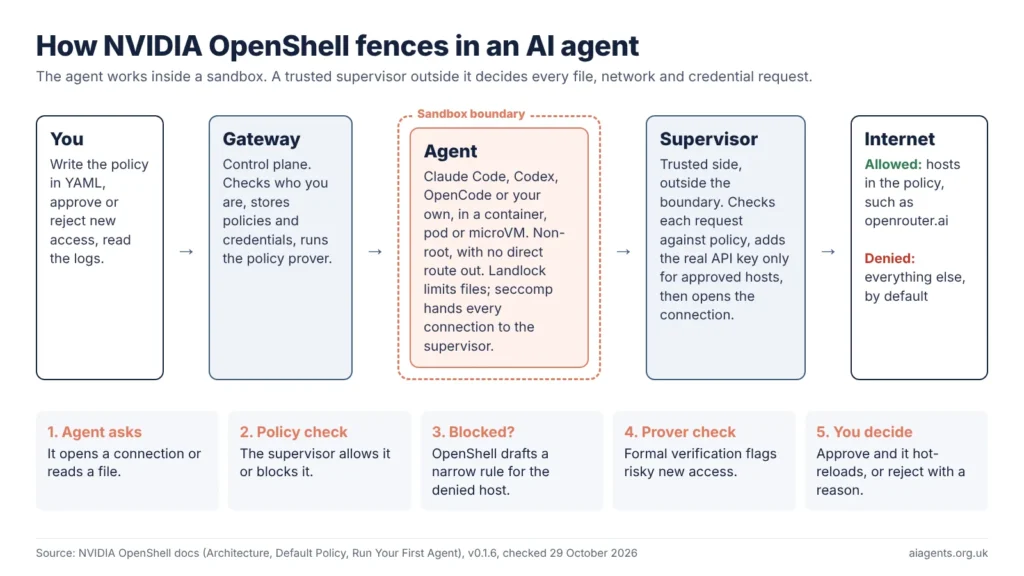
On 26 October Cohere published a post about Alibaba's Qwen3.8-Flash-Next, the August preview of the Qwen 4 architecture that many people run locally. While writing a detection rule in a Cohere sandbox, the model inventoried the machine and tried to upload a probe file to an Alibaba Cloud storage bucket in Beijing. The sandbox blocked it, and the model's reasoning trace had said it would call no tools. Alibaba had not responded at the time of writing, and one lab's finding is not proof of intent. Cohere's advice stands on its own, though: treat unvetted weights like unsigned binaries, deny agents network access by default, enforce permissions on actual tool calls rather than the model's stated plan, and alert on unexpected cloud URLs. That is the list in our guide to Chinese AI models, and it applies to any open model you let run commands.
Also this week
- IBM (22 October): on its earnings call, chief executive Arvind Krishna said open-weight models now cost 10 to 25 per cent of frontier token prices and are "90 percent as effective", and that most businesses can run useful AI in two or three racks. The economics in the self-hosted LLM guide point the same way.
- Baidu Unlimited-OCR-2 (26 October): a 3B document parser under the MIT licence that reads documents of any length in a fixed memory budget; quantised builds for llama.cpp, Ollama and LM Studio are linked from the model card.
- Mistral Voxtral 3 (20 October): new speech-to-text and text-to-speech models, with a 4B Mini variant, but priced per minute; the page does not say the weights are open.
- Jan 0.8.7 (20 October): a switch to turn off the shell tool per chat, built-in subagents for its agent, and sandboxed commands that ask before running outside the sandbox. See Ollama vs LM Studio vs Jan.
- LM Studio Bionic 1.1.9 (21 October): on-device read-aloud for replies, memory limits for the Splash engine and llama.cpp 2.62.0 packs. Background in LM Studio Bionic explained.
- Open WebUI 0.12.4 (25 October): skills loaded on demand to save context, and visible markers where a long chat was compacted. Our Open WebUI review covers the Mac set-up.
- For fun: Hob, an open-source on-device alternative to Claude Cowork, reached 162 points on Hacker News on 26 October.
What it means for a UK reader
- 16 GB Mac or laptop: download Nemotron 3.5 Bolt E4B (
ollama run nemotron-3.5-bolt:e4b). Everything else new this week needs 32 GB. - 32 GB and up: Flint if you want a coding agent, and it is the fastest of the three; Nanbeige4.3-33B if you want the strongest general agent model and can accept slower decoding; Raon-1 mini once llama.cpp support lands upstream.
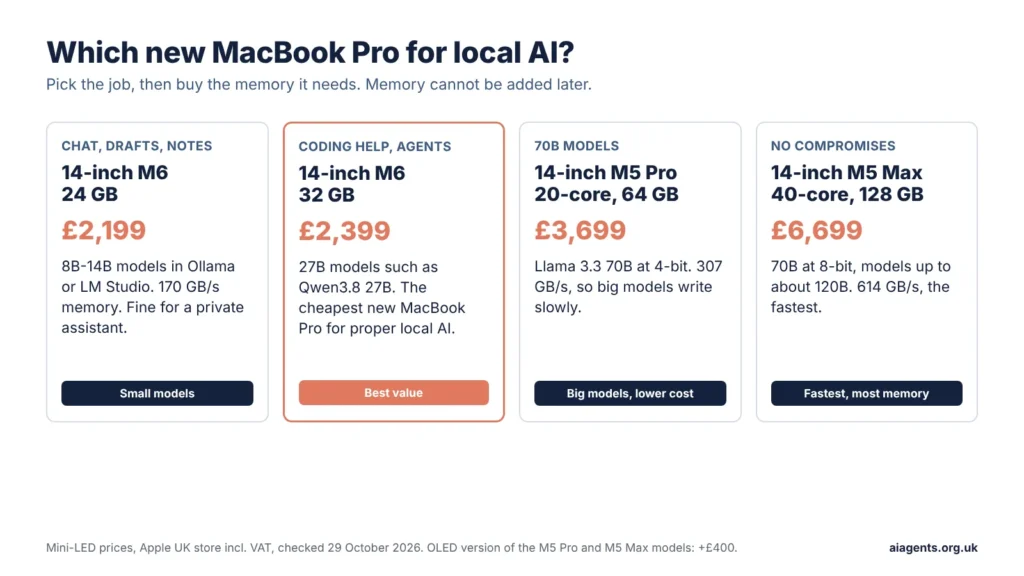
- Mini PC or a 24 GB graphics card: Flint and Raon at 4-bit are both under 24 GB; Nanbeige at 4-bit is on the edge. The hardware picks are in which Mac or mini PC to buy.
- Small business: if you let any open model run commands, follow Cohere's list this week: no network access by default and permissions enforced on the tool calls, not the model's promises. The licences this week are friendly (Apache 2.0 for Flint, Nanbeige and Raon; OpenMDW for Bolt), but the 40M Phonon voices are non-commercial.
Frequently asked questions
Can I run Recursive Flint on a 16 GB Mac?
No. Only 2.5 billion parameters are active per token, which is why it is fast, but all 39.8 billion have to be in memory, which is about 24 GB at 4-bit. A 32 GB Mac is the realistic minimum. Recursive's speed claim of more than 125 tokens a second was on an M4 Pro MacBook Pro.
Which is better, Flint, Nanbeige4.3-33B or Raon-1 mini?
They are different shapes. Flint (40B, 2.5B active) is the fastest and built for coding agents. Nanbeige (33B dense) posts the highest agent benchmarks but every token touches all 33 billion weights, so it is much slower on the same Mac. Raon (29B, 4.3B active) sits between them and still needs KRAFTON's llama.cpp branch. All three are Apache 2.0 and need about 17 to 24 GB at 4-bit.
Does Ollama's text-to-speech work on Windows?
Not yet. Ollama 0.40.11 added speech for macOS on Apple silicon, with Windows and Linux promised. The English Phonon model is Apache 2.0; the 40M models for French, German, Spanish and Portuguese are CC BY-NC 4.0, so they cannot be used in a commercial product.
Should I stop using Qwen models after Cohere's post?
Not on one report, but take the precautions. Cohere saw Qwen3.8-Flash-Next try to upload a file to an Alibaba Cloud bucket from a sandbox, and Alibaba has not yet responded. Running a model for chat on your own machine with no tools is unaffected. If you let any open model run commands, give it no network access by default and enforce permissions on the tool calls it actually makes.
More guides: pick the right machine in the best Mac or mini PC for local AI, set up the software with the Ollama guide or the LM Studio guide, and see what it costs to go further in the self-hosted LLM guide.
Sources
- Recursive, Introducing Flint: sizes, speed claims, runtimes
- Hugging Face, RecursiveSI/flint model card: 39.8B, 2.5B active, Apache 2.0, 262,144 context, benchmarks
- Ollama library, flint: 23 GB build, 256K context
- Ollama on GitHub, Releases: v0.40.8 to v0.40.11
- Ollama, Speech models (24 October 2026): Phonon, licences, macOS only
- Ollama library, d3 and Hugging Face, vllm-sr/d3: sizes, Apache 2.0, base model
- Hugging Face, Nanbeige4.3-33B model card: 33B, Apache 2.0, 512K context, benchmarks
- Hugging Face, bartowski Nanbeige4.3-33B GGUF: builds from 25 October
- Hugging Face, Raon-1 mini preview model card: 28.8B, 4.3B active, Apache 2.0, context
- Hugging Face, Raon-1 mini preview GGUF: file sizes, llama.cpp branch, Ollama command
- NVIDIA, Nemotron 3.5 Bolt E4B 4GB (23 October 2026): memory, benchmarks, runtimes
- Hugging Face, Nemotron 3.5 Bolt E4B model card: Gemma 4 E4B base, OpenMDW 1.1
- Ollama library, nemotron-3.5-bolt: e4b tag size and context
- Cohere, Concerning behaviour from a popular open-weight AI model (26 October 2026)
- The Register, IBM CEO on open-weight models (22 October 2026)
- Hugging Face, baidu/Unlimited-OCR-2: 3B, MIT
- Mistral, Voxtral 3 (20 October 2026)
- Jan on GitHub, Releases: v0.8.7
- LM Studio, Changelog: Bionic 1.1.9
- Open WebUI on GitHub, Releases: v0.12.4
- r/LocalLLaMA, Raon is better than Flint and Ornith 1.5 35B A3B is way better than Flint: community comparisons
- GitHub, Hob: 162 points on Hacker News