The biggest local AI story this week is Meta's Muse Spark Open, an 816-billion-parameter open-weight model that Meta and Apple say runs on two 512 GB Mac Studios. For most UK readers the more useful news is smaller: Hugging Face and the llama.cpp team shipped a one-click local AI app for Windows 11, Reflection put its 501B Beam model under Apache 2.0, DeepSeek updated V4.1 Flash under MIT, and Ollama shipped three releases in five days. Here is what each one means for what you can run on your own computer, checked against the makers' own pages on 21 October 2026.
This week in numbers
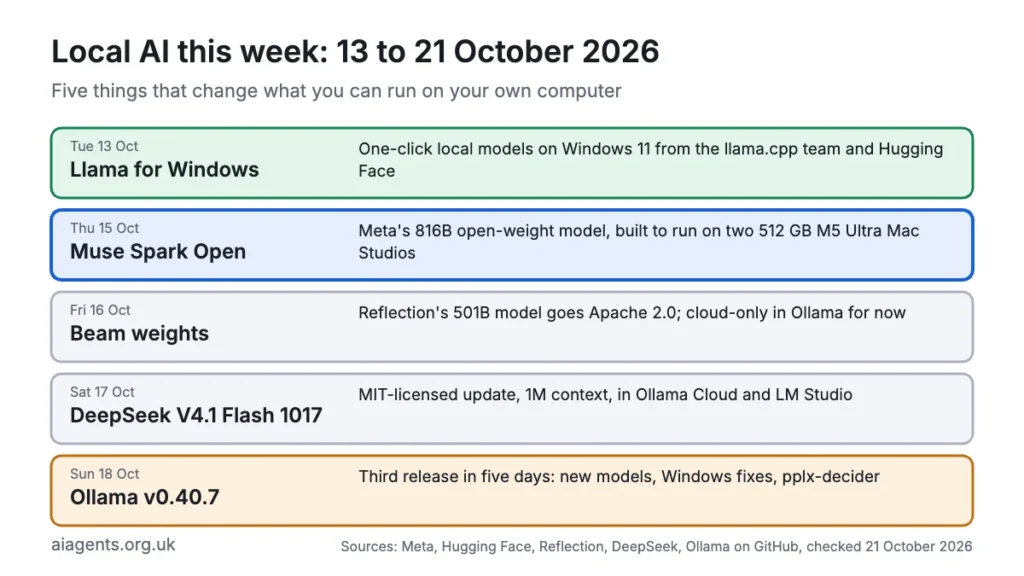
- Muse Spark Open (15 October): 816B total, 42B active, 1M-token context, Muse Model License. Meta's own setup is two M5 Ultra Mac Studios with 512 GB each.
- Llama for Windows (13 October): free, open-source tray app for Windows 11 from the llama.cpp team and Hugging Face; local OpenAI-style server on port 9931.
- Beam (16 October): Reflection's 501B mixture-of-experts model, 23B active, now Apache 2.0; cloud-only in Ollama.
- DeepSeek V4.1 Flash 1017 (17 October): MIT-licensed point update, 1M context; on Ollama Cloud and LM Studio Bionic.
- Ollama: v0.40.5 (14 Oct), v0.40.6 (16 Oct) and v0.40.7 (18 Oct). MiniMax M3.1 Flash free on Ollama Cloud for three days from 20 October.
- Apple's numbers: Qwen 3.8 (27B, full precision) decodes at 19.7 tokens a second on an M5 Ultra against 12.5 on an M3 Ultra.
- For a 16 GB Mac: nothing new to download this week. The useful local model is still Muse Glimmer at 4-bit on a 32 GB machine.
On this page
- What is Muse Spark Open, and can you run it?
- Llama for Windows: local AI in one click
- Beam goes Apache 2.0
- DeepSeek V4.1 Flash 1017
- Three Ollama releases in five days
- What Apple's M5 Ultra numbers mean
- Also this week
- What it means for a UK reader
- Frequently asked questions
- Sources
What is Muse Spark Open, and can you run it?
Muse Spark Open is Meta's new open-weight model, released on 15 October. It has 816 billion parameters in total, 42 billion active per token, a 1-million-token context window and handles text and images. Meta calls it "the most capable US open-weight model to date". It is released under the Muse Model License, which Meta says lets many developers use it free but which has limits on commercial use, so read it before building a product on it.
The headline for Mac owners was the hardware claim. Meta worked with Apple to run the model on "two Apple M5 Ultra Mac Studios" with 512 GB of memory each, using Apple's MLX framework, and Apple's own research post shows four M5 Ultras linked over Thunderbolt producing 36.7 tokens a second. The catch: the 512 GB Mac Studio is not on sale yet, and the 256 GB model already costs more than $10,000 in the US. This is a demonstration of where local AI is heading, not something to budget for.
In the UK the practical ways to try it are hosted. Ollama lists it as cloud-only (ollama run muse-spark-open:cloud), and it is also on Hugging Face, Together AI, Fireworks and OpenRouter. For a model that actually fits on your desk, Meta's 30B Muse Glimmer is the one: Apache 2.0, built for local agent work, under 20 GB at 4-bit, and the subject of a technical report Meta published on 19 October. Which Mac runs what is in the best Mac for local AI.
Llama for Windows: local AI in one click
On 13 October Hugging Face and the llama.cpp team released Llama for Windows, a free, open-source app that sits in the Windows 11 system tray. You pick a model from a recommended list, it downloads, and you chat with it from a pop-up (Alt + Space). It stores models in the standard Hugging Face cache, so a model downloaded once is shared with other tools that use the same cache, and it runs a local server at localhost:9931 that speaks the OpenAI API, so scripts and agents can use it. The download is about 1 MB; the models are the big part.
It matters because llama.cpp is the engine underneath most local AI tools, and this is its own team's first point-and-click desktop app. For a UK small business on Windows PCs it is now the simplest way to test a private model. It does not change the hardware maths: a 7-9B model still wants 16 GB of memory, and bigger ones want a proper graphics card. If you are choosing between it, Ollama and LM Studio, the differences are in Ollama vs LM Studio vs Jan, and LM Studio remains the pick if you want point-and-click tools; see LM Studio plugins and MCP.
Beam goes Apache 2.0
Reflection released the weights for Beam on 16 October under the Apache 2.0 licence, the most permissive of the week. Beam is a 501-billion-parameter mixture-of-experts model with about 23 billion active per token and a 1-million-token context window, aimed at coding and agent tasks. Reflection lists Ollama and LM Studio among its launch partners, but in Ollama the only tag is beam:cloud, which runs on Ollama's servers, and a 501B model needs roughly 250 GB of memory even at 4-bit. For a team that wants a permissively licensed model it can host itself, this is one to watch; the hardware and costs are in the self-hosted LLM guide.
DeepSeek V4.1 Flash 1017
DeepSeek shipped a point update to V4.1 Flash on 17 October, named 1017 after the date. The weights are on Hugging Face under the MIT licence, the context window is 1 million tokens, and DeepSeek's own figures show solid gains on agent and coding tests, for example 42.3 against 31.2 on Terminal-Bench 4.0, with shorter outputs that make each task cheaper. Within hours it was on Ollama Cloud (ollama run deepseek-v4.1-flash:1017-cloud) and in LM Studio's Bionic cloud tier, both hosted outside China.
It is a cloud model for almost everyone: hundreds of billions of parameters, far beyond a desktop. If you use it through Ollama or LM Studio, your prompts go to those companies' US servers; through DeepSeek's own app or API they go to China. The checks to do before either are in are Chinese AI models safe to run locally? and AI agents and UK GDPR.
Three Ollama releases in five days
- v0.40.5 (14 October): added NVIDIA's Nemotron 3.5 Super (120B) and put decision models on the cloud.
- v0.40.6 (16 October): fixed orphaned runner processes on Windows, added q2_0 tensor and file types (smaller quantisations) and launched the clef model in the cloud.
- v0.40.7 (18 October): added Perplexity's pplx-decider model, fixed conversation switching in the Responses API and now cancels remote requests when a client disconnects.
Ollama also announced on 20 October that MiniMax M3.1 Flash is free on Ollama Cloud for three days, hosted in the US with zero data retention. On a Mac or Windows PC the app updates itself: click the Ollama icon and choose Restart to update. Everything else about it, including the cloud plans in pounds, is in the Ollama guide.
What Apple's M5 Ultra numbers mean
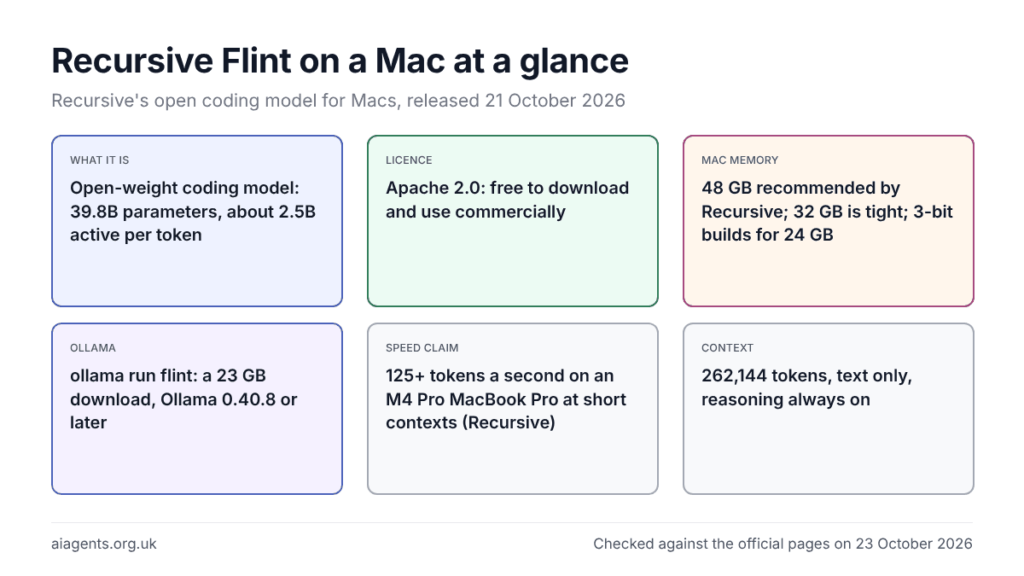
Apple's machine learning team published a post on 15 October on running large models across several Mac Studios with MLX, using RDMA over Thunderbolt. The useful part for buyers is the single-machine table. At full precision, Qwen 3.8 (27B) decoded at 19.69 tokens a second on an M5 Ultra against 12.46 on an M3 Ultra, and Mistral Medium 3.5 (128B) at 7.70 against 4.95. That is roughly a 55 per cent uplift from the new GPU neural accelerators, before any quantisation.
| Model | M3 Ultra | M5 Ultra | Note |
|---|---|---|---|
| Qwen 3.8, 27B, BF16 | 12.46 tok/s | 19.69 tok/s | 4-bit builds run faster and fit a 32 GB Mac |
| Mistral Medium 3.5, 128B, FP8 | 4.95 tok/s | 7.70 tok/s | Needs the 256 GB or 512 GB Mac Studio |
| Muse Spark Open, 816B, NVFP4 | n/a | 36.73 tok/s on four machines | Does not fit on one Mac |
Two cautions. These are Apple's figures at full precision; most people run 4-bit builds, which are faster and use a quarter of the memory. And an M5 Ultra Mac Studio costs several thousand pounds. The sensible UK buys for a 27B model are still a 32 GB or 64 GB Mac; see how to run a local LLM on your Mac.
Also this week
- Tencent Hy-Memory-30B-A3B (16 October): an open model whose only job is deciding what an agent should remember, released with a memory framework. A specialist piece, but it points at where local agents are going.
- KRAFTON Raon-1 mini (21 October): a preview of a 30B mixture-of-experts model with 4B active parameters, trained from scratch by the Korean games company, with MLX and GGUF builds promised.
- StepFun Step 5 Preview (15 October): a 600B open-weights model built for long-running agent tasks; cloud hardware only.
- Perplexity pplx-decider v1.2 (16 October): open-weight decision models in two sizes, now in Ollama.
- Prices: an r/LocalLLaMA price index put the RTX 5090 up 69 per cent in the EU since May, across 249 listings at more than 20 retailers. If you are buying a graphics card for local AI, check the hardware guide before paying this month's prices.
- For fun: llama.cpp running natively on a jailbroken PlayStation 5 reached the top of Hacker News with 375 points.
What it means for a UK reader
- 16 GB Mac or laptop: nothing to download this week. Keep running Gemma 4 or gpt-oss:20b; the new models are either cloud-only or need 32 GB and up.
- 32 GB and up: try Muse Glimmer at 4-bit if you want a local agent model, and Qwen 3.8 27B if you want the best general model that fits.
- Windows PC: Llama for Windows is now the easiest first step; Ollama or LM Studio when you want integrations or tools.
- Small business: the big new models (Muse Spark Open, Beam, DeepSeek) are cloud services with open licences, not things you will run. Treat them like any hosted AI: check where the data goes and whether a processor contract exists.
Frequently asked questions
Can I run Muse Spark Open on a normal Mac?
No. Meta's own setup is two Mac Studios with the M5 Ultra and 512 GB of memory each, a configuration Apple has not yet put on sale. The smaller Muse Glimmer (30B, Apache 2.0) is the one for a single machine: about 20 GB at 4-bit, so a 32 GB Mac or a PC with a 24 GB graphics card.
Is Llama for Windows better than Ollama or LM Studio?
It is simpler, not better. It is a free system-tray app from the llama.cpp team and Hugging Face that downloads a model, chats with it and runs a local server on port 9931 that other apps can use. Ollama has more integrations and LM Studio has more settings and built-in MCP tools. All three run the same open models.
Is DeepSeek V4.1 Flash 1017 safe to use?
The weights are MIT-licensed and can be run on your own hardware, where nothing leaves your machine, but it is far too large for a laptop. Through Ollama Cloud or LM Studio Bionic your prompts go to those companies' servers, not to DeepSeek. Through DeepSeek's own app or API, data goes to China. The checks are in our guide to Chinese AI models.
What is the smallest useful new model this week?
Muse Glimmer, if you count the technical report Meta published on 19 October as new. The model itself has been out since August: 30B parameters, built for local agent work, under 20 GB at 4-bit, with builds for llama.cpp, MLX, Ollama and LM Studio.
Next: pick the right machine in the best Mac or mini PC for local AI, or set up the software with the Ollama guide.
Sources
- Meta, Muse Spark Open (15 October 2026): sizes, licence, Mac Studio claim
- MacRumors, Meta and Apple bring Muse Spark Open to Mac Studio (15 October 2026): 512 GB Mac Studio not yet released
- Apple Machine Learning Research, Local and distributed LLM inference with MLX and RDMA on Mac Studio (15 October 2026): tokens-per-second figures
- Ollama library, muse-spark-open: cloud-only tag
- AI Weekly, Meta releases Muse Glimmer (10 August 2026): 30B, Apache 2.0, under 20 GB at 4-bit
- Llama for Windows (llama.app): tray app, port 9931, open source, free
- Windows Report, Llama Windows app from Hugging Face (15 October 2026): Hugging Face cache, Arm support
- Unite.AI, Reflection releases Beam's open weights under Apache 2.0 (16 October 2026): licence, sizes, partners
- Ollama library, beam: 501.3B total, 23.4B active, cloud-only
- Hugging Face, DeepSeek-V4.1-Flash-1017 model card: MIT licence, benchmarks, 1M context
- Ollama on GitHub, Releases: v0.40.5 to v0.40.7
- Ollama on X, MiniMax M3.1 Flash free for three days (20 October 2026)
- KRAFTON AI on X, Raon-1 mini preview (21 October 2026)
- NVIDIA AI on X, StepFun Step 5 Preview (15 October 2026)
- r/LocalLLaMA, RTX 5090 is +69% since May in EU: price index
- GitHub, PS5LM: llama.cpp on a jailbroken PS5 (16 October 2026): 375 points on Hacker News