
AI agents are covered by UK GDPR in full: if an agent reads a business inbox, calendar or customer records, your organisation is responsible for that personal data, and the ICO said on 8 October 2026 that "the fact AI agents act with autonomy is not an excuse for poor compliance". In practice you need a business plan with a data processing agreement, the narrowest access that does the job, a DPIA in most cases and a human check on significant decisions about people. Every data protection change in the Data (Use and Access) Act 2025 is now in force, including new automated decision rules from 5 February 2026 and a complaints duty from 19 June 2026. Below: what the ICO expects, a comparison of 11 popular agents and a 10-step checklist, with every source linked.
Key facts
- Applies in full: the ICO's January 2026 Tech Futures report says organisations "remain responsible for data protection compliance" of the agents they deploy. Its call for evidence on agentic AI runs from 8 October to 20 November 2026, and final agentic AI guidance is due in spring 2027.
- Article 22 is gone: replaced by Articles 22A-22D on 5 February 2026. Solely automated significant decisions are now permitted with safeguards, except on special category data.
- Four safeguards: tell people, let them make representations, offer human intervention, let them contest.
- DPIA: the ICO's draft guidance (31 March 2026) says you will usually need one for automated decision-making.
- Complaints: since 19 June 2026 you must give people a way to complain about your use of their data, acknowledge within 30 days and respond without undue delay.
- Vendors: only the business plans of the big AI providers come with a data processing agreement and no training by default; the comparison table covers 11 agents.
- The practical rule: narrow access, a human on anything irreversible, a log of every action, and a lawful basis written down before switch-on.
On this page
- Does UK GDPR apply to AI agents?
- What changed in 2026? The Data (Use and Access) Act timeline
- What has the ICO said about AI agents in 2026?
- Who is responsible when an agent reads your inbox?
- Which AI agents are UK GDPR compliant? 11 compared
- Can an agent send UK data to a US provider?
- What lawful basis does an AI agent need?
- What data may the agent reach?
- Special category data
- Automated decisions: Articles 22A-22D
- Do you need a DPIA?
- Transparency and individual rights
- What if someone complains about your agent?
- What are the new security risks?
- Does on-device processing change anything?
- UK GDPR checklist for AI agents: 10 steps
- Frequently asked questions
- Sources
Does UK GDPR apply to AI agents?
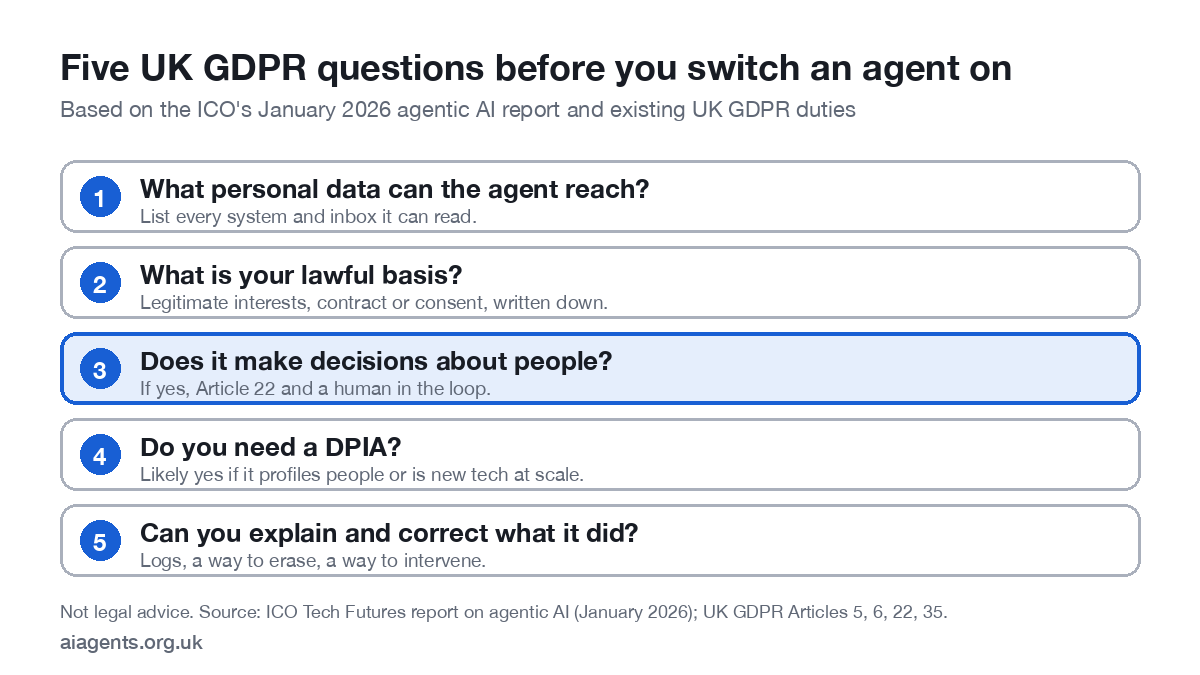
Yes. An AI agent is software that processes personal data, so every principle in Article 5 applies: lawfulness, fairness and transparency; purpose limitation; data minimisation; accuracy; storage limitation; integrity and confidentiality; and accountability. The ICO's Tech Futures report on agentic AI, published in January 2026, says in terms that the significant and growing quantities of personal information agents process remain fully subject to these obligations.
What is different about an agent is not the law but the shape of the risk. An agent acts rather than answers, so a mistake is an action in the world. It can reach many systems, so the scope of processing is wider than one form or one database. And it decides its own steps, so the data flows are harder to predict and explain. The ICO's report is organised around those three facts, and so is this page.
What changed in 2026? The Data (Use and Access) Act timeline
Every data protection change in the Data (Use and Access) Act 2025 was in force by 19 June 2026. For AI agents they came in two steps: new automated decision rules, a "recognised legitimate interest" basis and a new test for transfers abroad on 5 February 2026, then a duty to handle data protection complaints on 19 June 2026.
19 June 2025
- The Act receives Royal Assent
5 February 2026
- Articles 22A to 22D on automated decisions
- Recognised legitimate interest basis
- New test for transfers abroad
- Some cookies allowed without consent
12 May 2026
- ICO must prepare a code on AI and automated decisions
19 June 2026
- Duty to handle data protection complaints
30 September 2026
- The Information Commission replaces the Information Commissioner
8 October to 20 November 2026
- ICO call for evidence on agentic AI
Spring 2027
- Final ICO agentic AI guidance due
| Change | In force from | What it means for an AI agent |
|---|---|---|
| Automated decisions: Article 22 replaced by Articles 22A to 22D | 5 February 2026 | An agent may take a significant decision about a person with no human involved, on any lawful basis except recognised legitimate interest, if you tell people and let them make representations, get human intervention and contest it. Decisions based on special category data still need a human unless a narrow condition, such as explicit consent, applies. |
| Recognised legitimate interest: Article 6(1)(ea) and Annex 1 | 5 February 2026 | A lawful basis with no balancing test, but only for a short list of public-interest purposes such as crime prevention, safeguarding and emergencies. Routine business agents still use ordinary legitimate interests. |
| Legitimate interest examples: Article 6(11) | 5 February 2026 | The law now names direct marketing, intra-group admin transfers and network security as possible legitimate interests. You still need the balancing test. |
| Transfers abroad: Article 46(1A) | 5 February 2026 | Contract-based transfers to a US AI provider must pass a "data protection test": protection after the transfer must not be "materially lower" than in the UK. |
| Complaints: new section 164A of the Data Protection Act 2018 | 19 June 2026 | You must offer a way to complain, such as an online form, acknowledge within 30 days and respond without undue delay, including about what your agent did. |
| The regulator | 30 September 2026 | The Information Commission took over from the Information Commissioner. It still calls itself the ICO. |
Two things did not change. UK GDPR still applies to every agent that touches personal data, and the ICO's main Guidance on AI and data protection, last updated on 15 March 2023, is marked as under review because of the Act. Expect updated guidance, not new law.
What has the ICO said about AI agents in 2026?
The ICO's message in 2026 is that UK GDPR already covers AI agents and that autonomy is no excuse. On 8 October 2026 it opened a six-week call for evidence on agentic AI, closing on 20 November 2026, and its guidance plan lists final agentic AI guidance for spring 2027. Until then, the expectations it has published are the benchmark.
Richard Nevinson, the ICO's Director of Technology Regulation, put it plainly on 8 October: "the fact AI agents act with autonomy is not an excuse for poor compliance."
What the ICO has done on AI agents this year, in date order:
- January 2026: a Tech Futures report on agentic AI, flagged as early thinking rather than guidance, says organisations "remain responsible for data protection compliance" of the agents they develop, deploy or integrate.
- 3 February 2026: formal investigations into X Internet Unlimited Company and X.AI LLC over Grok's processing of personal data and its potential to produce harmful sexualised images. On 8 October 2026 the ICO said the investigation was ongoing. It concerns Grok, not Grok Bot by name.
- 31 March 2026: draft guidance on automated decision-making under the new Articles 22A to 22D. It was still a draft on 23 October 2026.
- 12 May 2026: regulations in force requiring the ICO to prepare a statutory code of practice on AI and automated decision-making. No publication date is set.
- 8 October 2026: a report on changes secured from ten foundation model developers, from Amazon to Stability AI; enquiries with OpenAI, Anthropic, Meta and the UK AI Security Institute after reports that some agents "bypassed protections, used unauthorised communication channels and accessed external systems such as Hugging Face"; and the call for evidence.
The call for evidence sets out the ICO's current expectations under six themes. For a small business using someone else's agent, these are the ones to act on now:
- Security: the level of autonomy should be "a deliberate and carefully considered" decision, backed by least-privilege access, limits on tools and human approval for high-risk actions. Register each agent with an owner and a purpose.
- Transparency: tell people what the agent can access, where it gets data, whether processing is local or remote, who receives the data and what it may decide. If a task changes midway, ask for approval before the agent acts.
- Accountability: "interpret the concept of a controller broadly". Whoever sets an agent's permissions, protocols and access may be a controller.
- Automated decisions: assess the whole workflow, not one step, and be able to reconstruct which agent acted, under what authority, with what data and whether a human was meaningfully involved.
- Fairness and purpose: an agent spotting a new use for personal data does not make that use compatible with the original purpose.
- Lawful basis: a user's instruction or your terms of service "doesn't automatically provide a lawful basis" for everything the agent does next. If an agent stores or reads information on someone's device, PECR may require consent as well.
Small firms can respond: the ICO is asking deployers as well as developers, through its online survey, until the end of 20 November 2026.
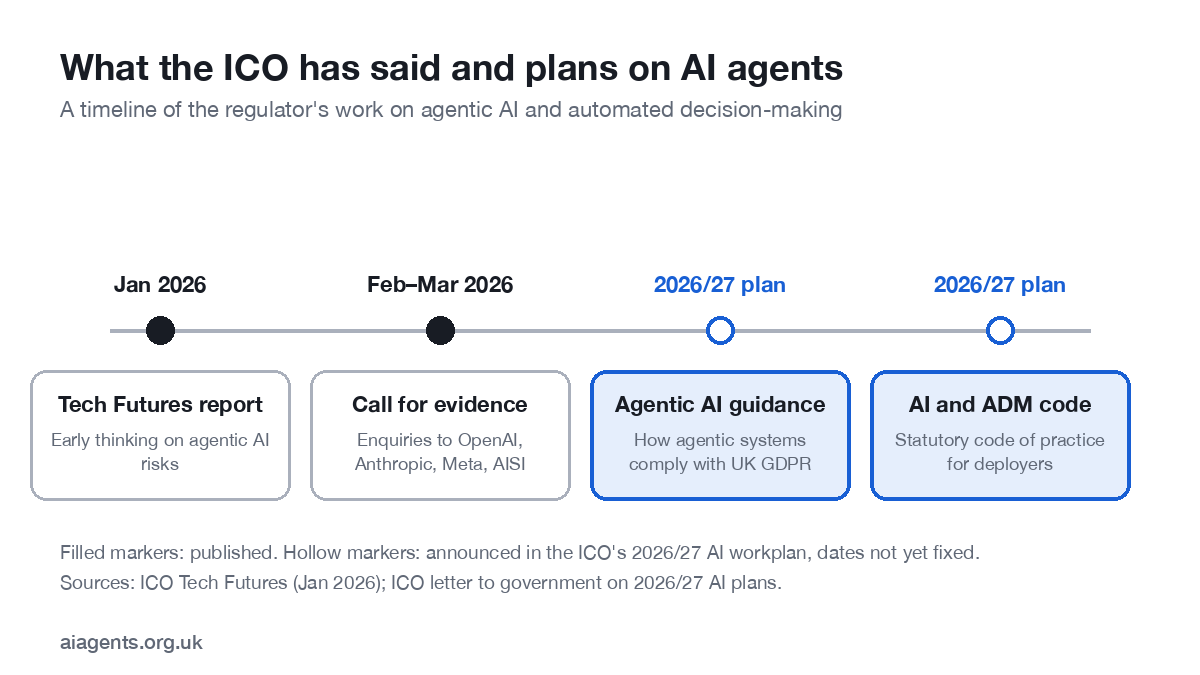
The risks the report names are the ones to plan around: transparency in multi-agent data flows; data minimisation where agents are given broad access "in case"; special category data inferred without being asked for; automated decisions with significant effects; security, including manipulation of an agent's reasoning and poisoning of its memory; and drift, where an agent that learns from its environment wanders from its original purpose. We keep a dated log of every ICO publication on AI in the ICO AI guidance tracker.
Who is responsible when an AI agent reads your inbox, calendar or customer data?
When a business connects an AI agent to its inbox, calendar or customer records, the business is the controller of that data and the AI company is normally its processor. That needs a business plan with a data processing agreement. On personal plans the AI company is a controller under its own privacy policy, with nothing for you to sign.
- Business plans: Anthropic's data processing addendum says "Customer is the controller and Anthropic is Customer's processor", and OpenAI, Microsoft, Google, Perplexity and SpaceXSI publish their own. Article 28 requires the contract to set out what is processed, why and for how long, and to bind the provider to act only on your instructions, keep data secure, control sub-processors, help with rights requests and delete or return data at the end.
- Personal plans: on ChatGPT Free, Plus and Pro, OpenAI OpCo, LLC in the US is the controller for UK users; on Claude Free, Pro and Max it is Anthropic Ireland, Limited. There is no processor contract, so keep client and customer data out.
- The people in your inbox: everyone who emails you, every meeting guest and every customer record is a data subject. They did not choose your agent, which is why transparency and minimisation matter so much.
- Your own personal admin: UK GDPR does not apply to an individual's "purely personal or household activity" (Article 2). If you point an agent at your personal email for your own life, the AI company is bound by the law, not you. A sole trader's work inbox is business use.
The ICO's call for evidence notes that some agent developers say they are controllers only for development, maintenance and security, and it asks organisations to read "controller" broadly. Its detailed guidance on controllers and processors is being updated, with a consultation due in January 2027 and a final version in spring 2027.
Which AI agents are UK GDPR compliant? 11 agents compared
No AI agent is UK GDPR compliant on its own: it depends on the plan and how you use it. As of 23 October 2026, the business plans of ChatGPT, Claude, Microsoft 365 Copilot, Gemini and Perplexity come with a data processing agreement and no training by default, while personal plans run under the provider's own privacy policy.
| Agent (UK plan) | Where your data is processed | Trains on your data by default? | UK GDPR data processing agreement? | Best for |
|---|---|---|---|---|
| ChatGPT Free, Plus and Pro | OpenAI's servers, mainly in the US; OpenAI OpCo, LLC (US) is the controller for UK users | Yes, unless you turn off "Improve the model for everyone" | No | Your own tasks, with training off and no client data |
| ChatGPT Business and Enterprise, including Dots on Business Premium | US by default; eligible Enterprise and Edu workspaces can store data at rest in the UK | No | Yes, with the UK Addendum to the EU standard clauses | Teams already on ChatGPT |
| Claude Free, Pro and Max, including Cowork | Anthropic's servers in the US; Anthropic Ireland, Limited is the controller for UK users | Yes, unless you opt out in settings | No | Sole traders' own files, with training off |
| Claude Team, Enterprise and API | US | No: Anthropic "may not train models on Customer Content" | Yes, with the UK Addendum | Small teams that want Claude under contract |
| Microsoft 365 Copilot | Stored at rest in the UK for UK tenants under Microsoft's data residency terms; queries may be processed in the US, EU or elsewhere | No | Yes, Microsoft's Data Protection Addendum | Firms already on Microsoft 365 |
| Gemini in Google Workspace and Gemini Enterprise | Google's cloud; Gemini Enterprise lets you choose UK, EU, US or global locations | No, not without your permission | Yes, Google's Cloud Data Processing Addendum | Firms already on Google Workspace |
| Grok Bot | Cloud computers in the US, on Cursor's cloud | Default not stated; turn on Privacy Mode to opt out | SpaceXSI publishes one with the UK Addendum (effective 22 September 2026); check your plan is covered | Low-stakes errands with no client data |
| Perplexity Computer | US | Yes on Free, Pro and Max (AI data retention is on); never on Enterprise | Enterprise and API customers only, with the UK Addendum | Research; Enterprise for anything personal |
| Manus | US and Singapore | May use de-identified data; opt out by email | For API customers; acts as a processor on Team plans | Reports and slide decks with no personal data |
| Proton Lumo | Proton's own servers in Europe | No | Proton offers a GDPR agreement for its business services; confirm it covers Lumo | Private chat and drafting rather than agent tasks |
| OpenClaw with a local model | Your own computer | No: nothing reaches a model provider | Not needed when fully local; you stay the controller | Client, health or HR data |
Not available in the UK at all on 23 October 2026: Claude Duet (US only), Meta Muse (US, Canada and Japan) and Gemini Spark. ChatGPT Dots reach the UK only on business plans, not personal Pro.
Customer or client data
The business plan of what you already use
Microsoft 365 Copilot on Microsoft 365, Gemini on Google Workspace, otherwise ChatGPT Business or Claude Team. Each comes with a processing agreement and no training by default.
Health, HR or legal files
OpenClaw with a local model
Nothing leaves your Mac, so there is no processor, no transfer and no vendor training to assess. Security, minimisation and a DPIA are still yours.
Your own admin as a sole trader
Claude Pro or ChatGPT Plus, training off
Fine for your own files, drafts and research. Keep client and customer data out, because personal plans have no processing agreement.
What can wait
Claude Duet, Meta Muse and Gemini Spark
None is available in the UK as of 23 October 2026, so there is nothing to assess yet.
Can an AI agent send UK personal data to a US provider?
Yes, if the transfer is covered. Most AI agents process data in the US, a restricted transfer under UK GDPR. You need either a US company certified to the UK Extension of the Data Privacy Framework, or a contract such as the UK Addendum to the EU standard clauses plus a transfer risk assessment.
- Check the UK Extension. The ICO's guidance, updated on 30 July 2026, says you can rely on it only for a US business with active status on the Data Privacy Framework list that has signed up to the UK Extension, and only for the types of data it registered for.
- Or use the contract route. Anthropic, OpenAI, Perplexity and SpaceXSI build the EU standard contractual clauses with the UK Addendum into their processing agreements. Since 5 February 2026 the test is that protection after the transfer must not be "materially lower" than in the UK, judged by you "acting reasonably and proportionately" (Article 46).
- UK storage is not UK processing. OpenAI lets eligible Enterprise, Edu and API customers store data at rest in the UK, but offers in-region inference, where the model does its work, only in the US or Europe. Microsoft stores Copilot data at rest in the UK for UK tenants but says queries from customers outside the EU may be processed in the US, EU or other regions.
- Personal plans: OpenAI and Anthropic cite UK adequacy regulations and standard clauses for moving your own account data to the US. That covers you as a user, not your clients' data.
The ICO's brief guide to international transfers (15 January 2026) has a checklist. If you would rather not make a transfer at all, run the model on your own hardware: the private AI guide explains how.
What lawful basis does an AI agent need?
Every purpose the agent serves needs one of the six Article 6 bases, written down before the agent runs. For most small-business agents the choice is between two.
| Lawful basis | Fits when | What you must do | Watch out for |
|---|---|---|---|
| Legitimate interests | Routine business admin: chasing invoices, triaging support, drafting replies | A short legitimate interests assessment: purpose, necessity, balancing test | Cannot be used for solely automated significant decisions under the new "recognised legitimate interest" basis; the ordinary one still can |
| Contract | The agent does something the customer asked for: booking, delivery updates, account changes | Show the processing is necessary to perform the contract | Does not cover marketing or profiling bolted on to the job |
| Consent | Optional extras the person can switch off: a personal assistant reading their calendar | Specific, informed, as easy to withdraw as to give; a record of it | Rarely right for background agents; stops working the moment someone withdraws |
| Legal obligation | Agents that produce regulatory filings, KYC checks | Identify the law | Narrow; does not stretch to "nice to have" steps |
Write the basis against each purpose, not against the agent. An invoice agent that also scores customers for creditworthiness has two purposes and may need two bases, and the second one is an automated decision.
Two 2026 points. The ICO says a user's instruction or your terms of service does not automatically give a lawful basis for everything an agent does next, and different stages of one workflow may need different bases. And the new recognised legitimate interest basis, in force since 5 February 2026, skips the balancing test but covers only a short list of public-interest purposes such as crime prevention, safeguarding and emergencies, so ordinary legitimate interests is still the usual choice for business agents.
What data may the agent reach?
Article 5(1)(c) requires personal data to be adequate, relevant and limited to what is necessary. The ICO's report singles out the agentic habit of giving a system broad access to everything it might need. That is the breach in waiting. The fix is a tool list: an explicit, reviewable list of the systems, folders and inboxes the agent can read, and a shorter list of the ones it can write to.
- Read access before write access. Most first agents need to read a ledger and send email, not edit the ledger.
- Scope by purpose. An invoice agent reads the sales ledger and the accounts inbox, not the HR drive.
- Prefer tool-level limits to prompt-level ones. Telling an agent "do not look at HR files" is a wish; not connecting the HR drive is a control.
- Review the list quarterly and whenever the agent's job changes. Drift happens in the permissions as much as in the model.
Special category data
Health, religion, politics, trade-union membership, sexual orientation and the other Article 9 categories need a separate condition as well as a lawful basis. The ICO's report warns that agents may encounter or infer this data unexpectedly: a support agent reading a customer's message about a hospital stay, a recruitment agent inferring age or disability from a CV. Two rules follow. First, if the agent could plausibly meet special category data, you need an Article 9 condition before it runs, not after. Second, under the new Article 22B, a significant decision that rests even partly on special category data cannot be solely automated unless it is based on explicit consent, or on a contract or legal requirement combined with the substantial public interest condition. In practice that means a human in the loop.
Automated decisions: Articles 22A to 22D
This is the part of the law that changed. The Data (Use and Access) Act 2025 repealed Article 22 and inserted Articles 22A to 22D, in force since 5 February 2026. The old general prohibition on solely automated decisions with legal or similarly significant effects has gone. Such decisions are now permitted on any ordinary lawful basis, provided four safeguards under Article 22C are in place, and provided the decision does not rest on special category data or on the new "recognised legitimate interest" basis.
| Article | What it says | What it means for an agent |
|---|---|---|
| 22A | Defines a significant decision (legal or similarly significant effect) and a solely automated one (no meaningful human involvement); reviewers must consider how far the decision relies on profiling | If your agent declines a refund, rejects an application or sets a price for a named person without a person checking, this applies |
| 22B | Significant decisions on special category data cannot be solely automated except with explicit consent, or contract/legal requirement plus substantial public interest; recognised legitimate interest cannot be used at all | Anything touching health, disability, religion or similar needs a human decision-maker |
| 22C | Safeguards: inform the person; let them make representations; offer human intervention; let them contest | Build all four into the agent's workflow before it goes live, not as an afterthought |
| 22D | The Secretary of State may regulate what counts as meaningful human involvement and what is significant, but cannot weaken 22C | Expect the definitions to be tightened by regulation; design to the stricter reading |
The ICO's draft guidance of 31 March 2026 adds what "meaningful human involvement" means: active, not tokenistic; carried out by someone trained to understand the system's logic, outputs and limits; and not satisfied by the person who built the system, because design happens before any real decision. Its parallel report on recruitment found employers routinely underestimating when a tool was deciding rather than assisting. If an agent's output is accepted by default, the decision is solely automated whatever the org chart says.
Do you need a DPIA?
Usually, if the agent processes personal data and makes or shapes decisions about people. Article 35 requires a data protection impact assessment where processing is likely to result in a high risk. The ICO's guidance names cases where a DPIA is always required, such as systematic and extensive profiling with significant effects and large-scale use of special category data, and a longer list of factors that point to high risk. Innovative technology, including AI, is on that longer list, but the ICO says it needs to be combined with another factor, such as automated decisions, large-scale processing or sensitive data, before a DPIA becomes mandatory. New technology on its own is not enough. The draft 2026 guidance says plainly that organisations will usually need a DPIA when engaging in automated decision-making. An agent reading a customer inbox combines innovative technology with personal data at scale and, often, automated decisions, which is the kind of combination the ICO has in mind. The ICO says its DPIA guidance is under review following the Data (Use and Access) Act; it was still marked that way on 23 October 2026.
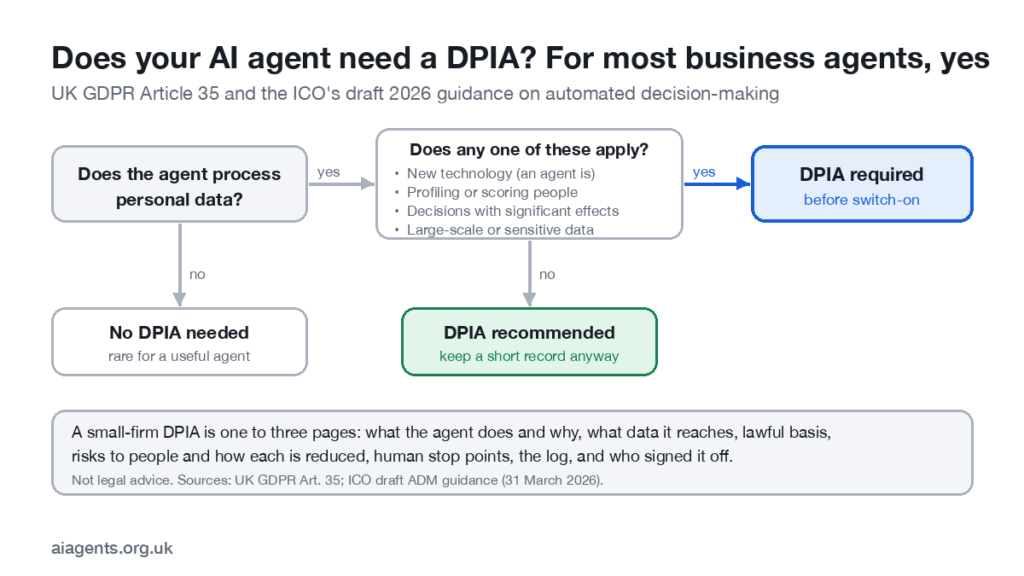
A DPIA for a small-business agent does not need to be long. One to three pages covering: what the agent does and why; what data it reaches, from where; the lawful basis; the risks to individuals and how each is reduced; the human stop points; the log; and who signed it off. Keep it with the tool list and review both together.
Transparency and individual rights
People must be told that an agent is processing their data, what for, and on what basis. The ICO's report stresses that multi-agent flows are hard to explain and that you must explain them anyway, ideally before processing starts. The draft ADM guidance requires information at three points: when data is collected, when someone makes an access request, and when an automated decision is taken. Explanations should avoid overly technical language, especially for children.
- Privacy notice: add a plain-English section on agents: what they do, which data, which basis, how to object.
- Access requests: the agent's memory is personal data too. You must be able to find, export and erase what it holds about a person.
- Accuracy: an agent that generates new personal data at scale (summaries, scores, inferences) must get it right and correct it promptly when it does not.
- Objection and erasure: an agent that cannot stop processing a named person, or cannot forget them, is not compliant.
What must you do if someone complains about your AI agent?
Since 19 June 2026, every UK organisation must give people a way to complain about how it uses their personal data, acknowledge each complaint within 30 days and respond without undue delay. That includes complaints about what an AI agent did, such as an email it sent or a decision it shaped. The ICO says there are no exemptions.
- Make it easy to complain: the law gives the example of "a complaint form which can be completed electronically and by other means".
- Acknowledge within 30 days of receiving the complaint. The duty covers complaints received on or after 19 June 2026.
- Investigate and reply: make appropriate enquiries, keep the person updated and tell them the outcome, all without undue delay.
- Keep the agent's log: if you cannot see what the agent did, read and sent, you cannot investigate a complaint about it.
The ICO published complaints guidance on 12 February 2026. On 23 June 2026 it said its research found more than two in three businesses aware of the Act either did not know whether the change applied to them or wrongly thought it did not. It is also writing guidance on handling subject access requests generated by AI, due in winter 2026.
What are the new security risks?
The ICO names attack types that did not exist for a database: goal distortion, where an agent is steered away from its task; reasoning manipulation through the content it reads; supply-chain compromise through the tools it calls; and memory poisoning, where false facts are planted for later use. An agent that reads the open web or an unfiltered inbox can be instructed by an attacker who simply writes the instruction where the agent will see it.
Article 5(1)(f) and Article 32 require appropriate security. For agents that means: the narrowest tool list; a human approval step before any irreversible action (send, pay, delete, publish); a full log of actions and tool calls; separation between what the agent reads and what it may act on; and a tested way to switch it off. Personal-assistant agents that concentrate one person's data in one place deserve particular care, because a breach exposes everything at once.
Does running the agent on your own device change anything?
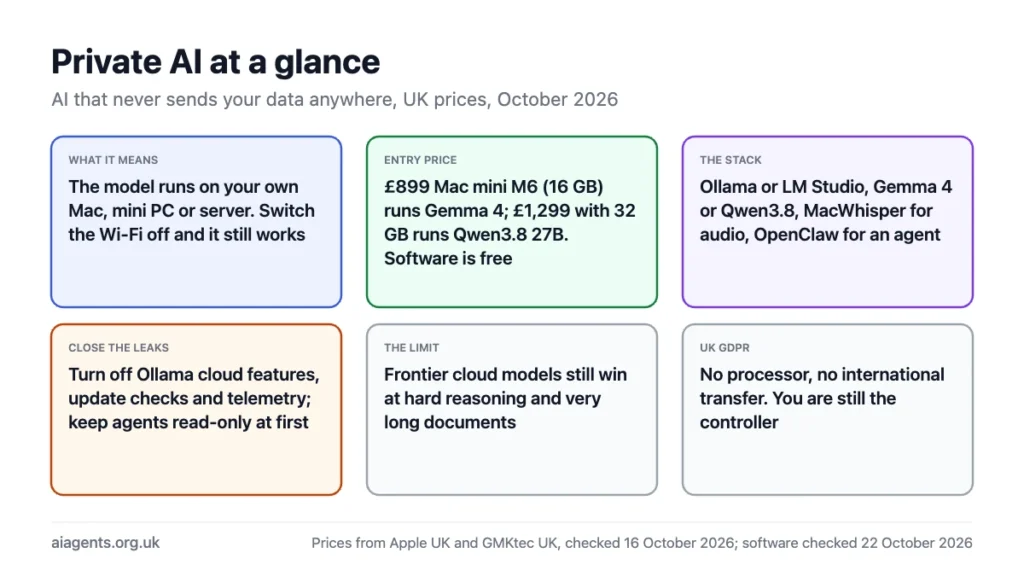
UK GDPR still applies: you are still the controller, and minimisation, security and individual rights are still yours to manage. What changes is the processor question. An agent that runs entirely on your own Mac, with a local model, sends nothing to a vendor, so there is no third-party processor, no data-processing agreement to negotiate, no international transfer to assess and no vendor training on your customers' data. For firms handling client or health data that removes a whole section of the DPIA. Our setup guide is Run AI agents on your own Mac.
UK GDPR checklist for AI agents: 10 steps for small businesses
A small UK business can get an AI agent ready for UK GDPR in ten steps, most of them an hour's work: choose a plan with a processing agreement, write down the purpose and lawful basis, limit access, check transfers, do a short DPIA, update your privacy notice, set up complaints and logging, then start small with weekly checks.
- Choose a business plan and sign the processing agreement. Check it covers UK GDPR and transfers (the UK Addendum or the UK Extension), and that training on your data is off.
- Write down each purpose and its lawful basis. One line per purpose. If you reach for consent, ask whether legitimate interests fits better.
- Register the agent. Give it a name, a named owner, a purpose and a list of the tools it may use, as the ICO suggests.
- Write the tool list. What the agent may read, what it may write, what it must ask about. Read before write; nothing "in case".
- Decide whether it makes significant decisions about people. If yes: design the four Article 22C safeguards and a trained human reviewer; keep special category data out of the automated path entirely.
- Check where the data goes. Note the country, the transfer mechanism and any UK storage option in your records.
- Do the DPIA. Short is fine. Cover data, basis, risks, stop points, log, sign-off.
- Update the privacy notice. Say in plain English what the agent does, with which data, on which basis and how to object.
- Set up complaints and logging. A complaint form, a 30-day acknowledgement routine and an action log you can search by person.
- Test the off switch and start small. Run the agent for 30 days with a weekly log review before widening its remit.
What can wait: the ICO's final agentic AI guidance (due spring 2027) and the AI and automated decision-making code (no date yet). Design to today's expectations rather than waiting for them. Answering the call for evidence by 20 November 2026 is optional, but it is the ICO asking what would help.
The ten steps above are the checklist; print this section. For the assessment itself, use the ICO's own sample DPIA template (Word), which the ICO says need not be long for a small project. More on UK rules in the ICO AI guidance tracker.
Frequently asked questions
Is ChatGPT GDPR compliant in the UK?
ChatGPT can be used lawfully in the UK, but only business plans come with a data processing addendum and no training by default. On Free, Plus and Pro, OpenAI's US company is the controller and may train on your chats unless you switch that off, so keep client data out.
Do I need a data processing agreement with an AI agent provider?
Yes, if the agent handles personal data for your business. Article 28 of UK GDPR requires a contract with any processor. Anthropic, OpenAI, Microsoft, Google and Perplexity publish data processing addendums, but only for their business plans.
Can I use a US AI agent with UK customer data?
Yes, if the transfer is covered and you have a processing agreement. Use a provider certified to the UK Extension of the Data Privacy Framework, or one whose agreement includes the UK Addendum to the standard contractual clauses, and record a transfer risk assessment.
What did the Data (Use and Access) Act change for AI?
It replaced Article 22 with Articles 22A to 22D on 5 February 2026, allowing solely automated significant decisions with safeguards. The same day brought a recognised legitimate interest basis and a new transfer test, and a complaints duty followed on 19 June 2026.
Is the ICO investigating AI agents?
The ICO has made enquiries with OpenAI, Anthropic, Meta and the UK AI Security Institute about agent testing, it said on 8 October 2026. Its formal investigation into Grok, opened on 3 February 2026, was still ongoing then, and its call for evidence on agentic AI closes on 20 November 2026.
Does UK GDPR apply if I use an AI agent on my personal email?
Not to you, if the use is purely personal or household: Article 2 of UK GDPR excludes it. The AI company is still bound by UK GDPR for what it does with your data. A sole trader's work inbox counts as business use, so the full rules apply.
Does UK GDPR apply to AI agents?
Yes, in full. The ICO's January 2026 report on agentic AI says the personal data agents process is subject to all the usual UK GDPR obligations. An agent is a processing activity like any other; the autonomy changes the risk, not the law.
Do I need a DPIA before using an AI agent?
Very likely, if the agent processes personal data at any scale, profiles people, or makes decisions about them. The ICO's draft 2026 guidance says organisations will usually need a DPIA for automated decision-making, and the ICO lists AI as innovative technology, which requires a DPIA when combined with another high-risk factor such as large-scale or sensitive data.
What replaced Article 22?
Articles 22A to 22D of the UK GDPR, inserted by the Data (Use and Access) Act 2025 and in force since 5 February 2026. Solely automated decisions with legal or similarly significant effects are now allowed, with mandatory safeguards, except where they rest on special category data.
What is a lawful basis for an AI agent?
The same six as for any processing. For most small-business agents it is legitimate interests (with a written assessment) or performance of a contract. Consent is rarely the right choice for an agent that runs in the background, because it must be as easy to withdraw as to give.
Can an AI agent read my customers' emails?
It can if you have a lawful basis, have told people in your privacy notice, give the agent the narrowest access that does the job, and can explain and correct what it did. Reading everything in case it is useful breaches data minimisation.
Does running the agent on my own computer change the rules?
No, UK GDPR still applies. It does remove one risk: no third-party processor sees the data, so there is no international transfer and no vendor data-sharing to assess. Security, minimisation and the rights of individuals are still yours to manage.
Related: keeping personal data on your own hardware changes some of this; see self-hosted LLMs and UK GDPR.
Next: if you have not yet chosen an agent, What is an AI agent? explains the options.
Running the model yourself removes the processor and transfer questions entirely; the private AI guide explains how, what it costs and which duties remain.
Read next
- The best new AI agents on Product Hunt, reviewed
- Meta Muse: what it does and whether you can use it in the UK
- Personal AI assistants in the UK: costs, setup and privacy compared
- AI for small business in the UK: where AI agents pay off
Sources
- Data (Use and Access) Act 2025: plans for commencement, GOV.UK (updated 12 October 2026): Royal Assent on 19 June 2025, commencement stages, the Information Commission from 30 September 2026 - checked 23 October 2026
- Data (Use and Access) Act 2025, section 103, legislation.gov.uk: the complaints duty (new section 164A of the Data Protection Act 2018), in force 19 June 2026 - checked 23 October 2026
- UK GDPR Article 6 and Annex 1, legislation.gov.uk: recognised legitimate interest and legitimate interest examples, in force 5 February 2026 - checked 23 October 2026
- UK GDPR Article 22C, legislation.gov.uk: the four safeguards for automated decisions - checked 23 October 2026
- UK GDPR Article 46, legislation.gov.uk: the data protection test for transfers, in force 5 February 2026 - checked 23 October 2026
- UK GDPR Article 2 and Article 28, legislation.gov.uk: the household exemption and processor contracts - checked 23 October 2026
- The Data Protection Act 2018 (Code of Practice on Artificial Intelligence and Automated Decision-Making) Regulations 2026, SI 2026/425: in force 12 May 2026 - checked 23 October 2026
- ICO, ICO secures changes from leading AI developers as scrutiny extends to AI agents (8 October 2026): the call for evidence, enquiries into agent testing, the Grok investigation still ongoing, Richard Nevinson's quote - checked 23 October 2026
- ICO, Agentic AI call for evidence: open 8 October to 20 November 2026 - checked 23 October 2026
- ICO, The ICO's call for evidence on agentic AI: the six themes and the ICO's current expectations - checked 23 October 2026
- ICO, ICO announces investigation into Grok (3 February 2026) - checked 23 October 2026
- ICO, Our plans for new and updated guidance: technology and general data protection: agentic AI guidance due spring 2027, controller and processor update, guidance on AI-generated subject access requests - checked 23 October 2026
- ICO, The Data Use and Access Act 2025: what does it mean for organisations? (updated 19 June 2026): all data protection provisions in force - checked 23 October 2026
- ICO, New data protection complaints law now in force (23 June 2026) and How to deal with data protection complaints - checked 23 October 2026
- ICO, Recognised legitimate interest (23 March 2026) - checked 23 October 2026
- ICO, Guidance on AI and data protection: under review since the Act, last updated 15 March 2023 - checked 23 October 2026
- ICO, When do we need to do a DPIA?: AI as innovative technology, in combination with another criterion - checked 23 October 2026
- ICO, A brief guide to international transfers (15 January 2026) and How does the UK Extension to the EU-US Data Privacy Framework work? (updated 30 July 2026) - checked 23 October 2026
- ICO, Tech Futures: agentic AI (January 2026) - checked 23 October 2026
- Anthropic privacy policy (effective 10 September 2026), Commercial Terms and Data Processing Addendum: UK controller, US transfers, training, processor role, UK Addendum - checked 23 October 2026
- OpenAI Europe privacy policy, Business data privacy and Data Processing Addendum (effective 1 January 2026): UK controller, training, UK data residency, UK Addendum - checked 23 October 2026
- Microsoft Learn, Data, privacy and security for Microsoft Copilot and Data residency for Microsoft 365 Copilot - checked 23 October 2026
- Google, Generative AI in Google Workspace Privacy Hub and Manage your tasks and workflows in Gemini Apps: no training on Workspace data, UK excluded from tasks - checked 23 October 2026
- Perplexity Data Processing Addendum (updated 13 August 2026), SpaceXSI Data Processing Addendum (effective 22 September 2026) and Proton Data Processing Agreement - checked 23 October 2026
- Our guides to ChatGPT Work, ChatGPT Dots, Claude Cowork, Copilot Autopilot, Gemini agent, Grok Bot, Perplexity Computer, Manus, Proton Lumo, OpenClaw and Meta Muse, linked in the comparison table: data location, training and processing terms - checked 17 to 23 October 2026
- ICO, Tech Futures: agentic AI (January 2026), summarised by Inside Global Tech - the report's named risks and its status as early thinking, not guidance
- ICO, Automated decision-making including profiling: draft guidance and consultation (31 March 2026) - consultation closed 29 May 2026
- Inside Privacy, UK ICO consults on draft ADM guidance and recruitment report (April 2026) - meaningful human involvement and DPIA expectations
- Travers Smith, UK's data protection reforms take effect (February 2026) - 5 February 2026 commencement and the new safeguards
- The Data (Use and Access) Act 2025 (Commencement No. 6) Regulations 2026, SI 2026/82: Articles 22A to 22D, recognised legitimate interest and the transfer test from 5 February 2026; complaints duty from 19 June 2026 - checked 23 October 2026
- Privacy Laws & Business, ICO updates AI plans for 2026/27 - agentic AI guidance and the AI and ADM code of practice

Pingback: Anything API review: Notte's website-to-API agent (2026)
Pingback: Bond review: AI chief of staff, pricing, pros and cons