Claude Design is Anthropic's tool for making visual work, such as slide decks, one-pagers, mockups and clickable prototypes, by describing what you want to Claude. It launched on 17 April 2026, now works inside any Claude conversation and is included on every plan, from free to Claude Pro at £18 a month including VAT.
Key facts
- What it is: an Anthropic Labs product that turns a description into a design you can edit, share and export. Official home: claude.com/product/design.
- Launched: 17 April 2026 as a research preview; brought into ordinary Claude conversations from 16 September 2026, in stages.
- Makes: slide decks, prototypes, mockups, one-pagers, landing pages, social posts and flyers.
- Price (UK, 29 October 2026): included on Free; Pro £18 a month or £180 a year; Team from £18 a seat a month yearly. All include 20% VAT.
- Exports: PDF, PowerPoint, HTML, .zip, Google Slides, Canva and 14 other apps, or a handoff to Claude Code.
- Biggest gaps: no photo or illustration generation, no version history yet, basic multi-person editing.
- Deadline: the old standalone site, claude.ai/design, closes on 14 December 2026.
On this page
- What is Claude Design?
- What can Claude Design make?
- How does Claude Design work, and where do agents come in?
- How much does Claude Design cost in the UK?
- What are the Claude Design usage limits?
- What formats can Claude Design export?
- Claude Design for teams: design systems, sharing and admin
- Is Claude Design private?
- Claude Design vs Canva AI, Figma AI and Google Stitch
- Who should use Claude Design?
- What are Claude Design's limits?
- Frequently asked questions
- Read next
- Sources and dates checked
What is Claude Design?
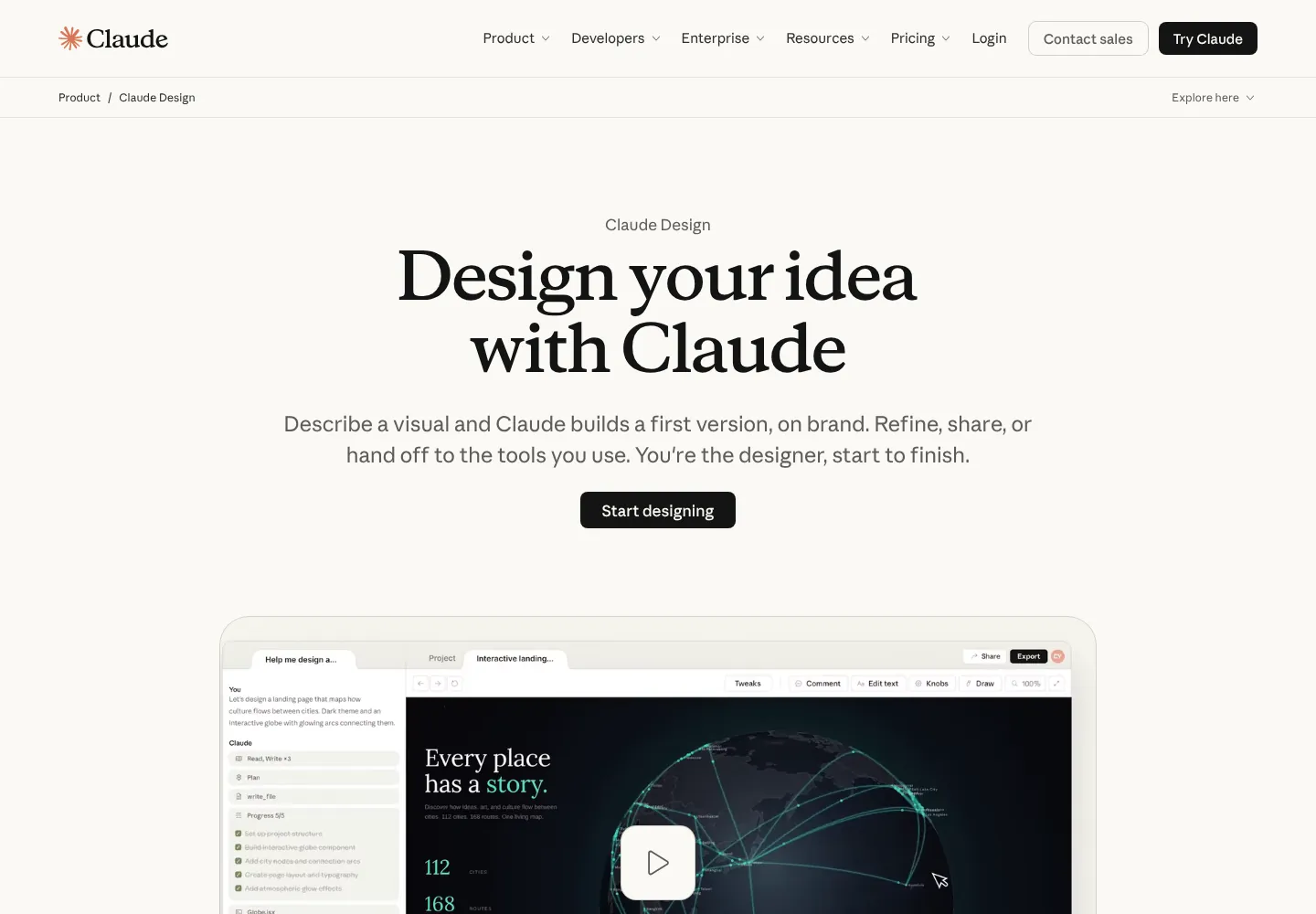
Claude Design is an official Anthropic product, not a third-party add-on. Anthropic describes it on its product page in one line: "Describe a visual and Claude builds a first version, on brand."
It arrived on 17 April 2026. Anthropic's launch post called it "a new Anthropic Labs product", powered by Claude Opus 4.7, and opened it as a research preview for Pro, Max, Team and Enterprise subscribers. It ran as a separate site, claude.ai/design.
On 16 September 2026 Anthropic merged Cowork and chat into one Claude and began bringing Claude Design into ordinary conversations, rolling out plan by plan, as my Claude Cowork review explains.
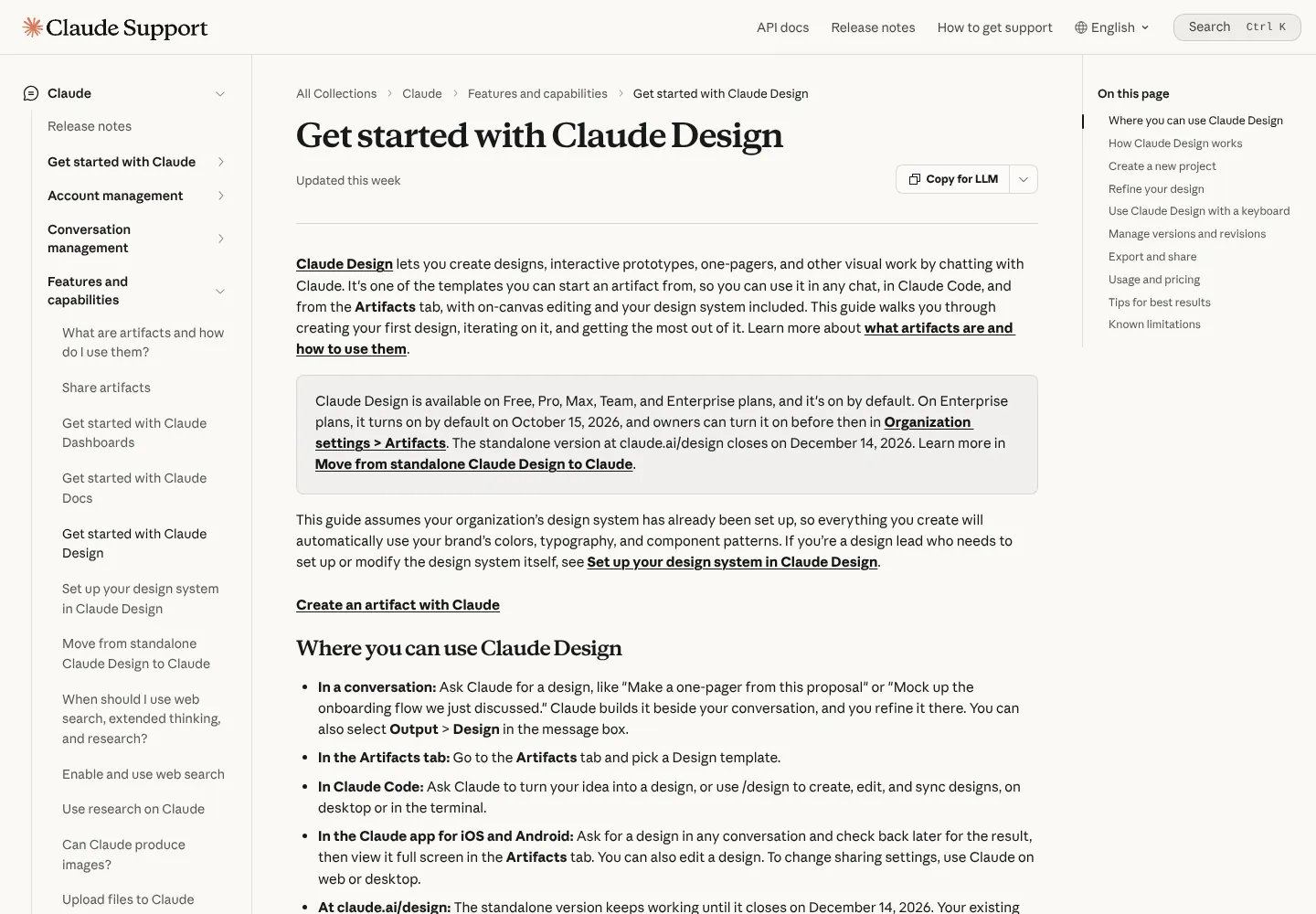
As of 29 October 2026 the main ways in are: ask for a design in any chat, pick a Design template in the Artifacts tab, or type /design in Claude Code. The iOS and Android apps can make and edit designs too. The standalone site turns read-only on 14 December 2026.
One naming note: Anthropic also publishes a frontend-design skill that helps Claude Code style the pages it codes. That is a coding helper, not the product this guide covers.
What can Claude Design make?
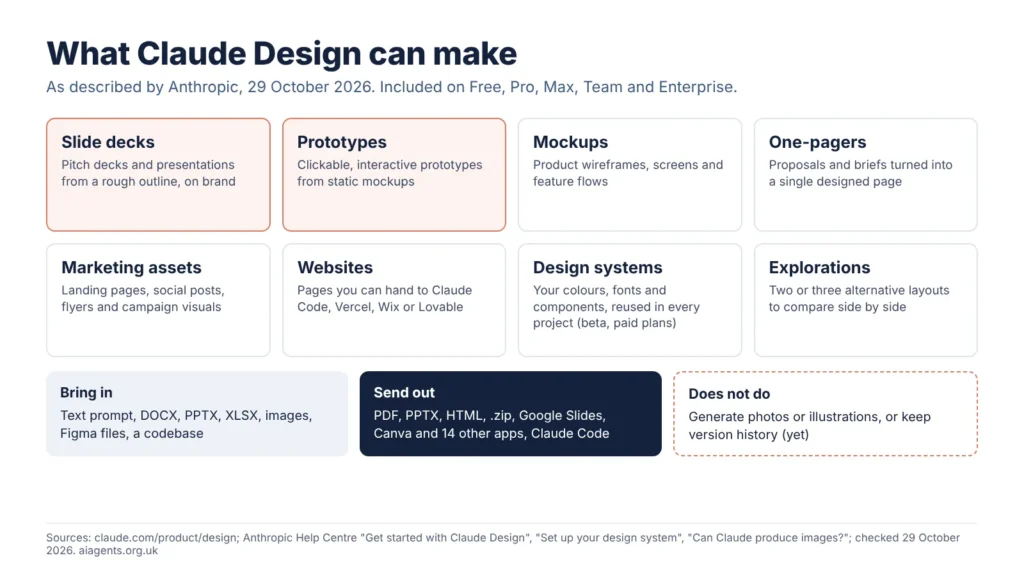
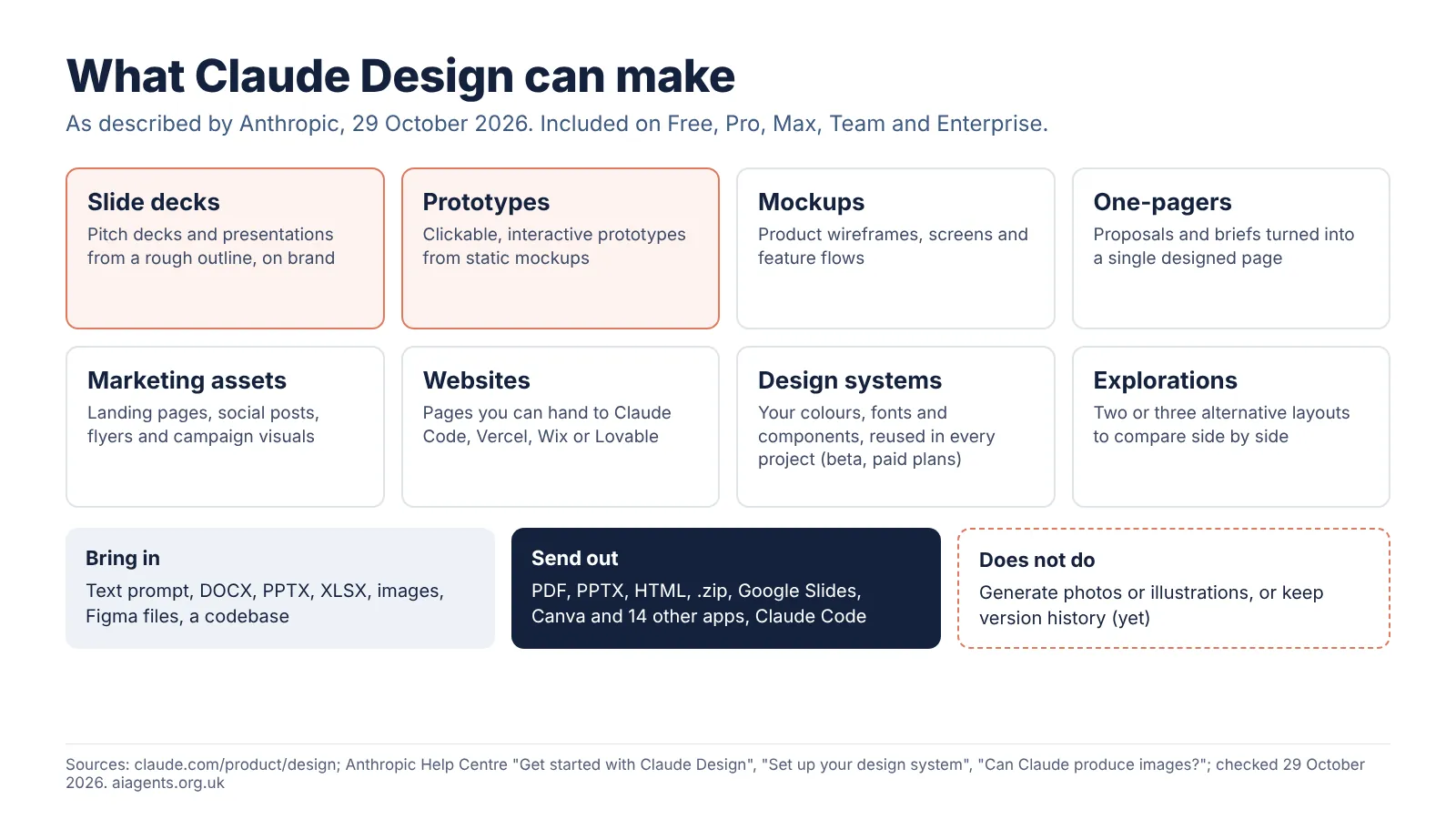
Claude Design makes polished visual work you would otherwise build in PowerPoint, Canva or Figma: decks, one-pagers, mockups, prototypes and marketing assets. It does not paint pictures.
Anthropic's launch post lists the uses teams found: designers turning static mockups into clickable prototypes, product managers sketching feature flows, founders going "from a rough outline to a complete, on-brand deck in minutes", and marketers making landing pages, social assets and campaign visuals. The product page adds flyers and websites.
Because Claude builds designs in code, Anthropic says you can also make "code-powered prototypes with voice, video, shaders, 3D and built-in AI".
What it will not do matters as much. Anthropic's Help Centre is plain: "Claude doesn't generate photos or illustrations the way image-generation tools do." It lays out text, charts and the images you upload, but will not make a new product photo.
How does Claude Design work, and where do agents come in?
You describe what you want, Claude builds a first version on a canvas beside the chat, and you refine it by chatting, commenting or editing directly. Claude plans the steps itself, then can hand the result to other tools and agents.
Anthropic's Get started guide gives this flow:
- Start a design in a chat or the Artifacts tab, and attach your design system.
- Add context, such as screenshots, a deck or a codebase.
- Describe what you want: the goal, layout, content and audience.
- Review what Claude puts on the canvas.
- Refine through chat for big changes, inline comments for targeted ones, or direct edits to drag, resize and align.
- Export or share.
Anthropic does not describe Claude Design as a team of separate agents, but Claude does work agent-style. With a design system attached, Claude "checks its own output against your design system, and makes corrections before you see them".
The bigger agent link is the handoff. When a design is ready to build, Claude packages it as a bundle for Claude Code, Anthropic's coding agent, which carries on from the design rather than a screenshot. And inside the merged Claude, a design can be one step of a longer job: Anthropic's September post describes Claude writing a weekly report and five matching slides in one conversation.
The product page goes further, showing Claude pulling numbers from QuickBooks, making assets in Canva and staging a HubSpot send for your approval. Those connectors use MCP, explained in what is MCP.
How much does Claude Design cost in the UK?
Claude Design costs nothing extra. As of 29 October 2026 it is included on every Claude plan, including Free, and Anthropic shows UK prices in pounds including 20% VAT.
The UK pricing page lists "Claude Design, Slides, Docs" under the free plan; you pay for more usage and extras. My Claude pricing guide for the UK covers every plan.
| Claude plan | UK price (29 October 2026, incl. VAT) | What it adds for design work |
|---|---|---|
| Free | £0 | Claude Design, Slides and Docs; smallest usage allowance; no saved design systems |
| Pro | £18 a month, or £180 a year (£15 a month) | More usage, design systems (beta), Claude Code for handoffs, Dashboards (beta) |
| Max | From £90 a month | 5 or 20 times Pro usage, priority at busy times |
| Team, standard seat | £18 a seat a month yearly, £22.50 monthly | Organisation sharing, admin controls, default design system, no training on your content by default |
| Team, premium seat | £90 a seat a month yearly, £113 monthly | 5 times a standard seat's usage |
| Enterprise | US$20 a seat a month yearly (about £15) plus usage at API rates; 20-seat minimum | Custom roles, audit logs, retention controls, SCIM |
Team is sold for 2 to 150 people. Enterprise is priced in dollars even on the UK page, so I have converted it.
What are the Claude Design usage limits?
There is no separate Claude Design allowance any more. Design work draws on the same usage limits as chat and Claude Code, and big jobs use more.
Anthropic's Help Centre says design activity "draws from the same pool as the rest of your work with Claude, including Claude Code", and that the old separate weekly allowance has gone. The product page adds that "a full deck or design" uses more of your limit than a typical message.
Paid plans have a session limit that resets every five hours and weekly limits, says Anthropic's usage limits article, without publishing message counts. At the limit, Claude Design stops until it resets, unless you have switched on paid usage credits.
What formats can Claude Design export?
Claude Design exports to PDF, PowerPoint and standalone HTML, among others. Every design also gets a link that stays private until you share it.
- Download as .zip, with every file in the project
- Export as PDF or PPTX (PowerPoint)
- Export to Google Slides
- Export as standalone HTML
- Send to 15 named apps: Adobe Experience Manager, Adobe for Creativity, Adobe Journey Optimizer, Base44, Canva, Gamma, HubSpot, Hyperframes, Lovable, Miro, Netlify, Replit, v0, Vercel and Wix
- Hand off to Claude Code, a local coding agent, or Claude Code on the web
Imports run the other way: a prompt, images, DOCX, PPTX and XLSX files or a codebase. Figma is not an export destination, though Figma files can feed a design system.
Claude Design for teams: design systems, sharing and admin
For a team, the key feature is the design system: your colours, fonts and components, captured once and applied to every new design and deck. Admins can lock a team to one approved system.
Anthropic's design system guide says the feature is in beta on Pro, Max, Team and Enterprise, and off on Enterprise until an owner turns it on. Build one from your brand deck, logos, fonts or Figma files in a chat, or run /design-sync in Claude Code to read a React component library.
Designs start private. On Pro and Max you can share with anyone who has the link or invite people by email. On Team and Enterprise you share with colleagues or the whole organisation, with view, comment or edit access, and an owner decides whether anything can leave the organisation.
Design, Slides and Docs are on by default on Team, and switched on for Enterprise on 15 October 2026, except in HIPAA-enabled organisations.
Is Claude Design private?
Claude Design follows the same privacy terms as the rest of Claude. On business plans Anthropic does not train on your work by default; on personal plans it depends on one setting you control.
For Free, Pro and Max, Anthropic's privacy centre says that if you let your chats improve Claude, it may keep them de-identified "for up to 5 years". Switch Model Improvement off, and deleted conversations leave its systems within 30 days.
For Team, Enterprise and the API, Anthropic says: "By default, we will not use your inputs or outputs from our commercial products ... to train our models."
Two catches for regulated teams: organisations with zero data retention cannot turn on artifacts, so cannot use Claude Design, and the standalone site does not support customer-managed encryption keys, so projects there are not encrypted under your own key until they move. For client personal data, see my guide to AI agents and UK GDPR.
Claude Design vs Canva AI, Figma AI and Google Stitch
Claude Design is best at turning words into decks and prototypes. Canva wins on images, video and templates, Figma on professional product design, and Google Stitch is a Google Labs experiment for app screens.
| Claude Design (Anthropic) | Canva AI (Canva) | Figma AI (Figma) | Stitch (Google Labs) | |
|---|---|---|---|---|
| Best at | Decks, one-pagers, prototypes from a brief or a codebase | Social, print, video and photo-led design with templates | Product and interface design for design teams | App and web screens from a prompt or sketch |
| Makes photos or video? | No | Yes, AI images and video clips | Images and vectors via Weave tools | Not stated |
| Free plan | Yes, inside Claude Free | Yes, up to 20 Standard or Premium AI uses | Starter: 150 AI credits a day, up to 500 a month | Google publishes no price |
| Paid entry price (29 October 2026) | Claude Pro £180 a year or £18 a month, VAT included | Pro £100 a year for one person | Professional $16 a month yearly, $20 monthly (about £12-£15) | Not published |
| Gets work out as | PDF, PPTX, HTML, Google Slides, Canva and 14 more apps | PDF, JPG, PNG, print-ready files | Code-backed prototypes, Dev Mode, MCP server | Paste to Figma, front-end code, AI Studio, Antigravity |
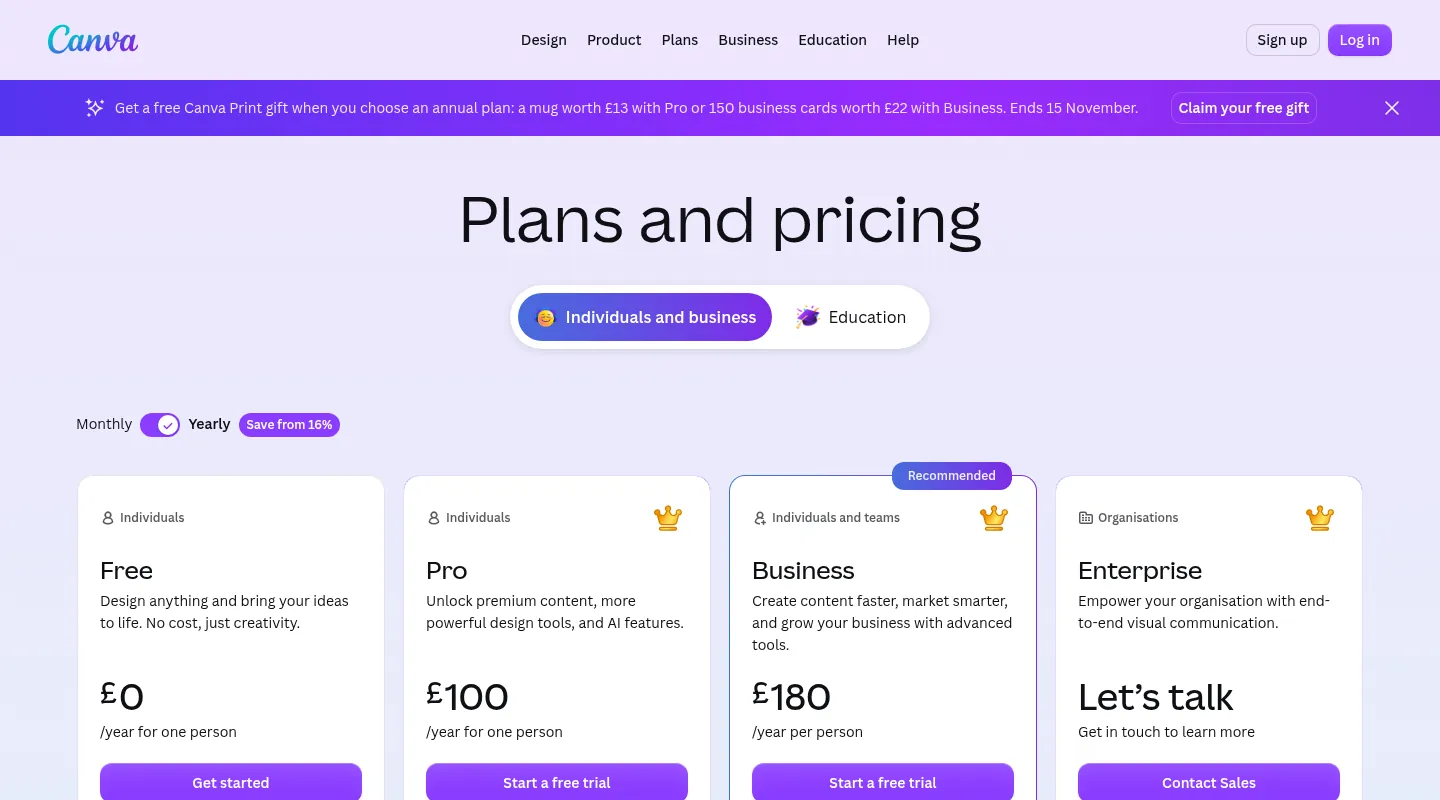
Canva. Canva's UK pricing page lists Free at £0, Pro at £100 a year for one person and Business at £180 a year per person, without saying whether VAT is included. AI runs on a shared allowance: Pro gets 10 times Canva Free's Premium AI (Free has up to 20 uses) or up to 20 Ultra AI uses, and Business twice that. Conversational design is an Ultra AI feature.
Figma. Figma's AI page offers a Figma agent and Figma Make, which turns "ideas and existing Figma designs into prototypes and web apps". Its pricing page shows only US dollars and does not mention VAT: a Professional full seat is $20 a month, or $16 billed yearly, with 3,000 AI credits a month. It is the deeper tool for design teams, with Dev Mode and full version history on paid plans, and it also sells Figma Slides for decks.
Google. Google's nearest equivalent is Stitch, a Google Labs experiment first shown in May 2025 and rebuilt in March 2026 with a design agent and voice control. It pastes designs into Figma and exports screens to Google Antigravity. It covers app and web screens, not decks or flyers, and Google gives no price.
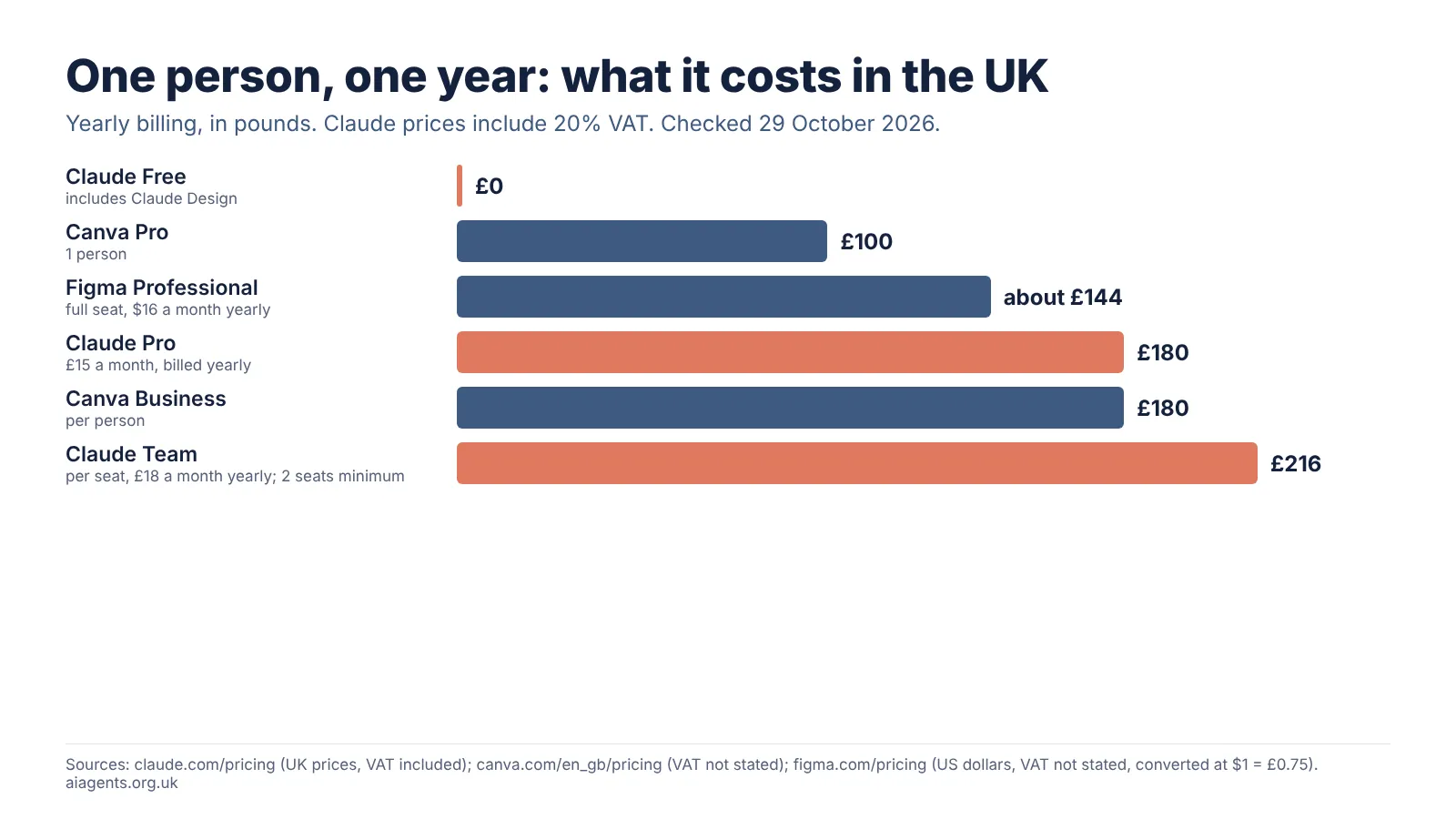
Claude Pro also buys chat and Claude Code; Canva Pro buys more than 141 million premium photos, videos, graphics and audio files. For Claude as an all-round assistant, see ChatGPT vs Claude vs Gemini vs Copilot.
Who should use Claude Design?
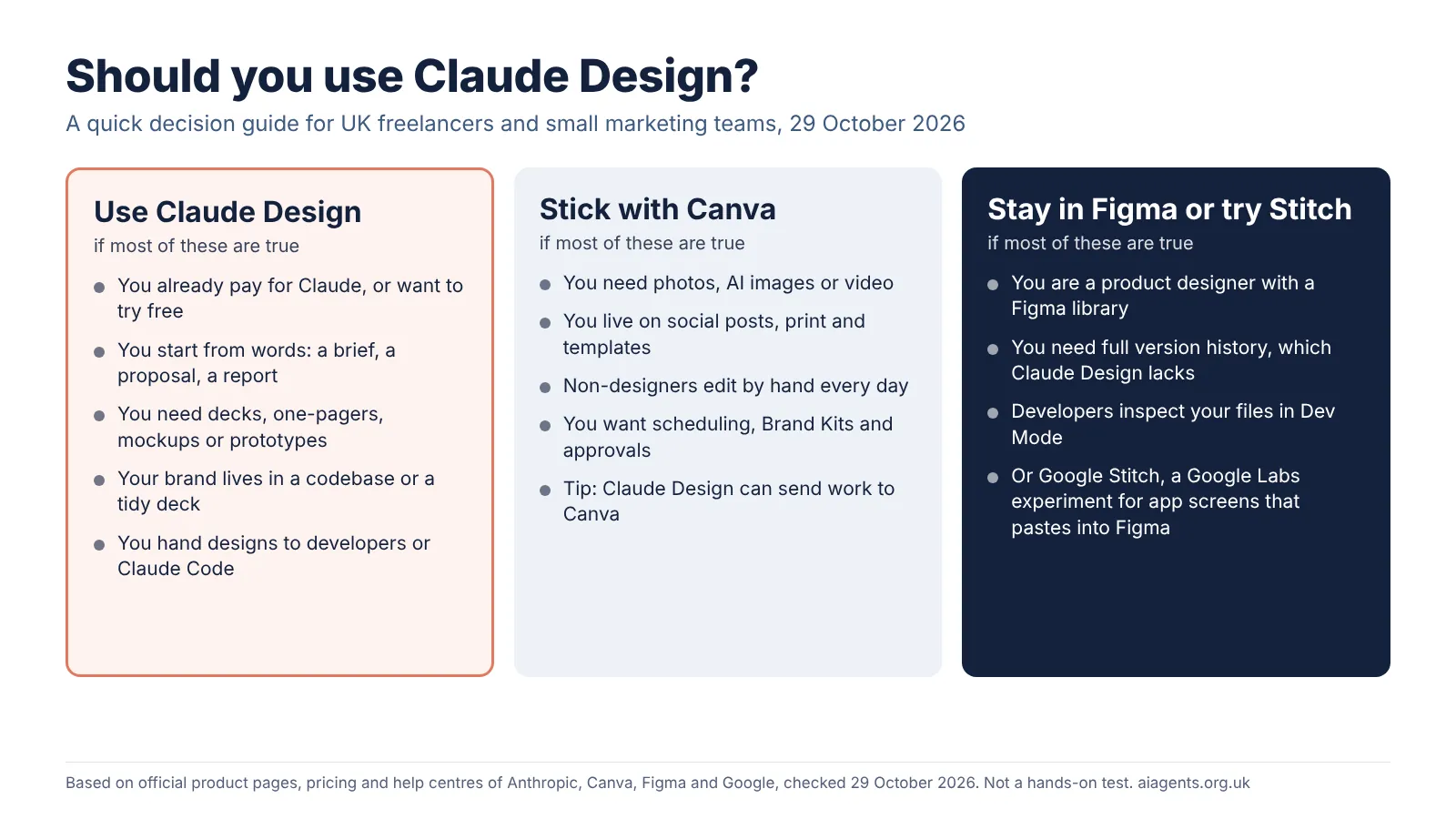
Claude Design suits UK freelancers and small marketing teams who already use Claude and start from words: a proposal or brief that must become a deck or one-pager. Agencies drafting monthly client updates can start with our free client-reporting kit.
- Try it free first. Ask Claude Free for a one-pager from a document you already have.
- Check what your work is made of. Mostly text, charts and layout suits Claude Design; mostly photos and video suits Canva.
- Set up a design system before you judge it. On Pro, give Claude your brand deck, logos and fonts.
- Fix the privacy setting. On a personal plan, switch off Model Improvement before you upload client material.
- Plan the handoff. If Claude Code or a developer will build it, use the handoff, not a PDF.
- Move old work before 14 December 2026. Chats and comments on claude.ai/design do not move.
For a small marketing team, Claude Team at £18 a seat a month (yearly) adds shared design systems and no training on your content by default. Claude skills can hold your writing style, and AI agents for small business has more ideas.
What are Claude Design's limits?
Anthropic lists its own known problems. The ones that matter for client work:
- No version history yet. To keep a direction, tell Claude to "save what we have and try a completely different approach".
- Basic multi-person editing. Two or more people editing at once "may not work reliably".
- Comments can go missing. Inline comments sometimes disappear before Claude reads them; Anthropic suggests pasting feedback into the chat instead.
- Large codebases lag. Anthropic suggests linking very large repositories from Claude Code instead.
- No sharing changes on mobile. You can make and edit designs on iOS and Android, but sharing settings need the web or desktop app.
- No image generation. Not on that list, but Anthropic's Help Centre says Claude does not generate photos or illustrations, so they must come from you or another tool.
The product also changed shape five months after launch, so expect more change.
Frequently asked questions
Is Claude Design free?
Yes. As of 29 October 2026 Anthropic includes Claude Design on every Claude plan, including Free. Free use draws on the free plan's small usage allowance, and saved design systems need a paid plan. Claude Pro costs £18 a month in the UK including VAT, or £180 a year.
When did Claude Design launch?
Anthropic launched Claude Design on 17 April 2026 as an Anthropic Labs research preview for paid subscribers, powered by Claude Opus 4.7. From 16 September 2026 Anthropic began bringing it into ordinary Claude conversations. The original standalone site, claude.ai/design, closes on 14 December 2026.
Can Claude Design make images?
Not photos or illustrations. Anthropic's Help Centre says Claude does not generate pictures the way image tools do. Claude Design builds layouts, slides, prototypes and charts, and uses images you upload. For AI photos or video you still need a tool such as Canva.
Is Claude Design better than Canva?
They do different jobs. Claude Design is stronger when you start from words, need a prototype or hand work to developers. Canva is stronger for photos, AI images, video, templates, print and social scheduling. Claude Design can send work to Canva, so many teams will use both.
Can I export Claude Design to PowerPoint or Figma?
PowerPoint, yes: Claude Design exports PPTX, PDF, standalone HTML, a .zip file and Google Slides, and sends work to 15 apps including Canva and Gamma. Figma is not on Anthropic's export list, though Figma files can feed a design system.
Does Anthropic train on my Claude Design work?
On Free, Pro and Max, only if the Model Improvement setting is on, in which case Anthropic may keep data for up to five years. You can switch it off in Settings. On Team and Enterprise, Anthropic does not train on your content by default.
Read next
- Claude pricing in the UK: every plan in pounds
- Claude Cowork review: Anthropic's agent for your files and office tasks
- Claude skills explained: how to use and create skills
- Claude Code explained: UK pricing, install and comparisons
- ChatGPT vs Claude vs Gemini vs Copilot (UK, 2026)
- Google Antigravity explained
Sources
- Claude Design product page, Anthropic - what it makes, connectors, imports and exports, plan inclusion, Enterprise defaults, usage note, standalone closure - checked 29 October 2026
- Introducing Claude Design by Anthropic Labs, Anthropic (17 April 2026) - launch date, Opus 4.7, research preview, use cases, Canva quote - checked 29 October 2026
- Claude Cowork and chat are now one Claude, Anthropic (16 September 2026, updated 23 October 2026) - Claude Design inside conversations, Docs and Slides - checked 29 October 2026
- Anthropic Help Centre: Get started with Claude Design - plans, workflow, export list, usage, known limitations - checked 29 October 2026
- Anthropic Help Centre: Move from standalone Claude Design to Claude - 14 December 2026 closure, what moves, ZDR and CMEK - checked 29 October 2026
- Anthropic Help Centre: Set up your design system in Claude Design - beta status, plans, /design-sync - checked 29 October 2026
- Anthropic Help Centre: Artifacts admin guide for Team and Enterprise plans - templates, defaults, external sharing - checked 29 October 2026
- Anthropic Help Centre: Share artifacts - access levels, 50 outside invitations - checked 29 October 2026
- Anthropic Help Centre: How do usage and length limits work? - five-hour session and weekly limits, usage credits - checked 29 October 2026
- Anthropic Help Centre: Can Claude produce images? - no photo or illustration generation - checked 29 October 2026
- Claude pricing, Anthropic (viewed from the UK) - UK prices including 20% VAT, plan features - checked 29 October 2026
- Anthropic Privacy Centre: How long do you store my data? - consumer retention and training - checked 29 October 2026
- Anthropic Privacy Centre: Is my data used for model training? (commercial) - no training by default - checked 29 October 2026
- Anthropic skills repository: frontend-design - separate coding skill with a similar name - checked 29 October 2026
- Canva plans and pricing (UK) - Free, Pro and Business prices, AI allowances - checked 29 October 2026
- Figma pricing - seat prices in US dollars, AI credits - checked 29 October 2026
- Figma AI - Figma agent, Figma Make - checked 29 October 2026
- Figma Help: View a file's version history - version history by plan - checked 29 October 2026
- Introducing Stitch, Google Developers Blog (20 May 2025) - launch, paste to Figma, front-end code - checked 29 October 2026
- Design UI using AI with Stitch from Google Labs, Google (18 March 2026) - design agent, Agent manager, DESIGN.md - checked 29 October 2026
- Real time design with Google Stitch, Google (19 May 2026) - voice, export to Antigravity and Netlify - checked 29 October 2026