Agentic AI vs generative AI comes down to one difference: generative AI creates content when you ask for it, and agentic AI takes a goal and acts on it, using tools and checking its own work. Most agentic AI runs on a generative model, so the two are layers of the same technology, not rivals. A chat that drafts an invoice reminder is generative. A system that finds the overdue invoices, sends the reminders, checks the bank feed and chases again is agentic. This guide compares the two side by side, with definitions from IBM, Google, Microsoft and the UK government, and sorts real UK tools into each camp.
Key facts
- Generative AI: creates text, images, video, audio or code in response to a prompt, then waits for you (IBM, GOV.UK).
- Agentic AI: pursues a goal by planning, using tools and taking actions with little human input, checking results as it goes.
- How they relate: agentic AI is built on generative AI. Google Cloud calls it "a subset of generative AI".
- AI agent vs agentic AI: an AI agent is one system; agentic AI is the capability or the field. For a buyer, they mean the same thing.
- Cost: agents typically use about 4x the tokens of a chat, and multi-agent systems about 15x (Anthropic, June 2025).
- Risk: generative AI's worst case is a wrong answer you read; an agent's is a wrong action you did not see.
- UK rules (29 October 2026): UK GDPR applies to both. The ICO's call for evidence on agentic AI is open until 20 November 2026.
On this page
- What is the difference between agentic AI and generative AI?
- How do IBM, Google, Microsoft and the UK government define them?
- Generative AI vs agentic AI: side by side
- How does a generative AI answer differ from an agent loop?
- Agentic AI vs AI agents: are they the same?
- Agentic AI examples in the UK: which tools are which?
- What changes for UK businesses?
- Generative AI or agentic AI: which do you need?
- Frequently asked questions
- Read next
- Sources and dates checked
What is the difference between agentic AI and generative AI?
Generative AI makes things. Agentic AI does things. That is the short version, and every official definition I checked agrees with it.
Ask a ChatGPT or Claude chat for a reminder email and it writes one. Then it stops. Every step after the first answer is yours.
Give an agentic system the goal "get overdue invoices paid" and it works out the steps itself. It reads the ledger, sends the reminder, checks whether the money arrived and chases again, until the job is done or it reaches a step you told it to ask about.
The two are not separate technologies. The agent uses a large language model as its reasoning engine and adds a goal, tools and a loop that checks results. My guide to what agentic AI is explains the loop in more depth; this page is the comparison.
How do IBM, Google, Microsoft and the UK government define them?
They define generative AI by what it produces and agentic AI by what it achieves. Here are the official wordings, checked on 29 October 2026.
- IBM: "generative AI creates new content such as text, images, video, audio and software code", while "Agentic AI focuses on achieving goals by planning, making decisions and carrying out multi-step workflows with varying levels of autonomy." IBM adds that generative AI is "primarily reactive, while agentic AI can proactively work toward a goal."
- Google Cloud: generative AI "is focused on the creation of new content, such as text, images, code, or music, based on input prompts." Agentic AI "is a subset of generative AI" that uses LLMs "as a 'brain' to perform actions through tools."
- Microsoft: generative AI "Creates new content or responses based on a user's request and available context." Agentic AI "Uses AI models with instructions and tools to pursue a goal and complete tasks", taking actions "within defined permissions and controls."
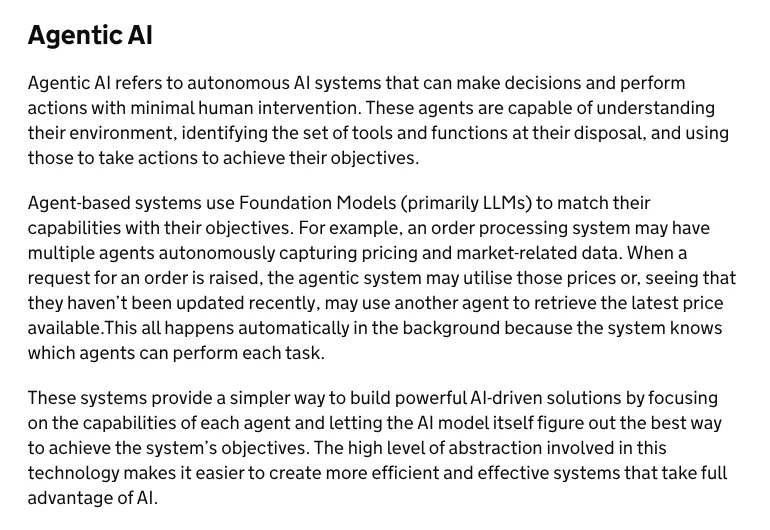
- UK government: the AI Playbook for the UK Government, published on 10 February 2025, says "Generative AI is a subset of AI capable of generating text, images, video or other forms of output" and "Agentic AI refers to autonomous AI systems that can make decisions and perform actions with minimal human intervention."
- The ICO: the UK data regulator's Tech Futures report on agentic AI says it "combines the capabilities of generative AI with additional tools and new ways of interacting with the world."
Google and the ICO both describe agentic AI as built on top of generative AI, not as a replacement for it. Microsoft puts limits inside its definition, and those limits are the part UK businesses need to get right.
Generative AI vs agentic AI: side by side
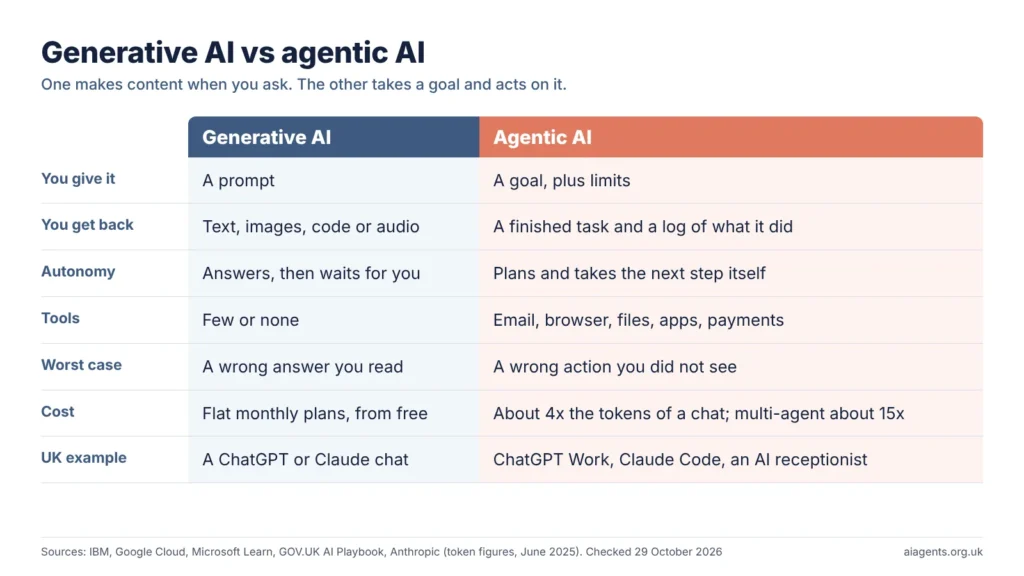
Generative AI gives you an output to check; agentic AI gives you an outcome to supervise. The table sets out the practical differences, with dated figures where a vendor publishes them.
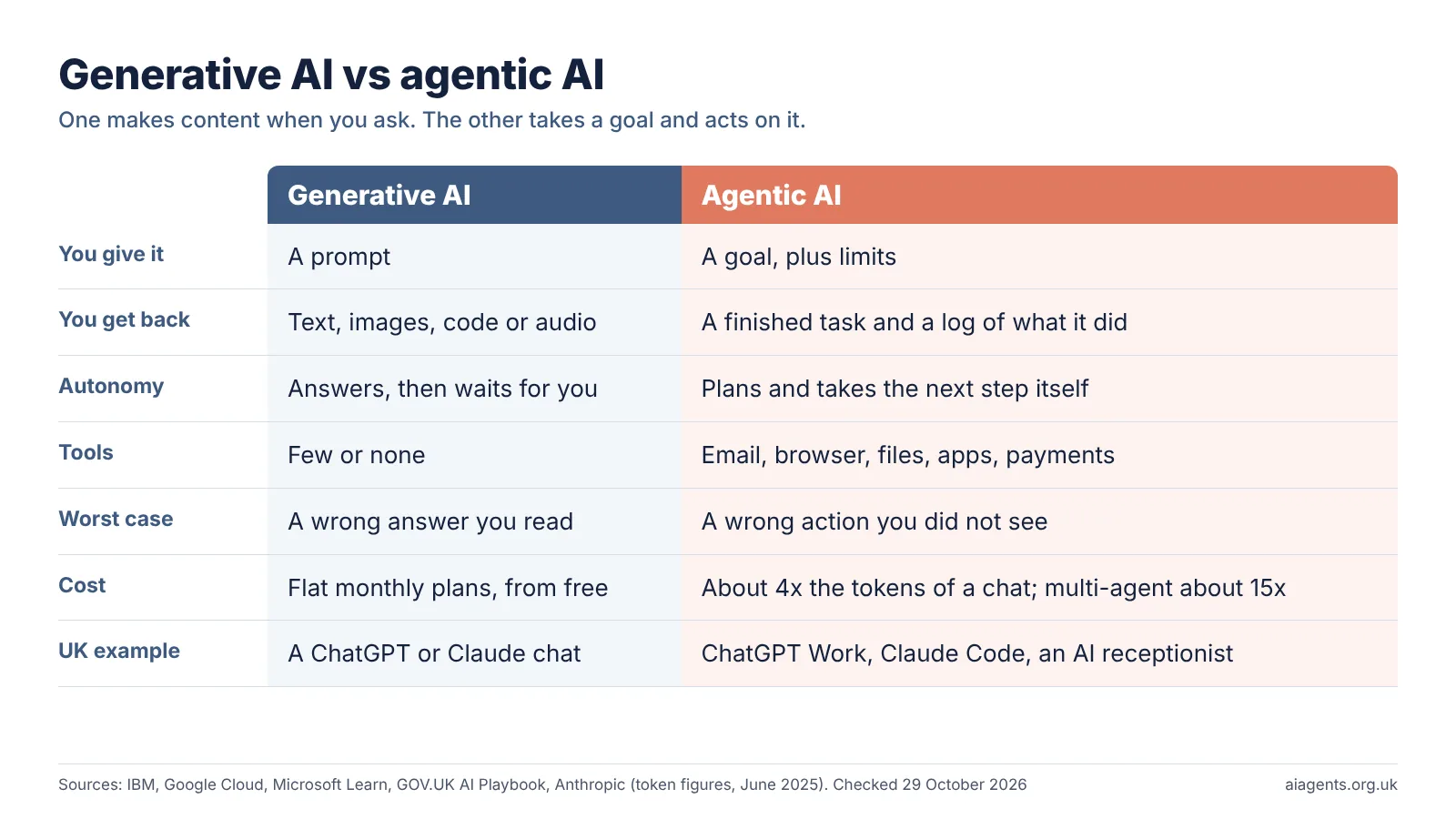
| Generative AI | Agentic AI | |
|---|---|---|
| What it does | Creates text, images, video, audio or code | Plans and carries out a multi-step task towards a goal |
| You give it | A prompt | A goal, plus the limits it must work within |
| You get back | A draft, image, summary or answer | A finished task, ideally with a log of every action |
| Autonomy | Reactive: answers, then waits | Takes the next step itself until done or blocked |
| Tools | Few or none; some can search the web | Email, browser, files, calendars, accounting or payment systems |
| Main risks | Wrong or invented facts; sensitive data pasted into prompts | Wrong actions; over-broad access; manipulated instructions hidden in emails or web pages; errors that repeat |
| Cost | Free tiers; personal plans about £18-£20 a month in the UK | Uses more compute: about 4x a chat's tokens for one agent, about 15x for multi-agent systems (Anthropic, June 2025) |
| Example products | A ChatGPT, Claude, Gemini or Copilot Chat conversation | ChatGPT Work, Claude Code, Copilot Researcher, an AI receptionist |
On a flat monthly plan, agentic work uses up your allowance faster; on pay-as-you-go billing it shows on the invoice. Anthropic's own engineering advice, from December 2024, is that "Agentic systems often trade latency and cost for better task performance", and that you should start with "the simplest solution possible". Gartner predicted on 25 June 2025 that over 40% of agentic AI projects will be cancelled by the end of 2027, "due to escalating costs, unclear business value or inadequate risk controls".
The risk row matters more. A chatbot's wrong answer is read before it is used. An agent's mistake may be sent, booked or saved before anyone looks. Microsoft's Taxonomy of Failure Modes in Agentic AI Systems describes agentic failure modes as either new or "existing risks materially amplified" compared with less autonomous generative AI.
How does a generative AI answer differ from an agent loop?
A generative answer is one pass: prompt in, content out. An agent runs a loop: plan, act with a tool, check the result, then repeat, ask you or stop.
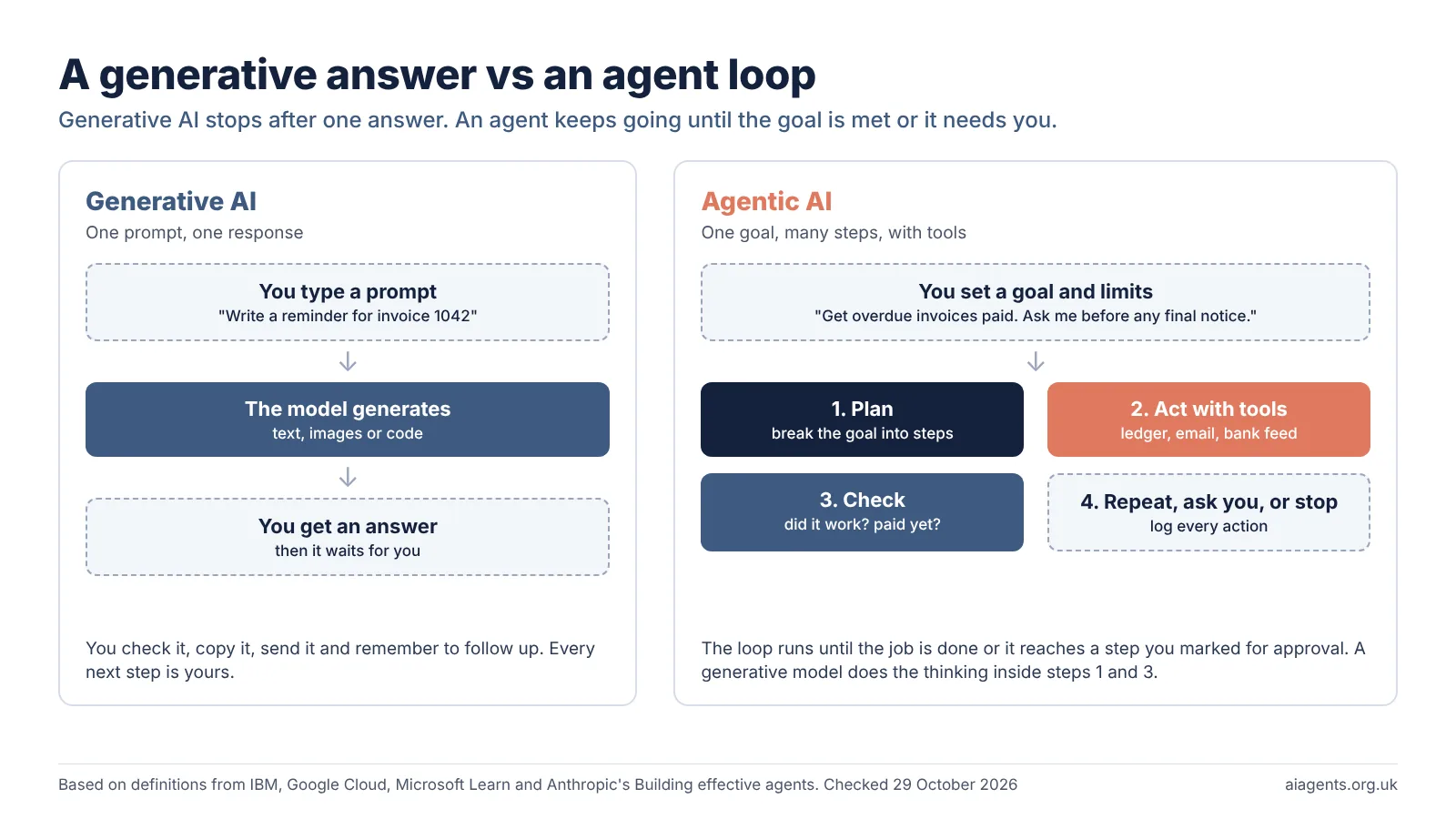
In the loop, the generative model does the thinking: it writes the plan and judges whether a step worked. The tools do the acting.
That is also why the same brand can sit on both sides. Claude in a chat window writes a reminder. Claude Code, Anthropic's coding agent, "understands your codebase, edits files, runs commands" in Anthropic's words, and keeps going until the change works. Same model family, different job. For the jump from chatbot to assistant to agent, see AI agent vs chatbot vs assistant.
Agentic AI vs AI agents: are they the same?
For anyone choosing software, yes. Agentic AI is the capability; an AI agent is one system that has it. People say "agentic AI" when they mean the trend and "AI agent" when they mean the product on their desk.
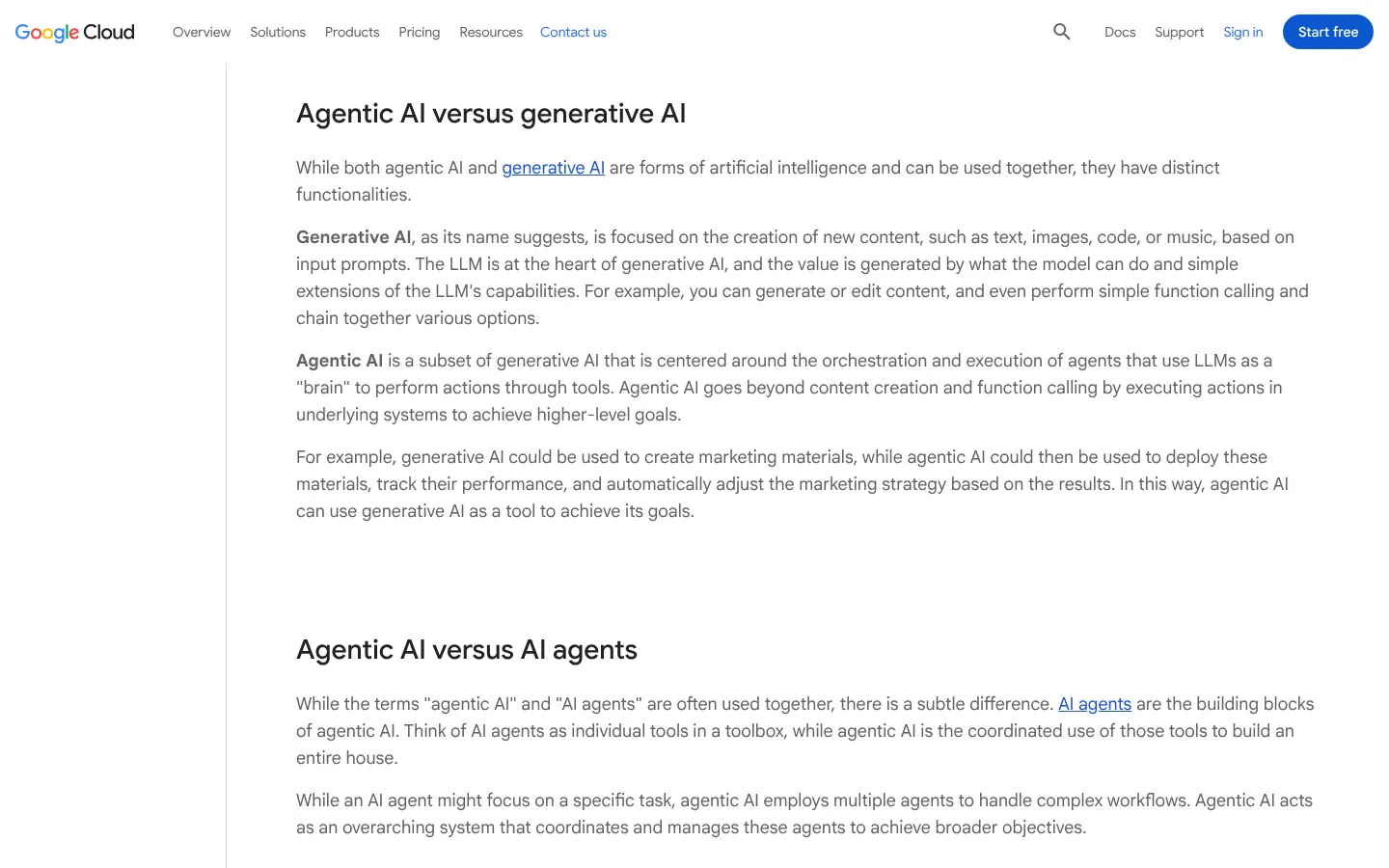
Google Cloud draws a finer line. It calls AI agents "the building blocks of agentic AI" and says that "While an AI agent might focus on a specific task, agentic AI employs multiple agents to handle complex workflows." On that reading, a single invoice-chasing agent is an AI agent, and a system where a research agent, a writing agent and a checking agent pass work between them is agentic AI.
That distinction rarely changes a buying decision. Both need a goal, tools, a check-and-retry loop and a log. A product with none of these is a chatbot with a new label, which Gartner calls "agent washing". In the same 25 June 2025 press release, Gartner estimated that only about 130 of the thousands of agentic AI vendors are real. For the different kinds of agent you can buy, see types of AI agents; for the basics of one agent, see what is an AI agent?.
Agentic AI examples in the UK: which tools are which?
Most big AI products now come in both forms: a chat that generates and a mode that acts. Here is how the tools I cover sort out, as of 29 October 2026.
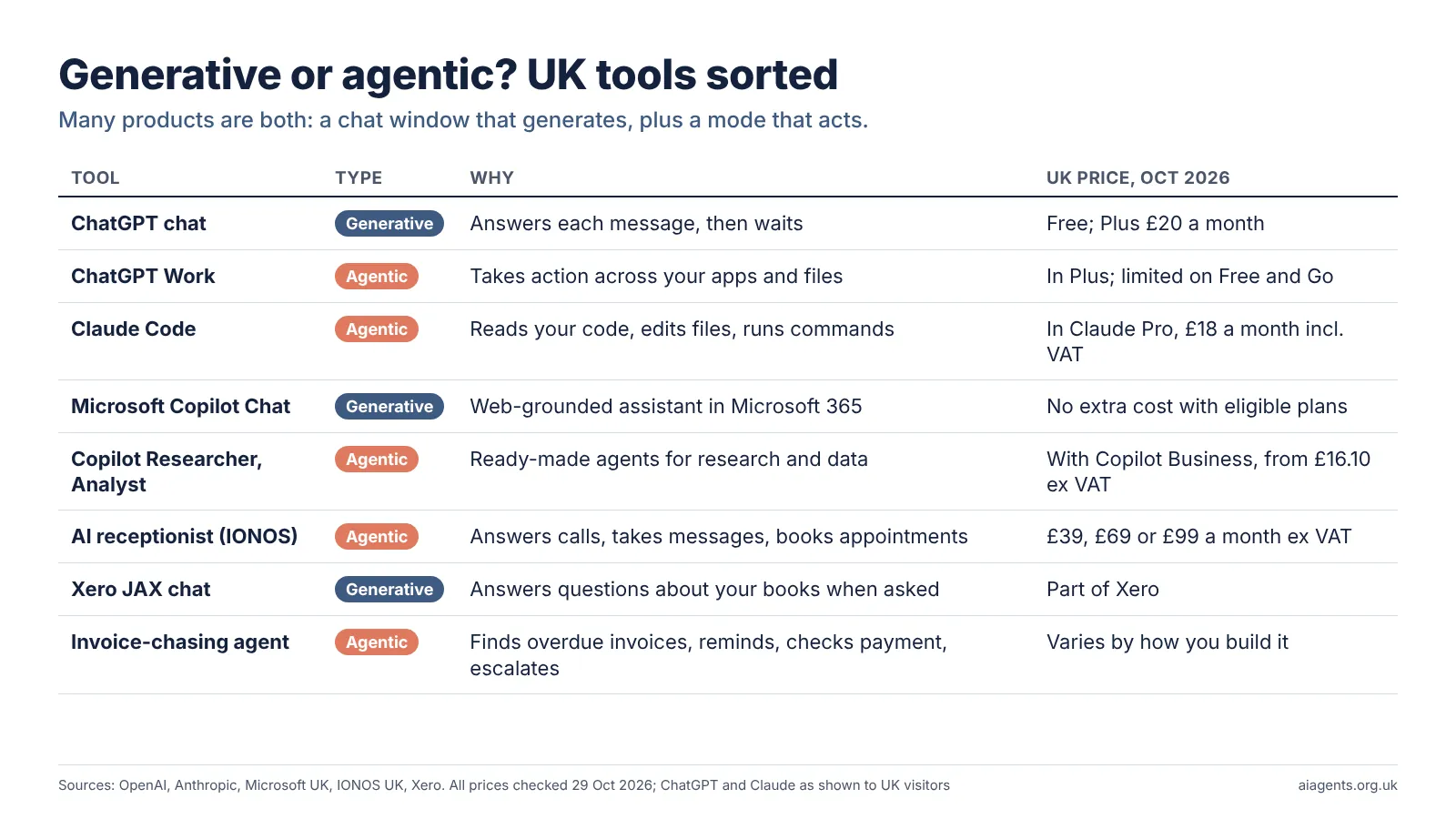
| Tool | Generative or agentic? | What makes it so | UK price |
|---|---|---|---|
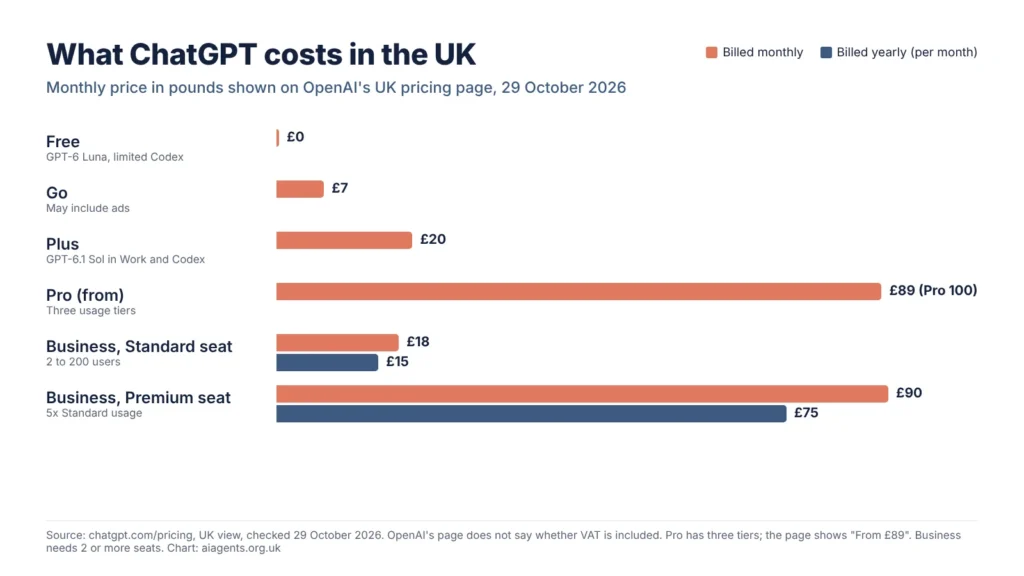
| ChatGPT chat (OpenAI) | Generative | Answers each message, then waits | Free; Plus £20 a month (UK price, 29 October 2026; OpenAI's page does not say whether VAT is included) |
| ChatGPT Work (OpenAI) | Agentic | OpenAI calls it "an agent that can take action across your apps and files" and turn a goal into finished work | Included in Plus on desktop, web and mobile; limited on Free and Go in the desktop app |
| Claude Code (Anthropic) | Agentic | Reads your code, edits files and runs commands | Included in Claude Pro, £18 a month including VAT (UK, 29 October 2026) |
| Microsoft 365 Copilot Chat | Generative | A web-grounded assistant inside Microsoft 365 | No additional cost with eligible Microsoft 365 plans |
| Copilot Researcher and Analyst (Microsoft) | Agentic | Ready-made agents for in-depth research and turning raw data into insights | With Microsoft 365 Copilot Business: £16.10 a user a month yearly (£13.80 offer to 31 December 2026) or £19.32 monthly, excluding VAT |
| AI receptionist (IONOS) | Agentic, narrowly | Answers calls, takes messages and, on the £69 and £99 plans, books appointments into your calendar | £39, £69 or £99 a month, excluding VAT; one-month free trial |
| Xero JAX chat | Generative | Answers questions about your books; Xero says it only does something when you ask | Part of Xero |
| Invoice-chasing agent | Agentic | Finds overdue invoices, reminds, checks payment, escalates, reports | Depends on how you build it; see the guide |
Three things stand out. First, the line runs through products, not companies. OpenAI, Anthropic and Microsoft all sell a generative chat and an agent, often in the same subscription. As of 29 October 2026, OpenAI's help centre says "ChatGPT agent is no longer available" and points users to ChatGPT Work instead, which my ChatGPT agents guide covers.
Second, the most useful UK agents are narrow. An AI receptionist does one job with a short list of actions, which is why it suits a small firm.
Third, accounting software is moving from generative to agentic. Xero calls JAX its "agentic platform", but its JAX chat only acts when you open it and ask a question. At Xerocon London on 8 July 2026, Xero announced JAX features that "will" go further, such as Payment Follow Ups that "automatically execute tailored collection plans". As of 29 October 2026, Xero's help centre says payment follow-ups are "only available to organisations in the early access group", so most UK businesses cannot switch them on yet. That is the invoice-chasing agent built into the ledger. My guide to AI for accountants tracks which of these features UK practices can use today.
What changes for UK businesses?
The law is the same, but your exposure grows. UK GDPR applies to both; with an agent, more personal data moves and more happens before a person looks.
The ICO is clear about who carries the risk. Its Tech Futures report on agentic AI says "organisations remain responsible for data protection compliance of the agentic AI they develop, deploy or integrate". Its call for evidence on agentic AI opened on 8 October 2026 and stays open "until the end of 20 November 2026". Its guidance plans list final agentic AI guidance as "due for publication: Spring 2027".
In practice, four things change when you move from a chat tool to an agent:
- Access. A chat tool sees only what you paste in. An agent connects to your inbox, files or ledger, so give it the narrowest access that does the job.
- Decisions about people. If an agent alone makes a significant decision about someone, such as rejecting a job applicant, the UK GDPR rules on solely automated decisions in Articles 22A to 22D apply. Article 22C requires safeguards, including a way to obtain human intervention.
- Records. You need a log of what the agent did and why, both to fix mistakes and to answer a complaint or a regulator.
- Contracts. Use a business plan with a data processing agreement. Personal plans are not built for client data.
My guide to AI agents and UK GDPR has the full 10-step checklist, and the ICO AI guidance tracker lists each new ICO publication as it lands.
Generative AI or agentic AI: which do you need?
Use generative AI when you want help with a piece of work you will finish yourself. Use agentic AI when a job repeats, the rules are clear and a mistake is cheap to catch. Work down this list and stop at the first match.
- You want a draft, a summary or an idea. Generative AI. A chat plan, or the free tier, is enough.
- You want help with research or analysis but will decide yourself. Generative AI, or an agent that only reads, such as a research agent. Check its sources.
- A job repeats every week with written rules, such as chasing invoices or answering missed calls. An agent with approval steps. Start with one job.
- The job changes records or sends messages for you. An agent, but only with a log, narrow permissions and a person approving anything you cannot undo.
- The decision significantly affects a person, such as hiring, credit or refunds. Keep a human decision-maker, and read the UK GDPR rules first.
- You cannot write the rules down on one page. Not an agent yet. Use generative AI to help you write the rules, then come back.
What can wait: multi-agent systems, custom-built agents and anything marketed as "fully autonomous". For most UK small businesses, the first year of value comes from a good chat tool plus one narrow agent. If you want to build that agent yourself, how to build an AI agent walks through it.
Frequently asked questions
What is the difference between agentic AI and generative AI?
Generative AI creates content, such as text, images or code, when you give it a prompt, then waits for you. Agentic AI is given a goal and works towards it: it plans steps, uses tools such as email or a browser, checks the results and carries on. Most agentic AI uses a generative model to do its thinking.
Is ChatGPT generative AI or agentic AI?
Both, depending on the mode. A normal ChatGPT chat is generative AI: it answers each message and waits. ChatGPT Work, launched on 9 July 2026, is agentic: OpenAI describes it as an agent that can take action across your apps and files and turn a goal into finished work. The older ChatGPT agent mode is no longer available.
Is agentic AI the same as an AI agent?
In practice, nearly. An AI agent is one system that pursues a goal with tools. Agentic AI is the capability, or the field, and Google Cloud also uses it for systems that coordinate several agents. If you are buying software, treat them as the same thing and judge the product on its goal, tools, loop and log.
Is agentic AI a type of generative AI?
Usually, yes. Google Cloud calls agentic AI a subset of generative AI, and the ICO says agentic AI combines the capabilities of generative AI with additional tools. The agent uses a large language model as its reasoning engine, then adds planning, tool use and a feedback loop so it can act rather than only write.
Is agentic AI more expensive than generative AI?
Usually, per task. Anthropic found that its agents typically use about four times as many tokens as chat interactions, and multi-agent systems about 15 times. On a flat monthly plan that shows up as usage limits; on pay-as-you-go it shows up on the bill. An agent can still be cheaper per finished job.
Do UK GDPR rules apply to agentic AI?
Yes, in full, whenever an agent handles personal data. The ICO says organisations remain responsible for the agentic AI they develop, deploy or integrate. Its call for evidence on agentic AI runs until 20 November 2026, and it plans to publish final agentic AI guidance in spring 2027.
Read next
- What is agentic AI? Meaning, examples and UK rules
- What is an AI agent? A plain-English guide for the UK
- AI agent vs chatbot vs AI assistant: the difference, with an example
- Types of AI agents: the five you can buy, and the five in the textbook
- 25 AI agent examples that do real work, by department
- AI agents and UK GDPR: what the ICO expects
Sources
- IBM Think, Agentic AI vs. generative AI (11 February 2025) - checked 29 October 2026
- Google Cloud, What is agentic AI? (last updated 16 September 2026) - checked 29 October 2026
- Microsoft Learn, AI adoption: Cloud Adoption Framework (last updated 15 October 2026) - checked 29 October 2026
- Microsoft, Taxonomy of Failure Modes in Agentic AI Systems v2.0 - checked 29 October 2026
- GOV.UK, AI Playbook for the UK Government (10 February 2025) - checked 29 October 2026
- ICO, Tech Futures: agentic AI - checked 29 October 2026
- ICO, Agentic AI call for evidence (8 October to 20 November 2026) - checked 29 October 2026
- ICO, Our plans for new and updated guidance: technology - checked 29 October 2026
- Anthropic, Building effective agents (19 December 2024) - checked 29 October 2026
- Anthropic, How we built our multi-agent research system (13 June 2025) - checked 29 October 2026
- Gartner, Over 40% of agentic AI projects will be canceled by end of 2027 (25 June 2025) - checked 29 October 2026
- OpenAI Help Centre, ChatGPT agent - checked 29 October 2026
- OpenAI, ChatGPT is now a partner for your most ambitious work (9 July 2026) - checked 29 October 2026
- legislation.gov.uk, UK GDPR Article 22C - checked 29 October 2026
- OpenAI, ChatGPT pricing (UK view: Plus £20 a month; ChatGPT Work by plan) - checked 29 October 2026
- Anthropic, Claude Code product page - checked 29 October 2026
- Anthropic, Claude pricing (UK view: Pro £18 a month including 20% VAT) - checked 29 October 2026
- Microsoft UK, Microsoft 365 Copilot Business pricing - checked 29 October 2026
- Microsoft Support, Agents built by Microsoft - checked 29 October 2026
- IONOS UK, AI receptionist pricing - checked 29 October 2026
- Xero UK, JAX - checked 29 October 2026
- Xero Central, Set up payment follow-ups (early access only) - checked 29 October 2026
- Xero, New AI innovations at Xerocon London (8 July 2026) - checked 29 October 2026
- UK prices compared in my ChatGPT vs Claude vs Gemini vs Copilot comparison and Claude pricing UK guide