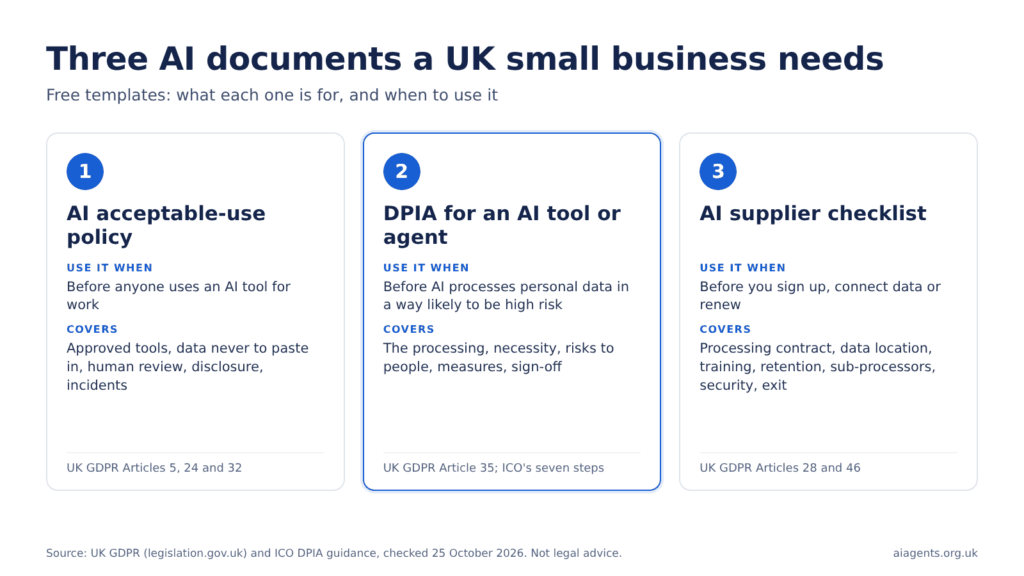
Every UK business whose staff use AI tools needs a short AI acceptable-use policy; any business connecting an AI tool to personal data needs to check the supplier and sign a processing contract; and if that use is likely to be high risk, UK GDPR Article 35 makes a data protection impact assessment (DPIA) a legal requirement before you start. Below are three free Word templates, one for each job, written against the ICO's guidance and the UK GDPR text, with what each covers, how to fill it in and when the law says you must. More free resources are in our templates library.
Key facts
- Three free downloads: AI acceptable-use policy, AI DPIA and AI supplier checklist, in Word. No sign-up.
- DPIA law: Article 35 requires one "prior to the processing" when it is likely to be high risk.
- AI on the ICO list: AI is innovative technology; with any one of nine European criteria, a DPIA is required.
- Automated decisions: Articles 22A to 22D, from the Data (Use and Access) Act 2025, fully in force since 5 February 2026.
- High risk left over: consult the ICO before you start (Article 36).
- Suppliers: Article 28 requires a written contract with any AI provider processing personal data for you.
On this page
- Download the three templates
- Which template do you need?
- The AI acceptable-use policy
- When is a DPIA legally required for AI?
- The AI DPIA template, step by step
- Automated decisions: what the Data (Use and Access) Act changed
- What to ask an AI supplier
- Frequently asked questions
- Sources
Download the three templates
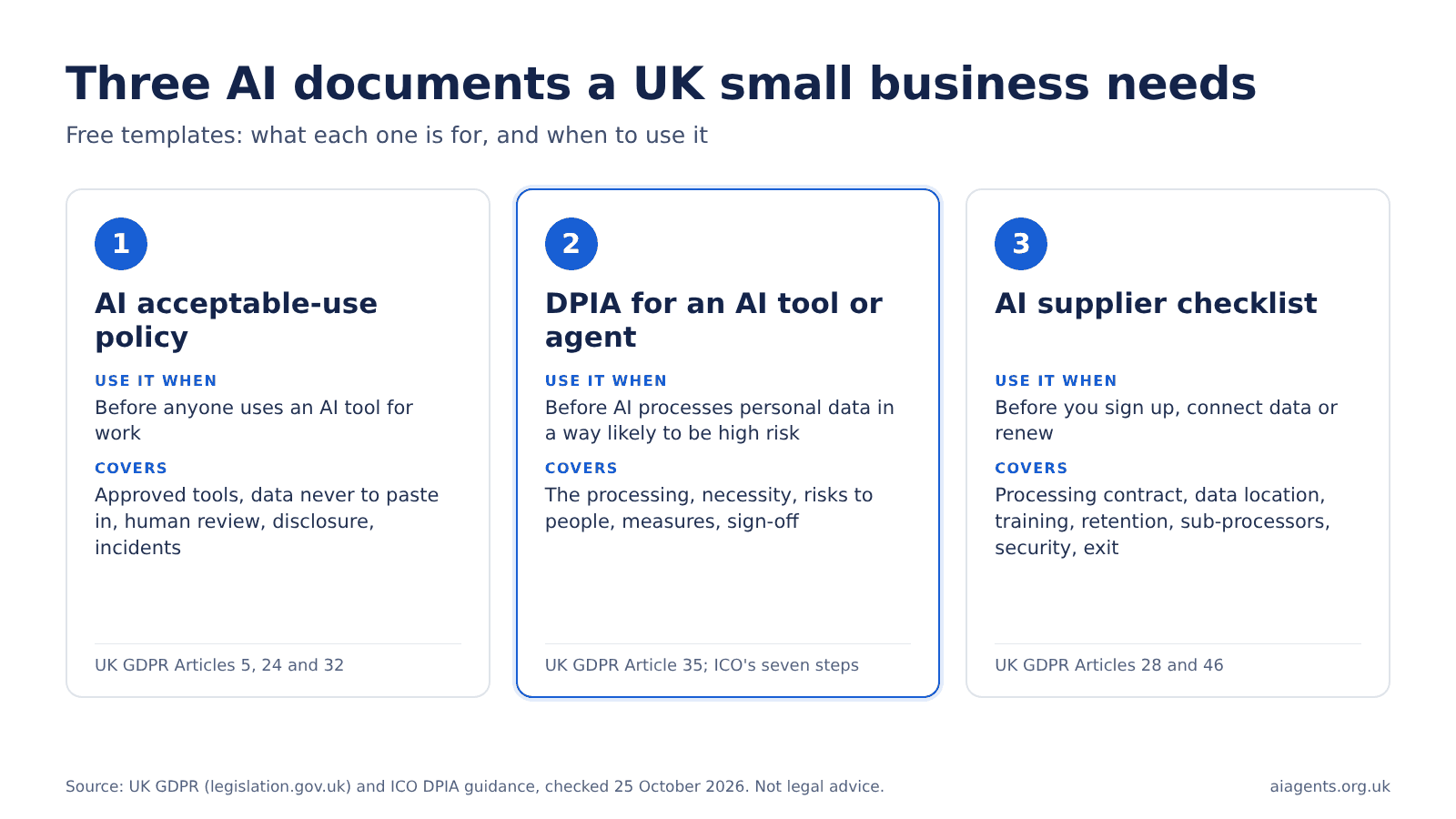
The AI policy template for UK businesses, the DPIA and the checklist are all editable Word files. Fields to fill in are in [square brackets] and highlighted, and each starts with a "how to use" box you delete when done.
- AI acceptable-use policy template (Word, 14 KB): approved tools, data that never goes in, human review, agents, disclosure, incidents and staff sign-off.
- AI DPIA template (Word, 16 KB): the ICO's seven DPIA steps with AI prompts, plus a filled-in example for an invoice-chasing agent.
- AI supplier due-diligence checklist (Word, 13 KB): 35 checks in eight sections, from the Article 28 contract to training, data location and sub-processors.
Which template do you need?
Most small businesses need the policy first, the supplier checklist second, and a DPIA for each AI use that touches personal data in a risky way.
| Your situation | Template | Required by law? |
|---|---|---|
| Staff use ChatGPT, Copilot, Gemini or Claude for drafting and research | AI acceptable-use policy | Not by name, but Articles 5, 24 and 32 require measures to protect personal data; a policy is the usual way to show them |
| You are buying an AI tool that will process customer or staff data | Supplier checklist | Yes: Article 28 requires a contract with any processor |
| An AI tool or agent will score, profile, monitor or decide about people, or handle sensitive data | AI DPIA | Yes, where likely to be high risk (Article 35) |
| Low-risk use, such as marketing drafts with no personal data | Policy only | No, but the ICO recommends a DPIA "if in any doubt" |
For lawful basis, data minimisation and individual rights in more depth, see my guide to AI agents and UK GDPR.
The AI acceptable-use policy
The policy is two or three pages, because staff read short policies. Its ten sections cover:
- Approved tools: each tool and plan, what it is approved for, whether personal data is allowed, and an owner. Free and personal plans are not approved for personal or confidential data.
- What never goes in: special category data, personal data in any tool without a processing agreement, passwords and keys, and confidential client information.
- Human review: people are responsible for anything sent or decided with AI help, and no AI takes a decision with a legal or similarly significant effect on someone without meaningful human review.
- AI agents: written approval, an agent register, the narrowest access, human approval for anything hard to undo, a searchable log, a DPIA and a tested off switch.
- Disclosure, training, security and incidents: privacy notice wording, training settings switched off, multi-factor authentication, and fast reporting so a breach can go to the ICO within 72 hours where feasible.
The security section explains prompt injection, where an email or web page hides instructions that steer the AI. The National Cyber Security Centre says such attacks "may never be totally mitigated in the way that SQL injection attacks can be" (NCSC), so the policy limits what agents can do rather than relying on filters. See also are agent skills safe?.
How to fill it in:
- Ask staff which AI tools they already use for work, including free apps on their phones.
- Check each tool with the supplier checklist; only tools that pass go in the approved table, with the plan named.
- Keep the standard "never put in" categories and add your own, such as unpublished prices.
- Name an AI lead who approves tools and agents, and an incident contact.
- Add each agent to the register: owner, purpose, what it can read, what it can change or send, and what needs approval.
- Get everyone to sign, and review every 12 months or when you add a tool.
When is a DPIA legally required for AI?
A DPIA is required when processing is "likely to result in a high risk to the rights and freedoms of natural persons", and it must happen "prior to the processing" (UK GDPR Article 35(1)). The ICO's guidance on when to do a DPIA sets three layers of tests.
1. Always required (Article 35(3)): systematic and extensive evaluation of people by automated processing, including profiling, with legal or similarly significant effects; large-scale processing of special category or criminal offence data; and large-scale systematic monitoring of a public area.
2. The ICO's list (Article 35(4)): ten more types. The one that catches most AI projects is "innovative technologies, or the novel application of existing technologies (including AI)", where the ICO says "a DPIA is required where this processing is combined with any of the criteria from the European guidelines." The list also covers decisions about access to a service based to any extent on automated decision-making, large-scale profiling, data matching, tracking, and targeting children or vulnerable people.
3. The nine European criteria: evaluation or scoring; automated decisions with legal or similar effect; systematic monitoring; sensitive data; large scale; matching datasets; vulnerable people; innovative technology; and processing that stops people using a service or right. The ICO says "in most cases, a combination of two of these factors indicates the need for a DPIA", though this is not a strict rule.
So an AI tool that also scores, profiles, monitors, matches data or handles sensitive data needs a DPIA. For automated decision-making, the ICO's draft guidance says "you should do a DPIA for any ADM" (ICO). If you decide one is not needed, write down why; the ICO's advice is that "if in any doubt, we would always recommend that you do a DPIA." Skipping a required DPIA can lead to "a fine of up to £8.7 million, or 2% global annual turnover if higher" (ICO, What is a DPIA?).
The AI DPIA template, step by step
The template follows the seven steps in the ICO's How do we do a DPIA? guidance and its sample DPIA template, with prompts for AI tools and agents. It covers the four minimum contents in Article 35(7): a description of the processing, necessity and proportionality, risks to people, and the measures to address them. The ICO says the process "is designed to be flexible and scalable", so a small, low-risk use can have a short DPIA.
| Step | What you record | AI prompts added |
|---|---|---|
| 1. Identify the need | What the tool does; which criteria apply | Tick boxes for Article 35(3), the ICO list and the European criteria |
| 2. Describe the processing | Nature, scope, context, purposes | Vendor and model, data location, training on your data, what the agent does alone, logs |
| 3. Consultation | Who you asked | The vendor must help you (Article 28(3)(f)) |
| 4. Necessity and proportionality | Lawful basis and compliance | Function creep, read versus write access, agent memory, Article 22C safeguards, transfers |
| 5. Assess risks | Likelihood, severity, overall risk | Eight pre-filled AI risks, from invented output to prompt injection |
| 6. Measures | How each risk is reduced; residual risk | Eliminated, reduced or accepted |
| 7. Sign off | Approvals, DPO advice, review date | Consult the ICO if high risk remains |
How to fill it in:
- Start early. The ICO says a DPIA "should begin early in the life of a project, before you start your processing". Do one per AI use, not one per vendor.
- Screen. Describe the tool in two or three sentences and tick every criterion that applies.
- Map the data. List what the AI reads, what it can change or send, the vendor and its sub-processors, and how long logs are kept.
- Consult. Ask staff, customers where possible, your IT adviser and the vendor. If consulting customers is not appropriate, say why.
- Test necessity. Name a lawful basis per purpose, and check data is "adequate, relevant and limited to what is necessary" (Article 5(1)(c)).
- Score and reduce risks. Typical measures are read-only access, human approval before sending, facts taken from your systems rather than the model, and a business plan with training off.
- Sign off and review. If you have a DPO, the ICO says "you must seek their advice". Repeat the DPIA if the tool, data or purpose changes substantially.
If a high risk remains, you must consult the ICO before going ahead (Article 36); it has eight weeks to advise, extendable by six. The template's last page is a worked example for an agent that chases unpaid invoices, built in my guide to an invoice-chasing AI agent.
Automated decisions: what the Data (Use and Access) Act changed
The Data (Use and Access) Act 2025 replaced the old Article 22 with Articles 22A to 22D. Legislation.gov.uk records them in force from "19.6.2025 for specified purposes, 5.2.2026 in so far as not already in force" (Article 22A), so they have applied in full since 5 February 2026.
- Definitions (22A): a decision is "based solely on automated processing if there is no meaningful human involvement", and "significant" if it has a legal or similarly significant effect.
- Restrictions (22B): a significant decision based on special category data may not be solely automated unless the person gave explicit consent, or it is needed for a contract or required or authorised by law and Article 9(2)(g) applies. It is also barred where the processing relies on the new "recognised legitimate interest" basis, Article 6(1)(ea).
- Safeguards (22C): for any solely automated significant decision, give people information about it, and let them make representations, obtain human intervention and contest it.
Step 4 of the DPIA template asks about all four safeguards. The ICO updated its draft automated decision-making guidance on 31 March 2026, and says its DPIA guidance "is under review and may be subject to change" because of the Act. My ICO AI guidance tracker follows each update.
Two more points. Since 19 June 2026 you must give people a clear way to complain and acknowledge complaints within 30 days (ICO). And on 8 October 2026 the ICO opened a call for evidence on agentic AI, open until 20 November 2026, warning that "the fact AI agents act with autonomy is not an excuse for poor compliance" (ICO); its agentic AI guidance is due in spring 2027 (ICO plans).
What to ask an AI supplier
When an AI company processes personal data for you, you are the controller and it is your processor. Four questions matter most.
Does it train on your data? Get the answer from the contract, not only a settings page. As of 25 October 2026, OpenAI's pricing page says business plans have "no training on your business data by default", with an opt-out on personal plans (ChatGPT pricing); Anthropic's says Team has "no model training on your content by default", with an opt-out on Free, Pro and Max (Claude pricing).
Where is data stored and processed? UK storage does not always mean the model runs in the UK. Transfers out of the UK need adequacy regulations, safeguards such as the IDTA or the UK Addendum, or a narrow exception, and often a transfer risk assessment (ICO).
Who are the sub-processors? Under Article 28(2), a processor needs your written authorisation to use another processor, must tell you about changes and give you a chance to object. Article 28(4) makes the same terms flow down.
Does the contract have the Article 28 terms? It must set out the subject matter, duration, nature and purpose, data types and categories of people, and bind the processor to act only on your instructions, keep staff confidential, provide Article 32 security, help with rights requests, breaches and DPIAs, delete or return data at the end, and allow audits (ICO contract checklist). Personal plans usually have no such contract.
How to use the checklist: complete one per product and plan, collect the processing agreement, privacy policy, security page and sub-processor list first, and answer every check with a link or clause number. If the tool will touch personal data, any "no" in sections A (contract), B (location) or C (training) means do not connect that data until it is fixed. File the decision with the DPIA and review it at renewal.
For real examples of where business tools keep data, see AI agents for accountants and AI receptionists in the UK. For rollout advice, see AI agents for UK small businesses.
Frequently asked questions
Is a DPIA a legal requirement for AI in the UK?
Yes, when the AI processing is likely to result in a high risk to people. UK GDPR Article 35 requires a DPIA before the processing starts. The ICO treats AI as innovative technology, so a DPIA is required when an AI tool also meets any one of the nine European criteria, such as scoring people or handling sensitive data.
Do I need a DPIA to use ChatGPT or Copilot at work?
Not for every use. Drafting marketing copy with no personal data is unlikely to be high risk. You need one when the tool processes personal data in a way likely to be high risk, such as profiling customers or screening job applicants. If in any doubt, the ICO recommends doing one.
Can I use the ICO's own DPIA template instead?
Yes. The ICO publishes a sample DPIA template and says you can use or adapt it. The template on this page follows the same seven steps and adds prompts for AI tools and agents.
What happens if the DPIA shows a high risk?
First try to reduce it with measures such as narrower access or human approval. If a high risk remains, Article 36 requires you to consult the ICO before you start. The ICO gives written advice within eight weeks, extendable by six.
Does a small business need an AI policy?
No law names an AI policy, but UK GDPR requires you to protect personal data and show how you comply. A short AI acceptable-use policy is the simplest way to set which tools staff may use, what data never goes in and who checks the output.
Are these templates free to use?
Yes. Download the Word files, edit them and use them in your business, with no sign-up. They are general guidance, not legal advice, so ask a data protection professional about any decision that matters.
Sources
All checked on 25 October 2026.
- UK GDPR Article 35 - when a DPIA is required
- UK GDPR Article 36 - consulting the ICO
- UK GDPR Article 28 - processor contracts
- UK GDPR Articles 22A to 22D - automated decisions, commencement
- ICO, When do we need to do a DPIA? - screening criteria
- ICO, How do we do a DPIA? - the seven steps
- ICO, What is a DPIA? - enforcement
- ICO sample DPIA template - structure and risk scales
- ICO, Automated decision-making (draft, 31 March 2026) - ADM safeguards
- ICO, ADM: what else do we need to consider? - DPIAs for ADM
- ICO, What needs to be included in the contract? - Article 28 terms
- ICO, A brief guide to international transfers - transfer tools
- ICO news, 8 October 2026 - agentic AI call for evidence
- ICO news, 23 June 2026 - complaints duty
- ICO guidance plans: technology - agentic AI guidance timing
- ICO, Personal data breaches: a guide - 72-hour reporting
- NCSC, Prompt injection is not SQL injection - prompt injection
- ChatGPT pricing - training defaults
- Claude pricing - training defaults