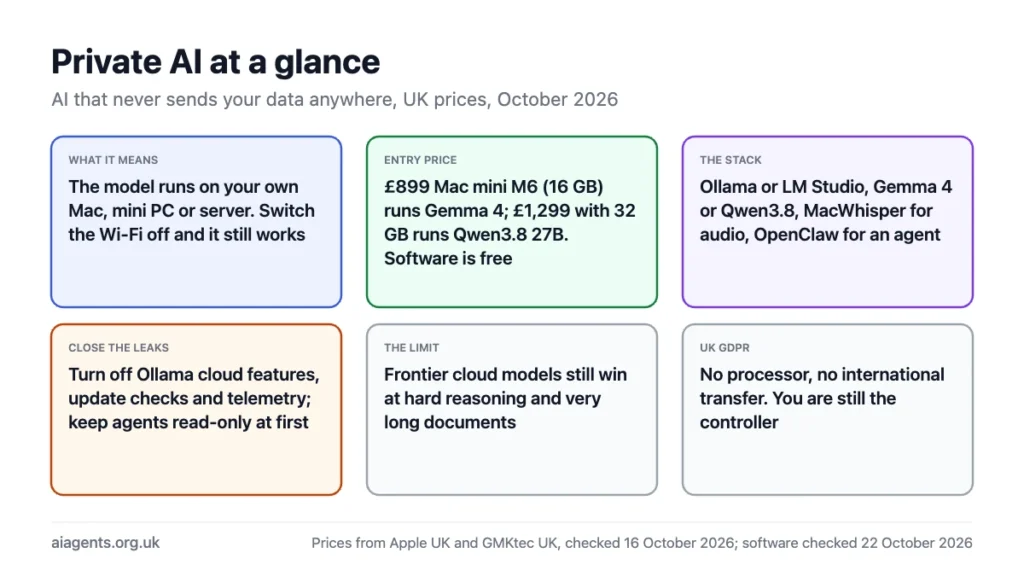
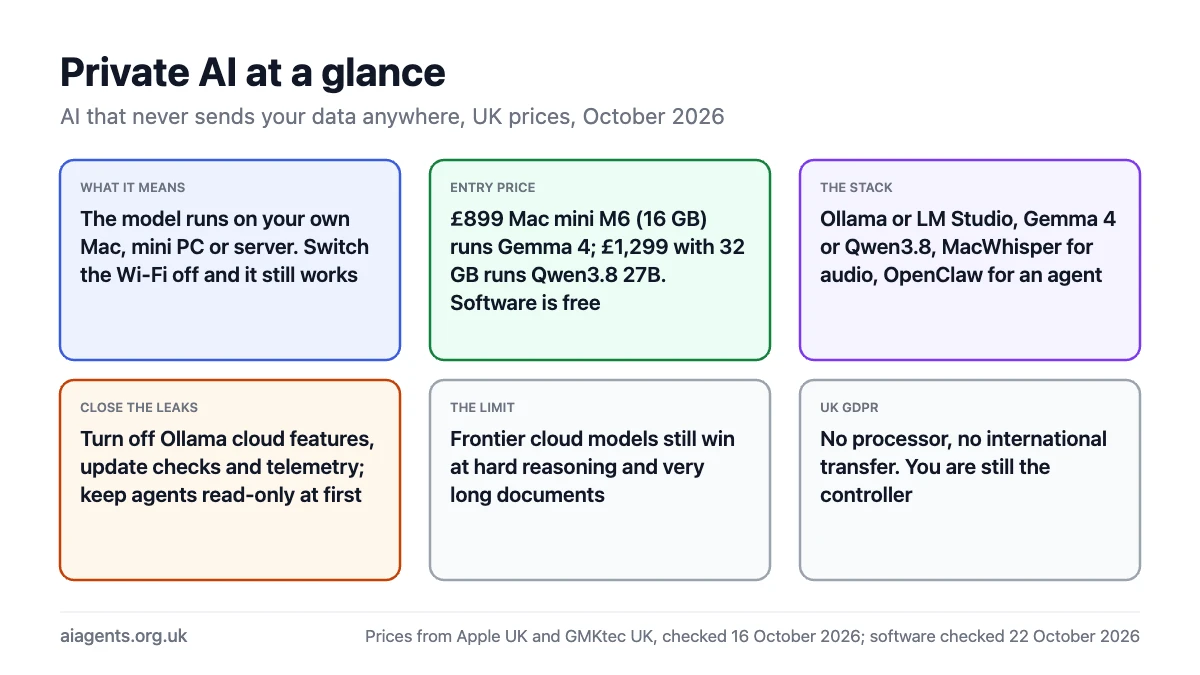
Private AI means running the model on hardware you control, so prompts, documents, recordings and customer data never reach OpenAI, Google, Anthropic or anyone else's servers. For one person or a small firm it is cheaper and simpler than it sounds: a £899 Mac mini runs a capable model offline through free software, and a £1,299 one runs the model of the moment. This page is the map. It covers the three ways to get private AI, what each costs in pounds, which models and tools to use, where local models still fall short of the big cloud ones, and what UK GDPR asks of you. Every section links to the detailed guide on this site.
Key facts
- Definition: AI whose model runs on your own device or server, so your data stays with you; the opposite of sending prompts to a cloud chatbot
- Three routes: on your own Mac or mini PC; on a server you rent or own; or a cloud service contracted not to keep or train on your data, which is private by promise rather than by design
- Entry cost: £899 for a 16 GB Mac mini M6, £1,299 for the 32 GB version that runs 27B models; software is free
- Software: Ollama or LM Studio for the model, MacWhisper for transcription, OpenClaw or Hermes Agent for an agent, all free
- Models: Gemma 4 on 16 GB, Qwen3.8 27B on 32 GB, gpt-oss 120B on 128 GB
- The catch: the strongest cloud models are still better at hard reasoning and long documents, and you maintain the machine yourself
- UK GDPR: local AI removes the international transfer and processor problems; it does not remove your duties as controller
On this page
- What private AI means, and what it does not
- The three routes to private AI
- What private AI costs in the UK
- The private AI stack: hardware, models, tools
- Is local AI really private? The leaks to close
- Where private AI falls short
- Private AI and UK GDPR
- Where to start: a weekend plan
- Frequently asked questions
What private AI means, and what it does not
When you type into ChatGPT, Claude or Gemini, your words travel to a data centre, usually in the United States, where the model reads them and sends an answer back. The provider's terms decide what happens to that text afterwards. Private AI removes the journey: the model is a file on your disk, the computation happens in your own memory, and the answer never crosses the internet. Switch the Wi-Fi off and it still works.
Two things it does not mean. It does not mean a cloud chatbot with a privacy toggle; that is a contract, not a wall, and a useful one for many businesses, but not the subject of this page. And it does not mean a lesser experience. The open models you can download, Google's Gemma 4, Alibaba's Qwen3.8, OpenAI's gpt-oss, are within a year of the cloud frontier and ahead of where ChatGPT was in 2024. For most writing, summarising, coding and document work they are enough, and for anything you would not want on someone else's server they are the only sensible choice.
The term overlaps with "local AI", "on-device AI", "self-hosted LLM" and "private LLM". They all describe the same idea at different scales: local and on-device for a laptop or desktop, self-hosted for a server, private LLM for the model itself.
The three routes to private AI
| Route | Where the model runs | Who it suits | Typical cost | Privacy |
|---|---|---|---|---|
| On your own Mac or mini PC | The computer on your desk | Individuals, freelancers, firms of one to ten | £899 to £5,099 once; software free | Complete: nothing leaves the machine |
| Self-hosted on a server | A machine in your office or a rented server in a UK or EU data centre | Teams who need one model for everyone, or always-on agents | A £899 Mac mini as an office server, £2,499 to £3,449 for a Mac Studio or Framework Desktop, or a GPU server rented by the hour | Complete on your own box; strong on a rented one with the right contract |
| Cloud with a no-retention contract | The provider's data centre | Businesses that need frontier models and can accept a processor agreement | Per seat or per token | Contractual: depends on terms, region and audit |
This site covers the first two in depth. Run a local LLM on your Mac is the full walkthrough for the desk route; self-hosted LLMs covers the server route, from a Mac in the office serving a team to a GPU server running vLLM, and when the sums favour each. The third route has a consumer version too: services such as Proton's Lumo, Venice and Duck.ai that are built so the operator keeps or sees less than ChatGPT does. Private AI chatbots compared checks six of them against their own policies and, for the ones that let me in without paying, against the same three test prompts: Duck.ai and Lumo both answered well, Lumo searched the web on its own in guest mode, and Venice turned out to block UK visitors until they buy Pro. Is ChatGPT private? covers what the big three keep and how to limit it, with the settings from my own accounts, where ChatGPT and Gemini were both training on me by default. For a business, the questions to ask any cloud provider are in AI agents and UK GDPR.
What private AI costs in the UK
Hardware is the whole bill. Every piece of software below is free, and electricity for a Mac mini running a model a few hours a day is a few pounds a month. The memory in the machine decides which models it runs, and the memory calculator turns any model into a yes or no for a given machine.
| Budget | Machine | Memory | Runs well | Who it is for |
|---|---|---|---|---|
| £899 | Mac mini M6 | 16 GB | Gemma 4, Llama 3.1 8B, Bonsai 2 27B | Writing, summaries, transcription, a first agent |
| £1,299 | Mac mini M6, built to order | 32 GB | Qwen3.8 27B, Gemma 4 31B, qwen3-coder 30B | Most people: coding, research, document work |
| £2,699 | Mac mini M5 Pro, built to order | 64 GB | Llama 3.3 70B, Qwen3.8 at 8-bit | Small teams, heavier agents |
| £1,730 plus import VAT | GMKtec EVO-X2 (64 GB) | 64 GB | 70B models on Linux | Tinkerers who prefer a PC |
| £5,099 | Mac Studio M5 Max, built to order | 128 GB | gpt-oss 120B, Qwen3.5 122B | Near-frontier quality on one desk |
Against that, a ChatGPT Plus or Claude Pro seat is about £18 to £20 a month per person, so a £1,299 Mac mini pays for itself against three seats in two years and never sends a word anywhere. The full comparison, with the hidden costs on both sides, is in how much AI agents cost in the UK, and which Mac or mini PC to buy compares twelve machines. Buying before Christmas? The Black Friday AI deals page tracks price drops.
The private AI stack: hardware, models, tools
Four layers, each with a free default.
- Hardware: an Apple Silicon Mac, because its memory is shared between processor and graphics chip, or an AMD mini PC on Linux. Sixteen gigabytes is the floor, 32 GB the comfortable choice. See which Mac to buy.
- Model runner: Ollama if you are happy with a menu-bar app and a Terminal command, LM Studio if you want a full chat window and a model browser. Ollama vs LM Studio vs Jan settles the choice. Both are free.
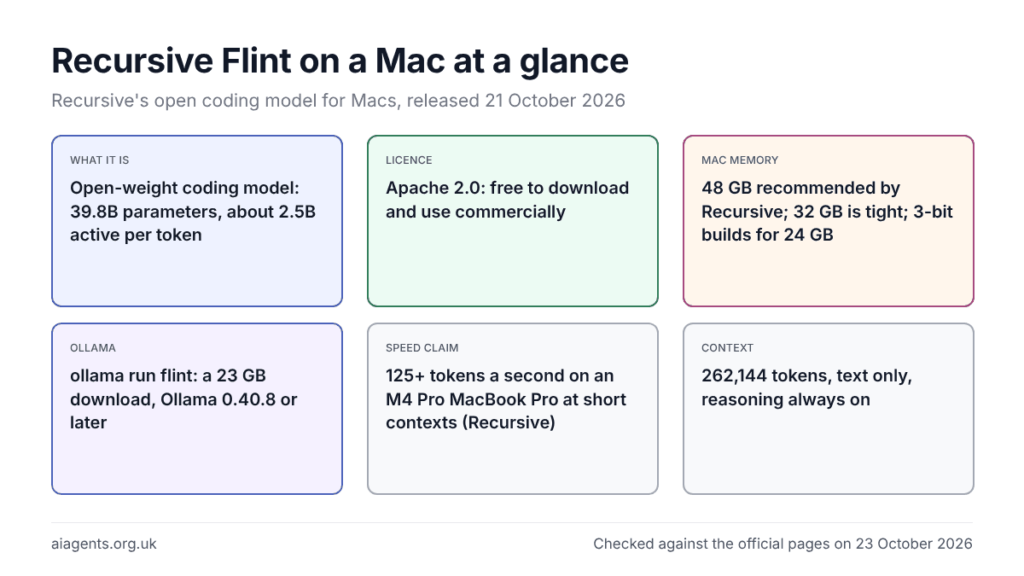
- Models: Gemma 4 for everyday work and images, Qwen3.8 27B for coding and agents, gpt-oss for reasoning. The Ollama models list ranks the 30 most downloaded with a pick for each memory size. Running a Chinese model locally is safe, and here is why.
- Tools on top: MacWhisper for transcribing interviews and meetings on the device; OpenClaw or Hermes Agent for an assistant that reads your files and acts in your chat apps; Claude Code or Kilo Code pointed at a local model for coding. For what an agent can do that a chatbot cannot, start with what is an AI agent?
Is local AI really private? The leaks to close
The model is private. The software around it can still phone home, so check four things once and forget about them.
- Cloud features inside local apps. Ollama offers cloud models and web search; set
disable_ollama_cloudto true in~/.ollama/server.jsonand the log confirms "Ollama cloud disabled: true". MacWhisper's cloud transcription and AI summaries are off unless you add a key. The Ollama troubleshooting page has the steps. - Update checks and telemetry. OpenClaw sends a daily update check with version and operating system and keeps approximate location for three months;
update.checkOnStart: falsestops it. Most apps have an equivalent setting. - Agents with tools. An agent that can browse the web or send email can leak by doing its job. Give it read-only access for the first fortnight, keep its Gateway on your own machine, and read are agent skills safe? before installing skills from a registry.
- Your network. Ollama listens only on your own machine by default. Leave it that way unless you know who else is on the network.
Two things that do not help, however often they are sold as privacy: a VPN, which hides your IP address from a service and nothing else, and paying in crypto, which hides your card and not your prompt. Both are explained in is ChatGPT private? and crypto AI explained. On the phone, private AI on an iPhone covers the apps that keep the model on the device. On a Mac, the simplest private set-up of all is the model Apple already ships: how to use it from Terminal. If you use Ollama, note that its cloud models do leave your machine; Ollama Cloud explained covers where they run and how to switch them off.
Where private AI falls short
Three honest limits. First, quality at the top end: the largest cloud models still beat anything that fits in 32 GB on hard reasoning, long multi-step tasks and very long documents, and the gap is clearest in coding agents. A 27B local model is a strong colleague; a frontier cloud model is a stronger one. Second, speed: a 70B model on a 64 GB Mac answers at reading pace, not instantly, and the first answer after a pause waits for the model to load. Third, upkeep: you install updates, pick models, and fix it when the port is in use or the model spills onto the processor. None of this is hard, and all of it is documented on this site, but it is your job.
The pragmatic pattern for many small firms is both: a local model for anything involving client data, and a cloud seat for the hard problems that contain nothing sensitive. The personal AI assistant guide walks through that split for an individual.
Private AI and UK GDPR
Running the model yourself solves the two problems that make cloud AI awkward under UK data protection law: there is no processor to contract with and no international transfer to justify, because the data never leaves your premises. What it does not change is that you are still the controller. You still need a lawful basis for using personal data, you still minimise what you feed in, you still do a data protection impact assessment if the processing is high-risk, and the rules on automated decisions in Articles 22A to 22D still apply to a decision a local model makes about a person. This is not legal advice; AI agents and UK GDPR sets out each duty with the ICO source, and the ICO AI guidance tracker follows what the regulator has said.
For a worked example of the whole thing in a regulated setting, AI for accountants and bookkeepers shows month-end jobs handled with client data kept local.
Where to start: a weekend plan
- Saturday morning: on any Apple Silicon Mac with 16 GB, install Ollama and run
ollama pull gemma4. Ask it to summarise a document you would never paste into ChatGPT. Ten minutes. - Saturday afternoon: install the free MacWhisper and transcribe a recording. Turn off Ollama's cloud features. You now have private writing, summarising and transcription.
- Sunday: if that was useful, decide whether you need 32 GB, and read the complete Mac guide for the agent step. If you are buying, wait for Black Friday on 27 November unless you need it sooner.
Frequently asked questions
What is private AI?
AI that runs on hardware you control, on your own computer or a server you own or rent, so the text, files and recordings you give it never reach a third party's servers. It uses open models you download, such as Gemma 4 or Qwen3.8, through free software such as Ollama or LM Studio, and it works with the internet switched off.
What is a private LLM?
A large language model you run yourself rather than access through someone else's service. Any open-weights model qualifies once it is on your machine: Gemma 4, Qwen3.8, Llama 3.3 and gpt-oss are the common choices. The model file is a few gigabytes, and the memory in your computer decides how large a model you can run.
Can I run ChatGPT privately?
Not ChatGPT itself, but OpenAI's open-weights models, gpt-oss 20B and 120B, run locally through Ollama and LM Studio, and the 20B version fits a 24 GB Mac. For most everyday work Gemma 4 or Qwen3.8 is the better local choice. ChatGPT's own privacy settings and business plans are a contract with OpenAI, not a private deployment.
How much does private AI cost?
From £899 for a 16 GB Mac mini M6, which runs Gemma 4, to £1,299 for the 32 GB version that runs 27B models, with all the software free. A 64 GB machine for 70B models is £2,699 as a Mac mini M5 Pro or about £1,730 plus import VAT as a GMKtec mini PC. A ChatGPT or Claude seat is about £18 to £20 a month per person by comparison.
Is local AI really private?
The model is. Check the software around it: turn off Ollama's cloud features, leave MacWhisper's cloud services unset, switch off update checks and telemetry where an app offers them, and keep an agent's tools read-only until you trust it. With those done, nothing you type leaves the machine, and you can confirm it by unplugging the network.
Is private AI GDPR compliant?
It removes the hardest parts: no processor contract and no international transfer, because data stays on your premises. You remain the controller, so you still need a lawful basis, data minimisation, a DPIA for high-risk processing and compliance with the automated decision rules. Local AI makes compliance much easier; it does not make it automatic.
Is private AI as good as ChatGPT?
For writing, summarising, coding help, document questions and transcription, a 27B local model on a 32 GB Mac is close enough that most people stop noticing. The largest cloud models are still better at hard reasoning, long agent tasks and very long documents. Many firms run both: local for anything sensitive, a cloud seat for the hardest problems.
Read next
- Run a local LLM on your Mac: the complete guide
- Which Mac or mini PC to buy for local AI (UK prices)
- Self-hosted LLMs: running a model on a server
- Ollama guide
- AI agents and UK GDPR: what the ICO expects
- Your Mac already has a free local LLM
- Ollama Cloud explained: free tier, Pro prices and privacy
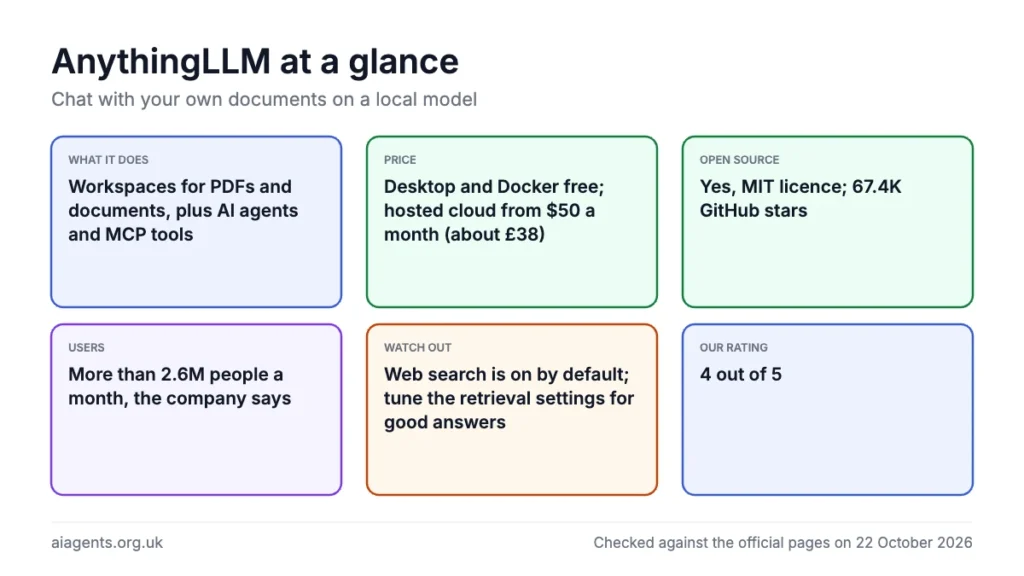
- AnythingLLM review: chat with your own documents
Sources
- Apple UK store, Mac mini and Mac Studio: prices checked 16 October 2026
- GMKtec UK: EVO-X2 price checked 16 October 2026
- Ollama FAQ: disabling cloud features, default bind address, data handling - checked 22 October 2026
- OpenClaw telemetry docs: update check and location retention - checked 17 October 2026
- ICO guidance on AI and data protection - checked 19 October 2026